










Knesset Press Release • September 5, 2025
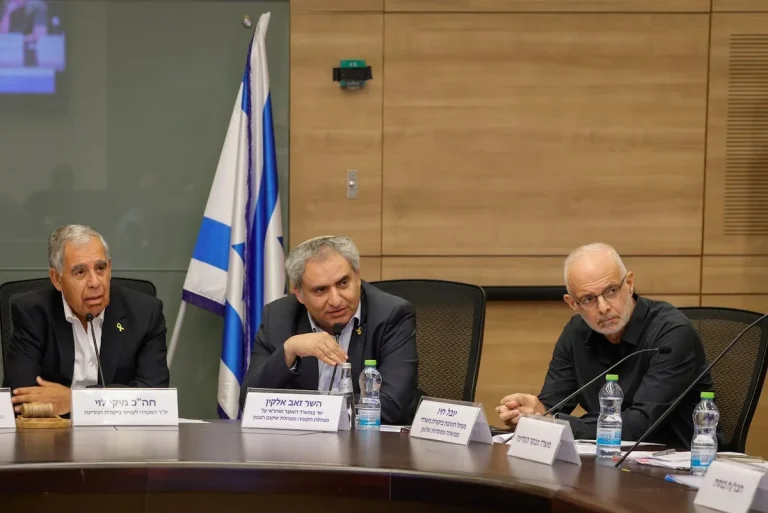
The State Control Committee, chaired by MK Mickey Levy (Yesh Atid), convened on Wednesday to discuss the State Comptroller’s report on the Government‘s handling of the localities in northern Israel during the Swords of Iron war. The report pointed at significant failings in the Government‘s preparations and response in the civilian-economic realm, including an ongoing delay in formulating Government resolutions, failures in operating the education system, and the lack of an effective response for rehabilitation and development of the localities.
During the debate, the State Comptroller issued another severe report, which found that similar failures were also revealed during Operation Rising Lion against Iran, after many Israelis were evacuated from their homes. In the report, responsibility was assigned to the political echelon as a whole—and particularly to Prime Minister MK Benjamin Netanyahu (Likud)—for not ensuring a suitable response to this fundamental failure, which had been known since the Second Lebanon War.
committee chair MK Levy said, “In this report, direct responsibility was assigned to the Prime Minister and to the director general of the Prime Minister’s Office at the time, Yossi Shelley. The ongoing delays in advancing multi-annual plans for rehabilitation and development of the localities, the failure to draw up draft resolutions in the Ministry of Finance for budgeting the rehabilitation, the frequent transfers of ministerial responsibility—all these are described in the report in a clear and concerning manner.
“I saw fit, given the fact that the Prime Minister was mentioned directly in the report as responsible, to summon him to a debate in order to comment on the matter. I sent a letter to his office as early as June. Not only did I not receive a response from his office or his representatives, but no representative from his office took the trouble to attend today’s debate. The State Control Committee is the only Knesset committee that is entitled to issue a subpoena requiring [Government officials] to appear before it, and I will send another letter to the Prime Minister and to the director general of his office so that they will attend the committee debate, as those who bear responsibility,” said MK Levy.
Additional Minister in the Ministry of Finance MK Zeev Elkin (New Hope—The United Right), who is in charge of rehabilitation of northern and southern Israel, said that immediately upon assuming his post he had understood that there were no plans ready for rehabilitation and development of northern Israel and for the residents’ return, but there was a NIS 15 billion budget, including NIS 12 billion designated for the confrontation line. Minister MK Elkin said, “After consultation with the heads of municipalities, it was decided to take action on two levels in parallel—to advance immediately dedicated government resolutions designed to ensure the return to the homes and development plans in confrontation line localities, and in parallel, to start working on a large-scale government resolution. A total of NIS 4 billion were allocated for this year. Following a series of partial government resolutions, we have already committed the full budget, and the budgetary framework has been utilized. The first government resolutions focused on the personal needs of the families. The process of the return to the localities, which started in March and lasted until the end of the summer, was planned as a gradual process, due to the personal circumstances of the residents. In addition, due to the lengthy absence of a year and a half to two years from the houses, it was decided to give the returnees a special grant to assist in taking care of the neglected houses.
“In addition, a significant budget was invested for the purpose of reorganizing for the rehabilitation process. Funds were transferred for rehabilitation of infrastructure and public buildings in local authorities, such as preschools and schools. Since the Property Tax Fund pays for the property that [the residents] had, additional budgets were allocated based on initial estimates of the local authorities. We started with NIS 200 million, and now we have presented a supplementary resolution in the amount of an additional NIS 281 million. We also invested money in the education system so that the schoolchildren would be able to return to their parent institution. Budgets were also invested in informal education and post-high school institutions, such as technological colleges,” said the minister.
Minister MK Elkin said further, “We coped with a complex difficulty regarding the definition of the confrontation line and the localities eligible for benefits. Despite this, a resolution was approved in the amount of NIS 600 million for assisting businesses and economic activity. We also identified a special difficulty in border-adjacent localities, in which the return of the residents was slower than in other localities, such as Shlomi. For this reason, another government resolution gives land in the extensions of these localities, subsidizes land development for the coming two years, provides temporary structures and more. As of August, 20% of the residents who were evacuated have not returned to the northern localities.”
Minister MK Elkin stated that work was now being done on two additional government resolutions. One provides aid to the education system (a five-year plan)—the money is given to the Ministry of Education to maintain the possibility of opening smaller classes, beneath the set standard, and to invest significant amounts in educational activity. The plan includes projects such as opening two schools for gifted children, building laboratories, investing in informal education and strengthening residential facilities. The projected cost is NIS 1.14 billion. The other [resolution] refers to a detailed plan for the Golan Heights and Katzrin; this is a dedicated resolution that will assist in the rehabilitation of these areas.