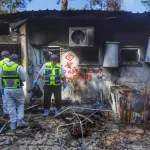



















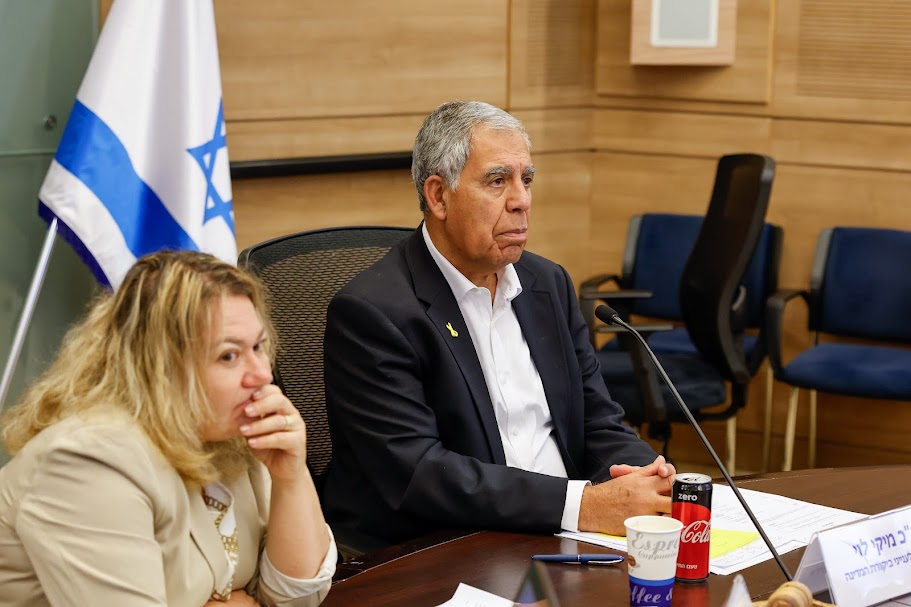
The State Control Committee, chaired by MK Mickey Levy (Yesh Atid), convened on Monday for a debate on critical gaps in fortification of the civilian home front in Israel, as presented in the State Comptroller’s reports and discussed by the committee in eight debates in the current Knesset term. It was also seen on the ground in the Iranian missile attacks that many houses are unprotected. It was stated in the debate that once again, failures in implementation of budgets [have been recorded], along with bureaucratic obstacles and long delays in approval of protected spaces, despite a significant increase in submission of requests for fortification annexes.
Committee Chair MK Levy: “History will judge us all—the bureaucrats, the Government, the ministers, and me as well. There is no time to drag out, no time to buy. People have lost their lives, and it’s too late. We must act at turbo speed. The State of Israel knows how to operate excellently in pressure situations, but it fails again and again in advance preparation. We submitted the conclusions of eight debates held here in the committee on this matter—did you pound on the Ministry of Finance’s door repeatedly to demand money? For months we searched here for a budget for fortification of the northern localities during Swords of Iron, which ministry is it stuck in? The Government of Israel, regrettably, doesn’t know how to prepare in advance; it doesn’t know how to create multi-annual plans or [implement] them.”
Eyal Sonnenfeld of the State Comptroller’s Office presented the findings of the latest reports, including gaps in the national preparations for [protection of] the civilian home front, lack of central management, flaws in provision of information to the public, budgeting gaps and flaws in approval of new protected spaces in new construction. Sonnenfeld said, “Despite the temporary provision from October 2023, which enables building a per-apartment protected space on an area of nine square meters without a permit, the processes continue to be carried out slowly. There’s an urgent need for orderly planning of public shelters and streamlining of licensing processes in order to reduce fortification gaps.” Sonnenfeld said further that since the war, the State Comptroller had been examining shelters, with an emphasis on “arranging ventilation, cleanliness, traffic, communication, order and personal security” in places in which people live in crowded conditions. He stressed the need for giving a response to people without a roof over their heads, “with a forward-looking perspective that does not return them to their previous state.”
A representative of the Central Bureau of Statistics presented data showing that only about 55% of households in Israel have a protected room. In Jerusalem the percentage is about 33.8%, in Tel Aviv it stands at about 47.7%, and in Haifa the percentage is similar. The Central Bureau of Statistics official said that the data was based on a survey, and not updated to reflect the current situation.
Herzliya Mayor Yariv Fisher described Herzliya’s activity to receive about 1,100 evacuees, and spoke about the lack of fortification in the city. Fisher said, “The situation of the shelters was appalling. I glad to say that we managed to upgrade them quickly thanks to our teams. But the serious problem is the delays in urban renewal projects. It’s inconceivable that a neighborhood such as Shaviv has been waiting for decades for renewal. All the state institutions have to mobilize and accelerate the processes.”
Asaf Langleben, head of the Upper Galilee Regional Council, warned that despite government resolutions and budgets allocated to fortification of the confrontation line, the implementation on the ground was stuck. He said, “They transferred the responsibility to the residents and reduced the state’s participation. The alert time here is zero but there’s no fortification. The budgets exist but are unutilized, and at the end of the year these funds could return to the Ministry of Finance. The state has to allow those who are ready to start the fortification immediately, and make sure that the budgets remain after the war too.”
Home Front Command official Moshe Shlomo: “Every building addition of 12 square meters or above requires adding a protected room. These processes are complex in existing houses. We are working to expand the powers of engineers and architects, and to enable streamlined procedures, but it requires additional legal regulation.”
Shlomo said that since the start of the war, there had been many municipalities that took advantage of the permits and the easements for building protected spaces in public installations, and said that in the past six months over 3,000 such spaces had been built through the fast track. Regarding underground parking garages, he stated that the Home Front Command had mapped over 7,000 parking garages throughout Israel in the past decade, but not every parking garage could be approved [as a protected space], because of risky construction methods and other reasons. However, among the parking garages checked, “We approved a significant number of parking garages, hundreds, for use,” he said.
Police official Chief Supt. Barak Mordechai said that the reports about people preventing entry to shelters were isolated incidents, and were not a widespread phenomenon. He said that each such report was handled immediately on a local level.