















Knesset Press Release • July 30, 2025
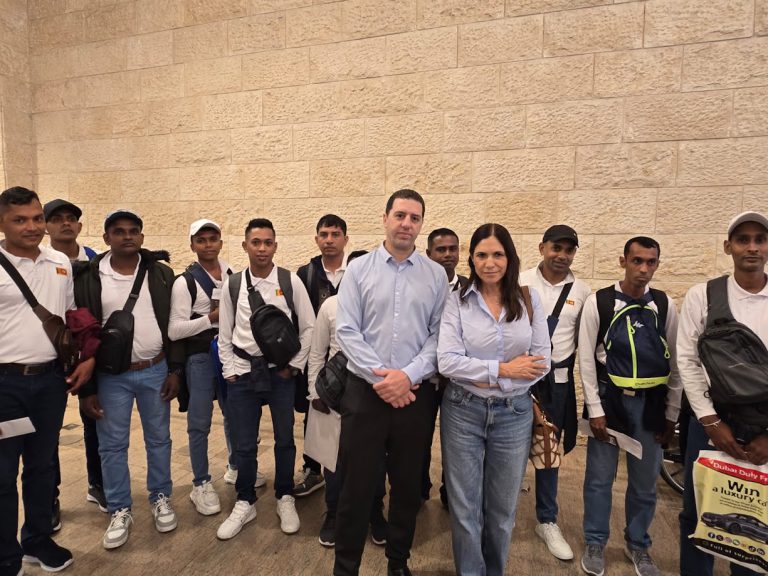
The special committee on Foreign Workers, chaired by MK Etty Hava Atia (Likud), conducted on Tuesday a tour of Ben Gurion Airport to examine the reception and registration process for foreign workers arriving in Israel.
Employer representatives requested a suitable space for foreign workers until the lengthy process at the airport is completed, but failed to reach agreements with the Israel Airports Authority. As a result, MK Atia called to expedite the border control process, including the fingerprinting procedure required of foreign workers, by reinforcing the border control inspectors from the Population Authority—among other things, through wage agreements and the recruitment of new inspectors, a process the committee is promoting with the Finance Ministry.
MK Atia also requested to shorten the process of signing the necessary contracts and documents in the workers’ countries of origin in order to reduce bureaucracy for both employers and workers, and to eliminate the need for reception and registration stations at Ben Gurion Airport —a measure that also requires improvement of the Population Authority’s computer system and budget allocation.
“We need foreign workers in industry, construction, caregiving, and agriculture. We are desperate for them,” said committee chair MK Atia.
According to data from the Population and Immigration Authority, since the beginning of 2025, about 30,000 foreign workers have arrived in Israel to work in various sectors. At the airport, committee chair MK Atia witnessed the reception of individuals from Sri Lanka and Thailand who are slated to work in renovation.
Shmulik Amsalem, head of the Passenger Services Division at the Israel Airports Authority, said “Ben Gurion Airport currently handles over 70,000 passengers daily, with a capacity of 120,000. The infrastructure is designed for passenger transit—not for a recruitment center. The corporations are handing out SIM cards and shoes. This is not a process that is suitable for an airport. We don’t have space for this.” Representatives of the Israel Airports Authority presented photos to illustrate his point. Employers of foreign workers rejected these claims, saying most logistics are handled in advance or after the workers are dispersed in Israel. Things like opening bank accounts or signing health declarations are done only during the 3 to 4 hours the foreign workers have to wait at the terminal until they are all processed, they said.
A representative of a real estate company said, “Yesterday, five workers arrived from China, and it took five hours [until they were all processed].” Ben Gurion Airport Director Udi Bar Oz said, “That should not happen.” Moshe Nakash, head of the Foreign Workers Administration at the Population and Immigration Authority, said “Today there are more delays than in the past, mainly due to manpower shortages at border control. Once we resolve the wage agreement issue, it will look different.”
A representative of a company that provides foreign workers to the Israeli construction industry said, “On a good day, we process 150 foreign workers in 24 hours at the airport. The welcome they receive is disgraceful.” He said delays are mainly due to biometric procedures and border inspectors.
Bar Oz said, “An airport is a hub for incoming and outgoing passengers, baggage, and aircraft. Any group that arrives—Birthright, sports, tourism—is picked up by its organizer and processed elsewhere. The only group that remains here for extended procedures is foreign workers.”
Gabi Bornstein, CEO of Blue Shirt Entrepreneurs, a private brokerage company for bringing foreign personnel for agriculture, asked the Israel Airports Authority to allow representatives to meet workers as they exit the jet bridge, so that they won’t get lost. “If you let our representative meet them as soon as they exit jet bridge, it will cut time in half,” he said. Bornstein also requested to increase the number of inspectors during the arrival of large amounts of foreign workers.
Shirly Raisin, director of the Population and Immigration Authority’s Bilateral Agreements Division, suggested switching to remote digital signatures to shorten processing time.
Regarding the reception of workers at the jet bridge, Amsalem said “Only 30% of aircraft are connected to jet bridges. Submit a request on behalf of organizers, not corporations—we can’t deal with 100 corporations—and we’ll consider it.”
Bar Oz said, “I can’t grant permanent clearance at wholesale because I’m responsible for everyone who enters the airspace. Those who have such permits could misuse them—and there have been incidents. We need to improve the process without allowing representatives inside.”
Employer representatives requested a designated space for worker registration and reception, as they currently wait several hours. Their request to use the gallery in the terminal was denied by Bar Oz. “The gallery is part of the terminal’s design, and I won’t close it off for foreign workers, important as they are. It’s also part of the safety and emergency escape areas,” he explained.
The second part of the tour began with an unusual incident, as a man with a psychotic history who was being held in the airport’s Yahalom detention facility began to act out near the committee members and staff. A Population and Immigration Authority representative said, “I fear for your lives. He’s acting violently.”
Following the incident, those who took part in the tour were removed from the detention hall, in which individuals who are denied entry to Israel, or are awaiting deportation, are held.
MK Atia expressed support for border control personnel and said, “Anyone who is not supposed to be in Israel—will not be here.”
A few minutes later, five detainees from the most recent Gaza-bound flotilla that was intercepted by Israel arrived. The activists had been in Israel for two days, were sent to Givon Prison, and then to the detention facility, ahead of their deportation.
A Population and Immigration Authority official told the committee members about “unusual” individuals who were held at the facility: “There were people with Jerusalem Syndrome, like the individual we just saw, one who said ‘I came to make peace in Gaza,’ and another who said, ‘I’m here to meet the Prime Minister. He’s waiting for me.'”
The manager of the detention facility said all incarcerated individuals are granted full rights—from basic needs to medical and social work care—and efforts are made to move up their flights, sometimes even at the state’s expense and with costly escorting when needed.
According to the Population and Immigration Authority, every day, border inspectors transfer hundreds of passengers for questioning when suspicions arise. Some are released after the procedure, but on certain days, three passengers are denied entry, and on others, 50–70 individuals may be denied entry. On the day of the tour, by noontime, two would-be infiltrators from Georgia had been apprehended.