
















Knesset Press Release • October 20, 2025
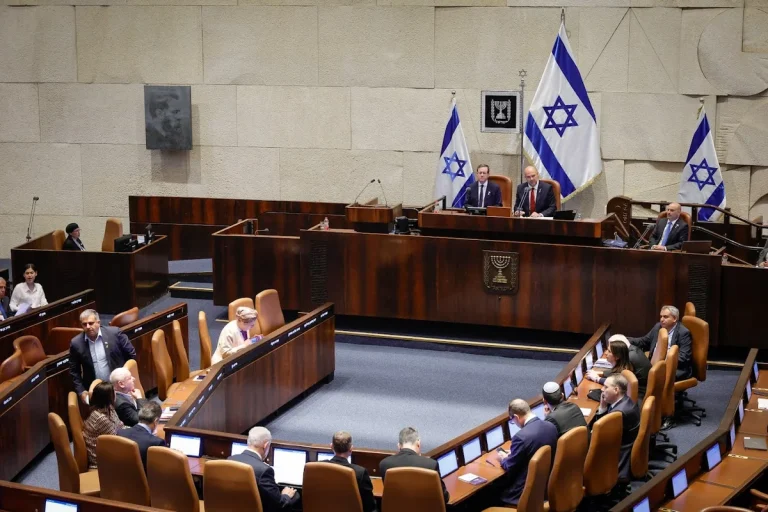
Speaker of the knesset MK Amir Ohana (Likud) opened the Fourth Session of the 25th Knesset on Monday, saying “Today we open the final session of the 25th Knesset. It is not yet time for summaries, but it can already be said that the days of the 25th Knesset have undoubtedly been historic and filled with events that will be etched not only in the annals of the Knesset but also in the history of the State of Israel.
“From the days preceding the war — when the Knesset sought to amend and balance the relations between the branches of government, a struggle that stirred deep emotions, anger, and concern among various parts of the public — through the darkest day in Israel’s history, October 7, 2023, and the war that erupted then, with all its developments and achievements, its victims, its fallen soldiers, and its hostages — those who, thank God, have returned alive, and those whose bodies still remain in Gaza — and the State of Israel is committed to bring them back.
“The following words I say out of deep concern for democracy and for the status of the legislative branch: the trampling of the Knesset by the judicial system is a severe blow to Israeli democracy. Because it is not we who are being canceled — it is the sovereign itself; it is the public that went to the polls on Election Day; it is the people, whose vote — each and every one — is equal. That is the reason we all go to vote. But the judicial system — including the Attorney General’s Office, an institution that operates without any law defining its powers, which continue to expand — undermines, through its actions, that very choice.
“These processes did not begin yesterday. I am not the first to warn against them. Great legal minds, judges, scholars, and public figures have said so before me. But these processes reached their peak with the annulment of a basic Law in Israel — a power never granted to the judiciary by law, one that it appropriated to itself — and it even went further, taking this unprecedented measure during wartime.
“There is no other authority in the democratic world that operates without any checks and balances, apart from those it occasionally chooses to impose upon itself — other than the Israeli judiciary. There is no other place in the democratic world where an authority wields power that is infinite and unchecked, where ‘everything is justiciable,’ and where it always has the final word — other than the Israeli judiciary.
“This is not a private struggle of mine. It is my public duty as Speaker of the Knesset to sound the alarm before the public. Your ballot is being eroded. It is losing its power and significance due to the conduct of the judicial system. The Knesset is the only institution that faithfully represents all citizens of Israel, with all their different opinions. This chamber is the most democratic of the three branches. Therefore, the laws passed here are binding upon the other two. This is where the rules of the game are set. These are foundational principles.
“The State of Israel needs a judicial system that the entire public can have confidence in — a civil service that acts as a servant of the public, not as a policymaker or legislator. We wholeheartedly want Israel to be a state governed by the rule of law — and this House represents that ideal more than any other. But it must be rule of law, not rule of lawyers.
“To all this is added the selective enforcement and the blatant disregard for offenses committed by Members of Knesset from the ‘correct’ camp, alongside the wholesale use of legal aggression against Members from the ‘incorrect’ camp. In my view, these matters should trouble every Member of Knesset, not only one side of the political map. Those who are in opposition today could be in the coalition tomorrow, and vice versa.
“In my opinion, those who harm the Knesset are those who annul its laws, who seize its powers, who expropriate the public’s authority to decide at the ballot box which decisions will be made and by whom. Those who harm the Knesset are those who systematically disregard the people and its elected representatives — not those who refuse to bow their heads and send out invitations to ceremonial events.
“Members of the Knesset, there is another way. I believe this war has proven that when we act together, there is no limit to what we can achieve. It is both possible and necessary to work together to correct the relationship between the branches of government. The Knesset is the place to hash things out, to talk, to reach understandings and compromises. And we have offered many such compromises, out of the belief that this correction can be achieved together. We have always been ready to meet with any party for this purpose — and so it will be in the future. And here I say again: we are open to dialogue with the judicial system, which so far has refused to engage or agree to even the mildest compromises.
“There is not an ounce of unity in striking down a basic law during wartime — especially one that was significantly softened to try to allay the concerns. This act represents an assault on Israeli democracy, on the Knesset, on the elected representatives, and, worse still, on the public that elected them. There is a deep disagreement over what Israeli democracy truly is — what is flawed in it and what needs fixing. Unity and mamlachtiyut [placing state interests above sectarian concerns] do not mean silencing disagreement or ignoring it as if nothing happened. They mean the ability to debate issues genuinely — without insults, curses, or outbursts — but incisively.
“That is what I have done, that is what most Members of this House — both coalition and opposition — are doing, and that is what we will continue to do in this session, in order to fulfill our public mission. I truly hope that after we have endured the hardest and longest war in the nation’s history, the new path that the State of Israel begins to tread — both in this House and beyond it — will be a path of repair, of listening, of understanding, and of compromise,” speaker mk Ohana said in his speech.