














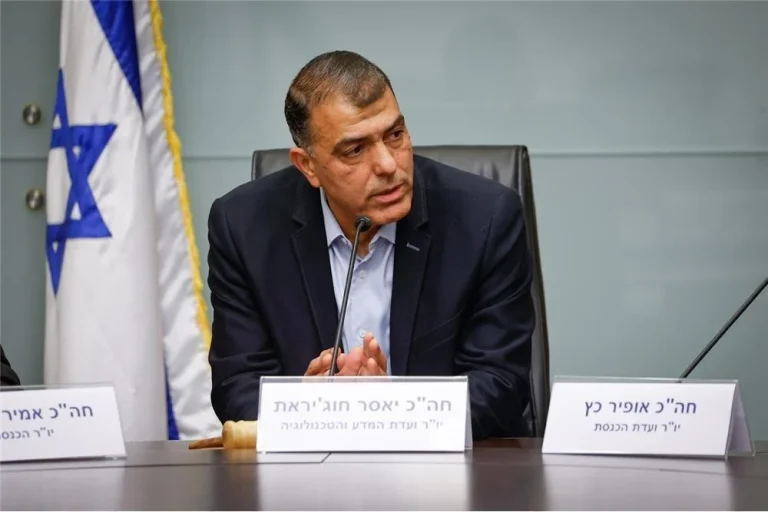
The Science and Technology Committee, chaired by MK Yasir Hujeirat (United Arab List-Ra’am), convened Monday for a debate on the topic of “Recruiting researchers to Israel in light of the crisis in American academia,” at the request of MKs Yorai Lahav Hertzanu (Yesh Atid), Matti Sarfatti Harcavi (Yesh Atid), Naor Shiri (Yesh Atid), Ron Katz (Yesh Atid), and Shelly Tal Meron (Yesh Atid).
During the debate, committee chair MK Hujeirat said, “We are witnessing severe phenomena of academic boycotts, cuts to research budgets, termination of grants, and economic instability, all of which directly affect Israeli researchers and their willingness to return to the country. A comprehensive national program must be accelerated to create an absorption track, incentives, and infrastructure for researchers – with the understanding that the crisis in American academia is a rare opportunity to strengthen scientific excellence in Israel.”
Dr. Avner Gross, senior lecturer at Ben-Gurion University‘s School of Sustainability and Climate Change, presented data from a survey published in the U.S., showing that 75.3% of researchers in the U.S. are considering leaving the country due to the harm caused to science during the Trump Administration, compared to only 24.7% who remain committed to staying. Gross further added that in practice, there has been a 35% increase in applications for work outside the U.S. since 2024 – indicating that the forecast has been accurate.
Prof. Or Chen from MIT said programs such as Kalaniyot, which promote international collaborations, overseas training, and integration into supportive faculty at leading universities, are important. According to him, Israel must improve personal absorption conditions – grants, salaries, and family support – and take advantage of the crisis in the U.S. in order to build long-term collaborations.
Dr. Eshkol Eytan, a researcher at a University in Colorado, noted that research in the U.S. has been severely harmed in the fields of health, environment, and climate. Young Israeli researchers return with research portfolios that do not reflect their full potential, and senior researchers are considering returning but are discouraged by the situation in Israel. He added that doctoral students are struggling to find postdoctoral positions in the U.S., while Europe does not offer a sufficient alternative. Eytan recommended scholarships that would allow researchers to complete their studies abroad, return to Israel with support, and integrate even without available tenure tracks. He also proposed visiting fellows programs and stable funding for postdoctoral research.
Dr. Adi Ashkenazi of the Israel Young Academy presented an in-depth survey indicating harm at all stages of academic training since the beginning of the war. She said there is a threat to Israel’s participation in the Horizon Europe initiative, difficulties in publishing, hosting experts, and in obtaining international recommendations. Postdoctoral opportunities have also been significantly affected. The Israel Young Academy recommends return grants, funding for joint research, researcher visits, and incentives for underrepresented populations – especially women and scholars in the humanities and social sciences, she said.
Prof. Albert Pinhasov, rector of Ariel University, said, “This cannot be the effort of a single university – this is a national mission that the State of Israel must lead.”
Prof. David Harel, president of the Israel Academy of Sciences and Humanities, said, “Bringing researchers is important, but without proper infrastructure and comprehensive support – the effort will fail. We must offer a complete package that allows for absorption and continued excellence.”
A Finance Ministry representative presented the government’s plans for recruiting researchers: the Or and Bereshit programs were launched despite budgetary constraints, with the aim of bringing senior researchers from abroad. “We provide up to NIS 12 million in allocations – including equipment, salaries, and grants. The Treasury, together with the Planning and Budgeting Committee (of the Council for Higher Education) and the Ministry of Aliyah and Integration, have identified the completion of the doctorate as a point of vulnerability. The goal is to bring researchers back before they are absorbed into the American system,” he said.
A member of the Planning and Budgeting Committee added: “The committee regards the return of scientists to Israel as a national mission. Through the Or program for absorbing senior researchers, with up to NIS 12 million per researcher, and the Bereshit program for young researchers, with up to NIS 5.33 million per researcher – we have already succeeded in bringing over 20 outstanding researchers to Israel, who have been absorbed into leading academic institutions and are strengthening Israeli research and innovation.”