












Knesset Press Release • August 6, 2025
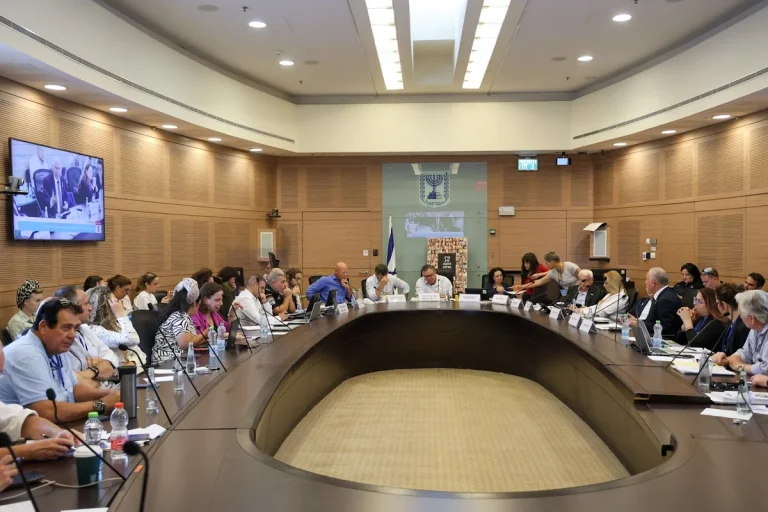
The Economic Affairs Committee, chaired by MK David Bitan (Likud), held a series of meetings on Wednesday dedicated to the fight against road fatalities, focusing on the development of a national road safety plan and increased enforcement.
At the opening of the meeting, committee chair MK Bitan recalled that the committee had held discussions on the issue about eight months ago, but since then nothing has progressed — and this year is expected to be even worse than last year, which was already the deadliest in recent years. He demanded that a national plan be approved by the government within two months, with budgetary backing, and clarified that any bills submitted to the committee would be passed within two months.
The chair of the National Road Safety Authority (NRSA), Deputy Commissioner (ret.) Yoram Halevy, noted that 276 people have been killed on the roads since the beginning of the year, and at this rate, the number will reach 460 by year’s end. “This figure is insane by all standards. We’ve had endless discussions — in the State Control Committee, in the Economic Affairs Committee, cabinet meetings, ministerial committees — and nothing has changed. Nothing at all. We’re going to hear the same things and come out with another summary, and nothing will happen — because nothing ever happens.”
He mentioned that the authority has prepared a national plan with a budget of NIS 350 million. NRSA Director-General Gilad Cohen added that only the authority is capable of winning this battle.
MK Boaz Toporovsky (Yesh Atid) said, “A year has passed since I resigned as chair of the [subcommittee for Promoting Road Safety], and nothing has changed. The responsibility lies with the executive branch, and those accountable are not paying the price.” MK Alon Schuster (Blue and White – National Unity Party) expressed his support for advancing steps on the issue and urged MK Toporovsky to return as chair of the subcommittee. MK Shelly Tal Meron (Yesh Atid) noted that these were the deadliest six months on the roads in the past 18 years, as was the previous year, and the situation was only worsening. A national plan, she said, is an urgent necessity. MK Eli Dallal (Likud) said it was unacceptable that the NRSA serves in a mere advisory role, and called for legislation to be advanced.
A senior Ministry of Transport and Road Safety official stated that the ministry has a detailed national plan approved by the minister, but that other ministries must also share the responsibility. “The plan cannot go forward without funding, and the Finance Ministry has not designated a line item in the budget. You can blame the ministry, but that doesn’t absolve other ministries — such as Justice Ministry, Finance Ministry, National Security Ministry, education ministry, and local government — of responsibility.”
Deputy Commissioner Haim Shmueli, head of the Israel Police Traffic Department, said that the police’s basket of resources remains unchanged, with no increase in personnel or funding. He presented a digital enforcement plan and said “Had we received a budget at the beginning of the year, we’d be in a different place.” In response, Halevy said “You know the issue isn’t money — you don’t have the manpower to implement it.” Shmueli added that due to the shortage of police officers, the plan is to reverse the ratio to 80% digital enforcement and 20% in-person police encounters with civilians. He acknowledged that the department needs 450 patrol cars per shift but currently operates only 250 per day.
Efrat Rave of the Ministry of Justice noted that several bills are in advanced stages, including ones dealing with enforcement against tourists and the presumption of reliability of enforcement devices. Liat Eliyahu Saban of the Ministry of National Security said that several dozen legislative amendments are in the pipeline, and the ministry has prioritized them at the Knesset’s request. committee chair MK Bitan said that legislation alone is not enough and promised to move quickly to pass any legislation submitted to the committee within two months, including the approval of the Knesset plenum. “We’ll put everything else aside and pass it,” he said.
Daniel Schwartz of the Finance Ministry’s Budget Department said that the NIS 350 million plan had never been formally submitted to the Treasury. “The [Minister of Transport and Road Safety] met with the Finance Minister last week and mentioned it, saying she needed a bit more time. We have no objection, but no plan was ever submitted, so we cannot address it. We’ve never been a budgetary obstacle,” he said.
Deputy Mayor of Tel Aviv Meital Lehavi said that 12 people have been killed on the city’s roads this year — a decline from previous years. She added that the city’s strategy to reduce road fatalities has been successful, though it still struggles to reduce the number of minor accidents that go unreported to the police and are thus absent from official statistics.
Committee Chair MK Bitan concluded the discussion by requesting that the ministerial committee convene within two months to discuss the plans of the NRSA, police, and Justice Ministry. He requested that a plan be submitted to the Economic Affairs Committee, and then to the government for its approval. “I will approach the Prime Minister and the Minister of Transport — this cannot remain up in the air. We have stopped giving ministries unlimited time. We need a target date for implementation,” he said.