












Knesset Press Release • October 21, 2025
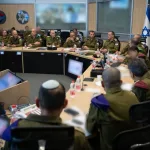
On Monday, shortly after the opening sitting of the fourth session of the Twenty-Fifth Knesset, Speaker of the Knesset MK Amir Ohana (Likud), prime minister MK Benjamin Netanyahu (Likud) and his wife Ms. Sara Netanyahu dedicated two areas in the Knesset: The interactive Government Room and the refurbished Six-Day War Room.
The prime minister was impressed by the display [in the Government Room] and said, “It’s very moving.” Speaker of the Knesset MK Ohana said, “From now on, we are opening this historical Government Room to visitors coming to the Knesset.”
Until now, the historical Government Room was closed to visitors, and it opened to the public for the first time on Monday. By means of advanced technology and artificial intelligence, the old Government table will come to life, and take the visitors on a journey through time to three dramatic decisions made by the Government in the past—the Six-Day War, Operation Entebbe and Operation Solomon.
speaker mk Ohana presented to Prime Minister MK Netanyahu the speech given by the Speaker of the Sixth Knesset, Yitzhak Shamir, on Mt. Herzl on the third anniversary of the death of Lt.-Col. Yoni Netanyahu, the commander of Sayeret Matkal, in which he referred to him as the “representative of the daring and the bold.” “Until that fateful night, only those who were close to him knew him—the soldiers under his command, his commanders, his friends and his loved ones,” said the knesset speaker at the time, Shamir, about Yoni Netanyahu. Shamir concluded his statements by a pledge to Yoni’s family, “We will walk, act and educate in light of his [legacy].”
Additionally, the Knesset Speaker and the Prime Minister dedicated the refurbished Six-Day War Room, which was the shelter to which the Prime Minister and the ministers were rushed on the day that the Six-Day War broke out. It was in that shelter that they held the Government meeting, while the Knesset and west Jerusalem were shelled from the Jordanian side. From now on, an interactive exhibit will be displayed in the room, recreating the decision-making process on the liberation of the Old City of Jerusalem.
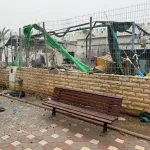
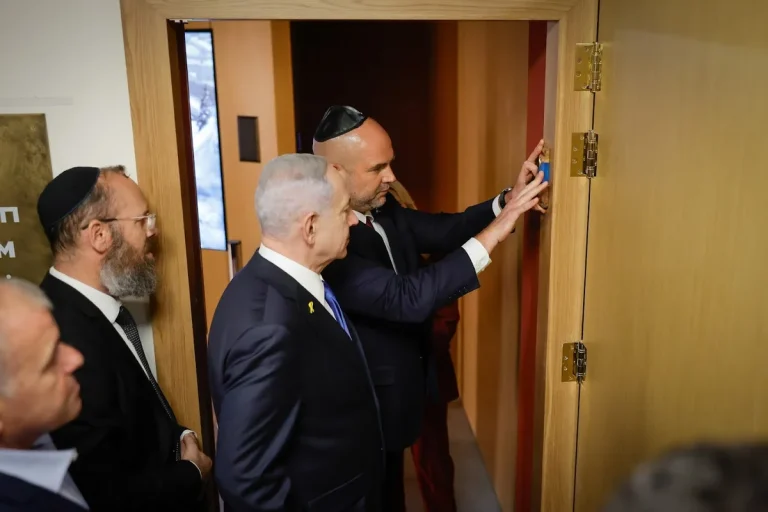
At the entrance to these two rooms, two special mezuzahs were affixed, made from the remnants of trees that were damaged and remained in the communities of the Gaza perimeter region and at the site of the Nova music festival after the October 7 massacre. The mezuzahs were created by students of the industrial design track in the Torah-Technological Atid campus in Ashkelon, who were evacuated from their homes at the start of the war.