




















Knesset Press Release • September 10, 2025
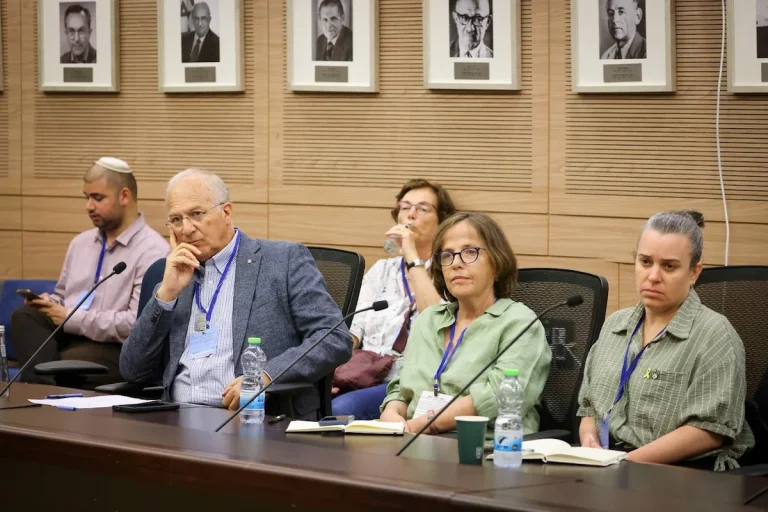
The foreign affairs and Defense Committee’s Subcommittee for Foreign Policy and Public Diplomacy, chaired by MK Moshe Turpaz (Yesh Atid), convened on Wednesday to discuss the academic boycott against Israel.
Prof. Daniel Chamovitz, President of Ben-Gurion University and chair of the Association of University Heads (VERA): “BDS has been organized for the past 30 years by anti-Zionist antisemites who attack us, and we knew more or less how to cope with it. Since the middle of the war, we have also witnessed BDS on the part of our friends. This is a virus that spreads from one campus to the next, mainly in Europe but also worldwide. There is no national strategy. The Israeli universities operate on this front alone, with their own funding and without state support. The Government is not involved, either in overall management of the war against BDS or in funding this battle. It’s important to understand that the boycott will continue as long as there is war.”
Emmanuel Nahshon Schlanger, who heads the team for combating the academic boycott at VERA: “This is a strategic threat, which is not necessary directed against the universities, but rather uses them to harm the state and cause intellectual isolation. We have compiled the statistics of the boycott cases, and we’re looking at an exponential growth rate. The fear is that we will reach numbers that [we] won’t be able to deal with individually. This refers to a broad range [of incidents], from an Israeli researcher who wishes to publish an article and is rejected because he’s an Israeli, and preventing people from participating in conferences, even the number one expert in the world—because they’re Israelis. On the severe side there are boycotts by institutions, universities abroad that make a conscious decision to boycott the Israeli academic community and sever their ties with it—as of today this includes about 30 universities in Europe, all the universities in Belgium and others.
“Two threats that face us are Horizon and CERN. At present there are over 100 Israeli scientists who conduct studies in the particle accelerator research field. At CERN in Switzerland, anti-Israeli activity is carried out, [consisting] of ads and petitions. If we leave there, it’s a dramatic impact, the scientific harm is very severe and we’re talking about harm to the Israeli reputation, both with regard to CERN and to the Horizon program. We have reached out to leading figures in CERN, but it’s beyond the universities’ scope. This requires the power of the state.
“The great danger is to the next Horizon program in 2028, and as of today it’s not certain that Israel would be accepted. This doesn’t only refer to money, in which regard Israel receives what it spends, but rather one of the leading scientific enterprises in the world, which allows us to join the global trends of cyber and AI. If we aren’t part of this, we will be swept backwards and will lose personnel. Israel has to recognize the strategic phenomenon and form a body, with personnel that is trained to combat the phenomenon. We have to form a legal team that will cope with the problem. In the past two years, we have spent over USD 800,000 on the legal issue,” he said.
Prof. Ariela Gordon-Shaag, President of the Jerusalem Multidisciplinary College and member of the Board of Public Academic Colleges (VARAM): “In all the colleges, we can see a quiet boycott at all levels, and I would like to propose creating a coalition of our friends who support us around the world. There are a few points of light such as the Czech Republic, which should be noted favorably. My heart is with the young faculty members in the early stages of their career, who are measured by acceptance of articles, studies and presentations at conferences, and this path is currently blocked to them.”
Dr. Amira Halperin shared her personal struggle with the subcommittee, saying, “I completed my doctoral research in England a decade ago; I live there and work in London. My doctoral research dealt with the Palestinians, and became unacceptable in the university in which I worked after October 7. I lost my livelihood and was threatened by Hamas supporters, without the university taking a stance, despite the fact that this happened in front of an entire audience. Eighteen universities signed a petition to remove Hamas from the list of terrorist organizations in Britain, saying that it was a resistance movement.
“I am asking for help in receiving professors such as myself back home, so that we’re not in an inferior position. I am sharing [my story] here not in order to say that I’m a victim, but rather to shed light on the phenomenon of support for terrorism in campuses, and to see how we as a state can fight against Hamas’s structured ties with universities,” said Dr. Halperin.
Pnina El-Al of the Ministry of Foreign Affairs: “A great deal of information flows to us through the embassies and from sources in Israel, including in the fields of culture, education and sports. We have requested not to elaborate upon all our actions and means of leverage, except in a closed debate. The embassies have been instructed to take action. We are working with the countries in question through the embassies, and when possible [we work] with the academic institutions. In the case of Dr. Halperin, the ambassador reached out and the university said that it did not intend to comment on the matter or to provide information, but there are other means of leverage that the Ministry of Foreign Affairs uses towards these countries. As for CERN, the Ministry of Science is the leading agency. As soon as we found out, the ambassador began to take action with the CERN management, in direct contact with the president, the CEO and the member states of CERN.”
Ministry of Innovation, Science and Technology official Itamar Gazala said, “We place an emphasis on strengthening the attractiveness of Israeli science worldwide. Two weeks after October 7, a team was convened with the Ministry of Foreign Affairs, the Ministry of Aliyah and Integration and VERA, and we are there all the time. We assist in funding research students, training programs, conferences for recruiting foreign students and bringing scientists from abroad to courses in Israel, and a legal response to boycotts. We are in advanced stages of formulating a plan for strengthening international collaborations, and we attach great importance to dynamic monitoring of the boycott and antisemitism incidents.”
Subcommittee Chair MK Turpaz: “I am asking you to prepare a list for the Israeli doctoral student—who wants us and will collaborate. In the legal aspect, not just defense—we have to go on the offensive to protect the researchers and the research.”
MK Amit Halevi (Likud): “If your purpose is only to strengthen scientifically, you’re missing the point in a big way. The terrible October 7 massacre was a window of opportunity to spread the values of the West, of Israel, while we are facing barbarism incarnate. This threatens the entire world. There was a window for a cultural-academic offensive against these sons of darkness. There should have been a deep shaming campaign for heads of universities who collaborate with these human animals. VERA should have taken the lead, in the name of the values of human culture.”
Yevgeniy Glider of the Council for Higher Education presented to the committee a number of programs designed to encourage the return to Israel of Israeli researchers: “The OR program, which gives amounts of NIS 750,000 to NIS 1.5 million, and the Beresheet program, which offers research grants of NIS 800,000 per year for five years.”
Ministry for Diaspora Affairs and Combating Antisemitism official Shlomit Hammer reviewed the activity of the control center established by the ministry, which is wholly dedicated to the battle against antisemitism around the world. Hammer said, “We monitor the web from end to end, we submit reports and statistics, and send materials to VERA and government ministries. [As of] May 2025, there are 352 incidents in the field of antisemitism and delegitimization related to the academic boycott. A few days ago there was a demonstration against a weapons exhibition, and we arranged heightened security and a change of venue.” Subcommittee Chair MK Turpaz asked the representative of the Ministry of Foreign Affairs, Pnina El-Al, whether she was familiar with the issue, and she responded in the negative.
Subcommittee Chair MK Turpaz thanked the Israeli academic community for its battle in the past years, and called to allocate a budget for legal activity and to adopt a public diplomacy approach and go on the offensive. “When a missile intercepts a missile from Yemen, this doesn’t happen on its own, or only due to the great Israeli spirit, it is thanks to the minds that have developed here. And also thanks to the world. ‘A people that shall dwell alone’ [Numbers 23:9] is not a blessing, it is a curse. Within the threat of the war, the return of the minds is also an opportunity. We want the Israelis who are abroad to be with us,” he said.
MK Turpaz said further, “The subcommittee views the current situation as an emergency, and requests that all agencies take proactive and aggressive actions, including allocation of budgets that have not been designated until now. We need to identify the friends we have lost and strengthen the relationships with them, and identify who our academic enemies are and deal with that too.”