











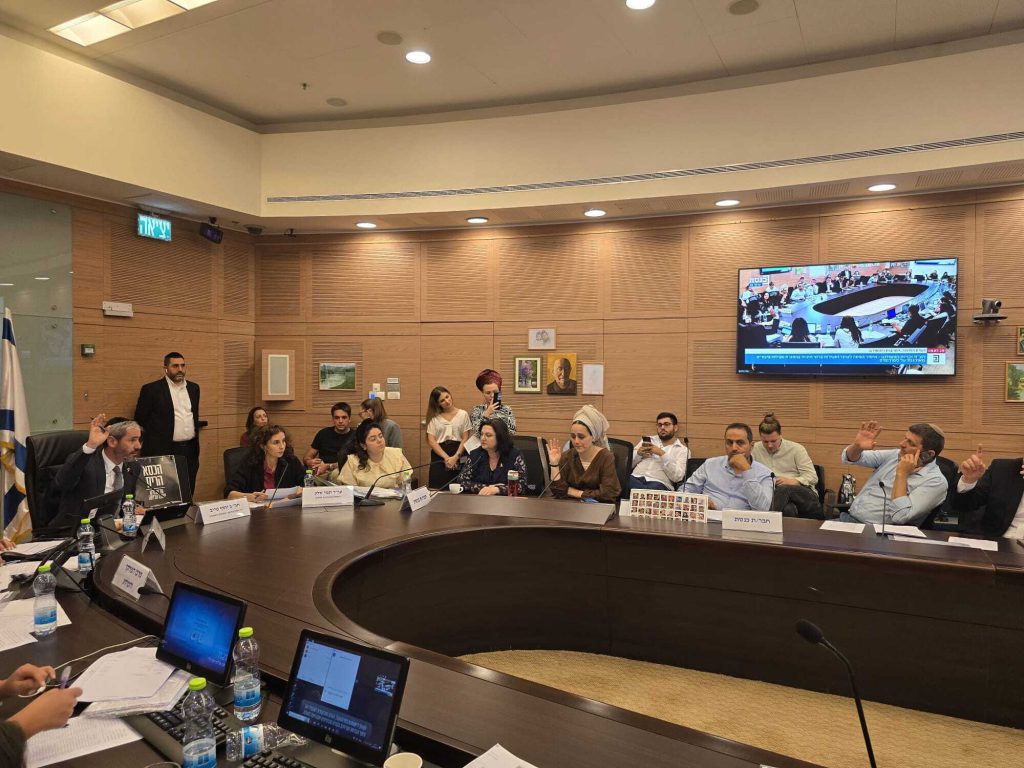
The Education, Culture and Sports Committee, chaired by MK Yosef Taieb (Shas), convened on Tuesday and voted to approve for second and third readings the Students’ Rights Bill (Amendment No. 10) (Prohibition on Incitement to Terrorism and Illegal Activity within Organized Public Activity of Students), 2025.
The bill, sponsored by MK Limor Sonn Har Melech (Otzma Yehudit), proposes to impose restrictions on conducting organized public activity in academic institutions, including a student group, which supports or incites to terrorism against the State of Israel. Following the debates in the committee and the Legal Department’s position, a clause was also added that prohibits publication of incitement to racism. The academic institutions are required in the legislation to issue regulations on public activity that will include, among other things, prohibition on incitement to terrorism and racism.
MK Sonn Har Melech, the bill’s sponsor: “After consultation and dialogue I had with students, mainly from the Ethiopian community, I was convinced to include in the legislation a clause prohibiting incitement to racism.” Following statements presented by representatives of the Standing Together (Omdim Beyachad) movement, Committee Chair MK Taieb clarified, “A phrase such as ‘May your village burn’ is also part of the bill.”
MK Sonn Har Melech: “Institutions of [higher] education are supposed to be seats of study, research and dialogue. In practice, students incite to terrorism, with a forgiving attitude by the administrations of the academic institutions. These institutions are financed by public funds, and it’s unthinkable that students who support terrorism will continue to study there.”
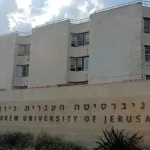
At the request of the Education Committee, the Council for Higher Education (CHE) sent detailed data on the number of complaints regarding incitement to racism and violence, and the disciplinary handling of these complaints by academic institutions during the war. The document shows that in the period in question (until March) several dozen complaints were submitted. In some cases, the institutions stated that there was no incitement or racism involved; in others, disciplinary proceedings were conducted, to the point of permanent expulsion from studies; and there were also cases that were turned over to the police. The Hebrew University received 41 complaints, Bar-Ilan University handled 18 complaints, Tel Aviv University 28 and the University of Haifa 15.
Dr. Marc Assaraf of the CHE: “There were also institutions that reported ‘we have no such things here.’ When I look at the review, if you isolate the issue of incitement to racism, it’s not as severe as incitement to terrorism and support of terrorist organizations. The issue of racism is not equal to those issues in terms of the number of complaints.” Adv. Omri Golan, representative of the CHE’s Legal Department, said that they were not opposed to the version of the bill on the committee’s table.
Hebrew University student Hadar Kali: “The university doesn’t enforce complaints about incitement, on the grounds that it’s freedom of speech, but this is incitement. Absolutely. We had demonstrations in which people called IDF soldiers murderers and raised PLO flags.” A representative of the Im Tirtzu movement: “We in the movement submitted hundreds of complaints over the years, and nothing was handled.”
Nadav Golan, chair of the student union at Bezalel: “This is a populist bill that is intended to persecute the Arab students. You’re turning the academic institutions into enforcement and policing institutions, and that’s not their job.”
The university presidents who were present in previous debates asserted that their regulations did not need incitement clauses, and stated that the meaning of the legislation was to “impose a legal issue on the institutions,” and that “incitement offenses should be handled by the police in any case.” MK Sonn Har Melech said, “If you had done your job, the bill might not have been necessary.”
Ministry of Justice official Hadeel Younis said, “The Ministry of Justice’s position is that a clause of incitement to violence should also be added.” The clause was not ultimately included in the legislation.