























Knesset Press Release • October 27, 2025
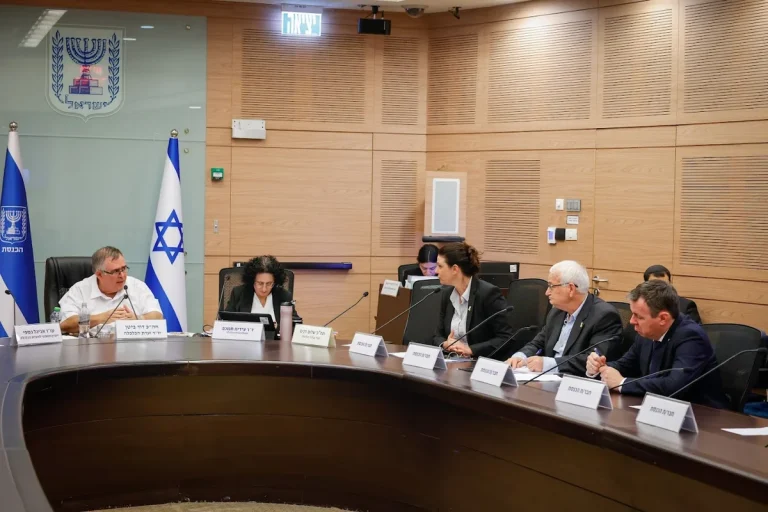
The economic affairs Committee, chaired by MK David Bitan (Likud), convened on Monday to discuss the implications of Israel’s economic isolation.
MK Efrat Rayten Marom (Labor), who initiated the debate along with MK Alon Schuster (Blue and White – National Unity Party), said she asked to hold the debate mainly due to the remarks made recently by Prime Minister MK Benjamin Netanyahu, according to which Israel should switch to a more self-sufficient economy. She asked whether the state was preparing for such a transition, and whether the economic threats to the country have been removed following the end of the war in Gaza.
MK Schuster said the economic component must be taken into account in any strategic decision, since any economic damage to the country may be long term.
Entrepreneur Einat Schreiber referred to the high-tech sector, noting that Israeli companies are struggling to find investors, and that investments are down 80%. Sarit Fishbane of the Federation of Israeli Chambers of Commerce said the problem is not limited to high-tech, that multinational companies are refusing to work with Israelis, and that every extreme statement has a ripple effect, negatively impacting small businesses. Industrialist Meir Arnon explained that today, when he starts a business, he does not do it in Israel.
Manufacturers’ Association of Israel representative Lior Kochavi said Israel was in the midst of a national crisis that must addressed. He said 50% of respondents in a survey conducted by the Manufacturers’ Association reported cancellations, indicating a need for public relations efforts in the economic sphere.
Alon Kuba, Deputy Director of the Anti-Defamation League (ADL) Israel, referenced an ADL study showing that if the top 100 universities in the U.S. stand to lose $33.2 billion if they stop investing in Israeli companies. He argued that if the Norwegian investment fund continues to reduce its investments in Israel by 30%, it would lose $5-10 million of its own funds.
Lena Zeiger, Director of Bilateral Agreements at the Ministry of Economy and Industry, said the ministry invests significant resources in support efforts. She mentioned that threats of boycotts have not been completely removed from the table. Zeiger addressed the threat of canceling the trade agreement with the European Union, saying, “We were close to losing the support, the guillotine did not fall, but the pressure is still in the air.” Zeiger also noted that exports of goods in the first half of 2025 decreased by 2% compared to the same period in 2024, while before the war, the trend was a 2.8% annual growth.
Ministry of Finance official Moshe Lau said that in terms of economic isolation, Israel’s macroeconomic situation is stable. “It’s a risk factor we are closely monitoring, but in terms of foreign investments and high-tech investments, the situation remains stable, not in free fall,” he told the committee. “This doesn’t contradict the fact that there are quiet boycotts, but at the macro level, there is no significant impact.” committee chair MK Bitan asked if there was a plan for a scenario in which the situation worsens. Lau responded, “We believe the ceasefire agreement reduces the likelihood of damage to the free trade agreement.”
MK Tzvi Sukkot (Religious Zionism) said there had been fears of an economic collapse, but there is a huge gap between that and what the government professionals are saying. “Thank God, Israel’s economy is in good shape,” he said. On the other hand, Einav Eshkol from the Brothers and Sisters in Arms organization said that farmers are struggling and Europe is looking for substitutes. She argued that the data presented by the public point to a disconnect between the public and the Government. Lau replied, “We have different data, and in the coming weeks, we will publish our foreign investment report.”
Committee Chair MK Bitan concluded the discussion by stating that the “negative dynamic” has stopped, and that he hopes Israel will eventually reach a balance. MK Bitan said the committee would hold another debate on the matter, specifically focused on the high-tech sector.