
















Knesset Press Release • July 7, 2025
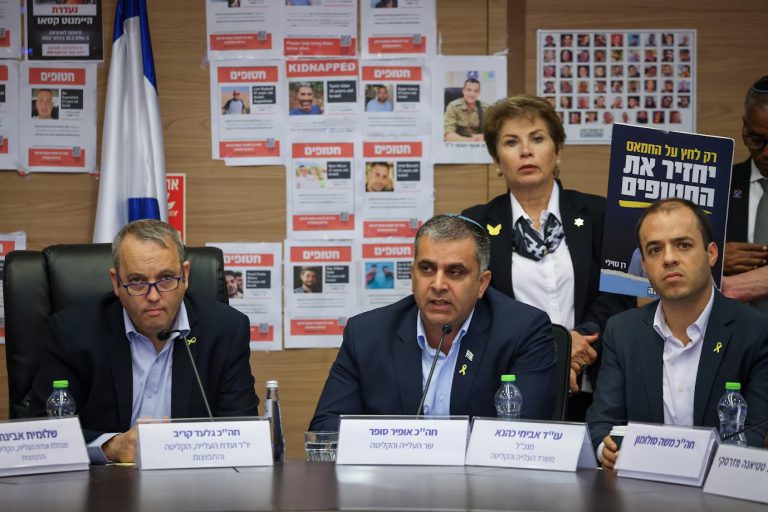
The Committee for Immigration, Absorption and Diaspora Affairs, chaired by MK Gilad Kariv (Labor), convened on Monday to hear a report from Minister of Aliyah and Integration MK Ofir Sofer (Religious Zionism) on the activity of his ministry and its budget, in accordance with Article 123(g)(1) of the Knesset Rules of Procedure.
Committee Chair MK Kariv: “I would like to express the committee’s thanks to the workers of the Ministry of Aliyah and Integration, who are working for the benefit of the immigrant population in light of the security challenges of this period. We feel that the ministry has mobilized in a good and proper way to find solutions for 235 immigrant families whose homes were damaged during the days of warfare of Operation Rising Lion. As far as the committee is concerned, there are three issues that stand at the core of the Ministry of Aliyah and Integration’s activity: 1. Policy for encouragement of Aliyah; 2. Aliyah of those waiting in Ethiopia; 3. Bringing back Israelis who have emigrated.
“We certainly welcome the new trend of encouraging Aliyah from Western countries. Along with this effort, there must not be harm to encouragement of Aliyah from other countries. In countries in which there is a decrease in Aliyah statistics, it is important to invest efforts there too. Contrary to previous years, there is no policy for bringing immigrants from Ethiopia, and the Government is called upon to formulate a suitable policy. The committee believes that the time is ripe to encourage Israelis who have emigrated to come back to Israel. […]
“Regarding the Aliyah of those waiting in Ethiopia, there are entire families that are being torn apart. There are about 1,300 people waiting in Ethiopia who are entitled to make Aliyah to Israel, but the Aliyah is not taking place in practice. The committee under my leadership will oppose any initiative that harms or reduces [the scope of] the Law of Return. It should be remembered that even if there are ideological difference on Jewish identity, the scope of the Law of Return must not be reduced. Yesterday the Government postponed once again the discussion on MK Avi Maoz (Noam)’s idea to abolish the ‘grandchild clause’ of the Law of Return, this time by a month. But as I have already said in the past, the Government must reject this idea out of hand.
“I am very troubled by the fact that the Ministry of Aliyah and Integration shows the committee an impressive presentation with statistics on Aliyah and opening [Aliyah] files, but it doesn’t have statistics on the former Soviet Union states. We see that there is a deterioration in opening files and in immigration from the South American states and the former Soviet Union states, and the Ministry of Aliyah and Integration needs to know how to stop this trend. The option should be considered of granting absorption baskets to Israeli residents who choose to return to the State of Israel. I believe that there is great potential to bring back tens of thousands of Israelis to the State of Israel,” said Committee Chair MK Kariv.
Aliyah and Integration Minister MK Sofer: “The initiative to encourage Aliyah from Western countries began before the outbreak of the Swords of Iron war, and it increased after the war broke out. I am willing to make compromises on the issue of bringing the Bnei Menashe community and those waiting in Ethiopia, as long as we succeed in finding the solutions vis-à-vis the Chief Rabbinate and the other agencies related to this issue. I want to reach a consensus on the immigration to Israel of those waiting in Ethiopia. I would be glad for the committee chair’s help in securing the opposition’s consent to the Aliyah of those waiting in Ethiopia. Revisions should be found to the Law of Return that expand the ability to make Aliyah and do not reduce it. The fact that I have not addressed this issue attests to the marginal importance of this private member’s bill,” said Minister MK Sofer.
According to statistics presented by the Jewish Agency, between the years 2022–2024 an increase of 394% was recorded in the opening of Aliyah files in Belgium and France, 160% in the United States and Canada, and 161% in Britain. Since the end of Operation Rising Lion, about 100 new immigrants have already made Aliyah to Israel. In addition, according to statistics provided by the Ministry of Aliyah and Integration, in the course of the operation 235 immigrant families were evacuated from their homes, after the homes were damaged or destroyed. Director General of the Ministry of Aliyah and Integration Adv. Avichai Kahana: “All the immigrants who suffered harm and were evacuated from their homes during the days of the operation are known and handled by welfare services and our ministry. We are assisting all the immigrants to submit bureaucratic forms to property tax.”
Regarding the Aliyah statistics and opening files in Western countries, Director General Adv. Kahana said, “The ministry operates in light of the minister’s policy and guidelines. The minister has instructed us not to forgo the efforts for any country, and at the same time, to step up the efforts for immigration from Western countries. For many years, no attention was paid to investment in encouraging Aliyah from Western countries, and the minister is working to change that trend. Our great missed opportunity with regard to the former Soviet Union states is not because of a lack in encouragement of Aliyah, it is because of absorption efforts that were not good enough over the years. Personally, most of my professional time is dedicated to meetings that will improve the quality of absorption in Israel. We have established a division of growth engines, for the first time, because we believe in the great opportunity that exists throughout the Diaspora for people to come to Israel. We are presenting great tidings by funding rental fees for immigrants who choose to live in Haifa or northward and in Ashdod or southward. We are continuing our efforts to increase the immigration of physicians to Israel.”
MK Evgeny Sova (Yisrael Beitenu): “MK Avi Maoz’s proposal threatens Jewish solidarity and the relationship between Israel and the Diaspora. MK Maoz does not understand properly the life of the Jewish community in the Diaspora. The missiles from Iran did not distinguish between a Jew with a Jewish father and a Jew with a Jewish mother. Israel’s relationship with the life of the Jewish communities in the Diaspora must not be severed. I am requesting that the Minister of Aliyah and Integration reject any proposal that calls to change the Law of Return at this time.”
Marina Rozenberg Koritny of the World Zionist Organization: “Encouraging Aliyah is a process that takes time. Changes in the Law of Return mean changing the rules of the game. The Law of Return must not be touched. The Jewish communities are looking at the Law of Return, and any change in it deters Jews from immigrating to Israel. In addition, the Jewish communities around the world are waiting to see what will become of the hostages—many people are sitting at home in the Diaspora and awaiting the return of the hostages, which will, accordingly, restore the sense of security in Israel.”