









Knesset Press Release • Invalid Date
There are approximately 50,000 new immigrant students in the education system | Since the start of Operation ‘Lion’s Roar’, over 700 calls have been received at the “Kol Le’Kol” hotline for social and emotional support operated by the ministry of Education | Committee Chair MK Kariv: “We must ensure that during an emergency, the population of immigrant children does not fall through the cracks.”
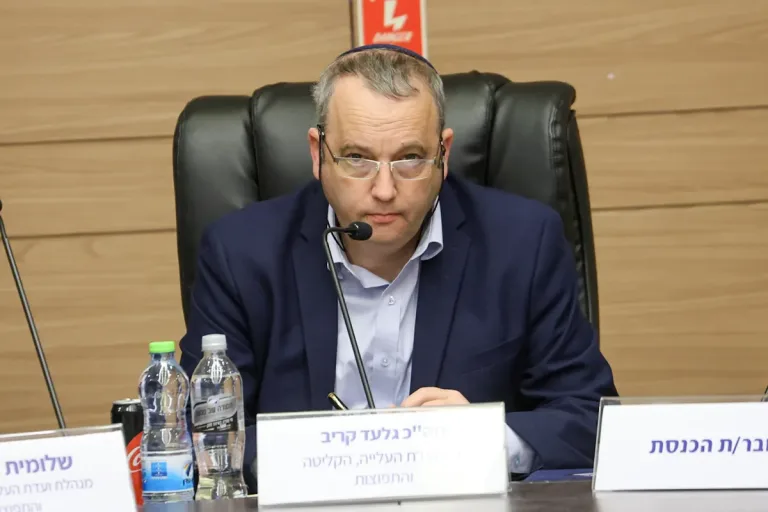
The Committee on Immigration, Absorption, and diaspora affairs, headed by MK Gilad Kariv (Labor), convened today (Wednesday) for a discussion on the needs and responses for new immigrant children and youth during emergencies and war.
At the beginning of the discussion, Committee Chair MK Gilad Kariv addressed the Knesset’s work during the war:
“The format of discussions in the Knesset committees, as determined by the Speaker of the Knesset, is completely unacceptable to me as the Chair of the Committee on Immigration, Absorption, and Diaspora Affairs. The fact that representatives of government ministries are participating only through online means is inconceivable to me. Precisely during an emergency, the work of the Knesset committees gains even greater significance. Discussions in the Knesset bring problems into public discourse, and we lead to the desired solutions for the citizens of Israel. I call upon the Speaker of the Knesset and the Knesset management to change the procedures regarding the invitation of government representatives to Knesset discussions, especially during the war period. Parliamentary oversight must be accelerated and increased precisely during wartime.”
Adv. Dan Marzouk, Knesset Secretary:
“Your words are heard with great attention. We in the Knesset management will continue to hold discussions on the continuation of the Knesset’s activities during emergencies. I hope, like everyone else, that we can soon return to full routine.”
Committee Chair MK Kariv addressed the challenges of new immigrants in the education system during the war: “We must ensure that during an emergency, the population of immigrant children does not fall through the cracks. At the first opportunity, I will schedule a follow-up discussion on the issue of bullying against immigrant children within the education system. I request that the Ministry of Education provide the committee with an answer as to whether a director-general’s circular has been sent dealing with the treatment of bullying against immigrant children in the education system. I request that the Ministry of Education be proactive in its outreach and in making information accessible to every immigrant student and their families.”
MK Vladimir Balyak (Yesh Atid): “Immigrant children are by definition in a risk group. The Israeli government is going to make very significant cuts in government ministries that will also harm the entire support system for immigrant absorption in Israel. I am very concerned that the State of Israel will not be able to support the wave of immigration expected to arrive here in the post-war period. There are many unnecessary government ministries where the cuts are almost negligible.”
MK Tatiana Mazaraki (Yesh Atid): “The entire State of Israel is under security tension due to the situation. When children do not sleep well at night, it affects their lack of concentration in learning, which is already being done through online means. The process of learning Hebrew for immigrant children is being harmed during the war, and appropriate solutions must be provided for them.”
MK Evgeny Sova (Israel Beiteinu): “Despite all the experience the education system has gained regarding distance learning in recent years, there are still very large gaps in the learning of Israeli children, especially among immigrant children. Parents have no certainty regarding the future. The messages of the Minister of Finance are not synchronized with the Minister of Education and other relevant parties. I call upon the Israeli government to create certainty for students and their parents and to provide relief to areas designated as ‘yellow’ throughout the State of Israel.”
According to Ministry of Education data, since the start of Operation ‘Lion’s Roar’, 701 calls have been received at the “Kol Le’Kol” hotline for social and emotional support in various languages.
Tira Galinur, Director of the Absorption of Immigrant Students Department, Ministry of Education: “There are approximately 50,000 immigrant students in the education system. Every letter for children or parents published in the education system since the start of the war has been translated into six different languages so that the information flows to all immigrant students and their parents in the education system. We strive to ensure that every immigrant student receives one hour of instruction per day in learning Hebrew. We are in a very challenging period. The educational psychological services are highly adapted for the various populations, with an emphasis on new immigrants. The entire education system is mobilized for the students and is doing everything possible to ease the situation. Daily letters are published containing materials adapted for immigrant students. We strive to enable new immigrant students to have Hebrew learning hours as much as possible, in accordance with Home Front Command restrictions.”
Michal Englert, Director of the Educational Psychology Department, Ministry of Education: “We are constantly refining the response we provide to the population of immigrant students in the education system. We have a dedicated information campaign for students, which is also translated for immigrant students. The Ministry of Education has allocated additional budget to expand psychological support services. We are holding psychological support meetings in absorption centers in cities that were affected during the war.”
Elisheva Sabato, Deputy Director General, Ministry of Absorption and Integration: “We maintain direct contact as much as possible in various frameworks. We launched a targeted operation of direct phone calls with all new immigrants residing in Israel. We enable immigrants to raise their needs to us and try to help as much as possible. When there is a security incident, we define a certain radius within which we know how many new immigrants exist and contact them directly.”
Adi Wales, Director of Social Services, Ministry of Absorption and Integration: “We identify that the population of immigrant youth is at increased risk compared to other youth in Israel. We work primarily with parents who are defined as new immigrants and assign social workers to families that require them. We operate a hotline that provides responses in a variety of languages, and most of the inquiries we receive these days are related to parental guidance during the challenging period of war.”
Alex Rif, CEO of the Million Lobby: “We have established a forum to prevent racism against immigrant students in schools. We have received inquiries from immigrant families who are struggling to function during the war because parents are required to work and children are barely learning via Zoom. There is a need for a volunteer support system to provide assistance to immigrant children, especially those whose parents are not at home. There are many new immigrants for whom it is impossible for children at home to learn via Zoom because they do not have a laptop at home.”
Varki Kasai, Ministry of Welfare and Social Security: “We have 1,666 new immigrants who are in the ministry’s welfare programs. In times of emergency, we provide a response according to the gaps identified on the ground. We provide guidance for maximizing rights and assist with information for effective emergency preparedness. We provide gender and cultural adaptation for the immigrants we are in contact with.”
Yeshayahu Yechiel, Director of the ‘Na’aleh’ Program: “We have approximately 1,700 youth in the Na’aleh project nationwide. Of these, about 900 are in boarding schools that maintain a full study routine as much as possible. We have about 100 students who left for abroad before the Purim holiday and could not return to Israel. And there is a small number of children who requested to return to their families abroad via the Taba crossing. From the first day of the war, we have enabled Zoom learning for our students worldwide. I salute all the educators engaged in this sacred work.”
Vered Ahayon, The Jewish Agency: “In our absorption centers, there are about a thousand students who receive full service from us according to Home Front Command guidelines. A large portion of the educators outside the absorption centers have visited our complexes. The Jewish Agency has raised funds for special activities for new immigrants during the current war.”
Committee Chair MK Kariv summarized the discussion:
“It is moving to see the blessed work for the immigrant population, especially during wartime. We will hold a follow-up discussion on this next week. We need to ensure, within the education system frameworks, the operation of online learning for the special frameworks for immigrant students. We need to refine the Ministry of Education’s advertising campaign for new immigrants within the system. We need to examine, starting now, exemptions in matriculation exams with an emphasis on immigrant children. I request to receive data on the activities of the various programs for immigrant children during the war.”
Related Topics