








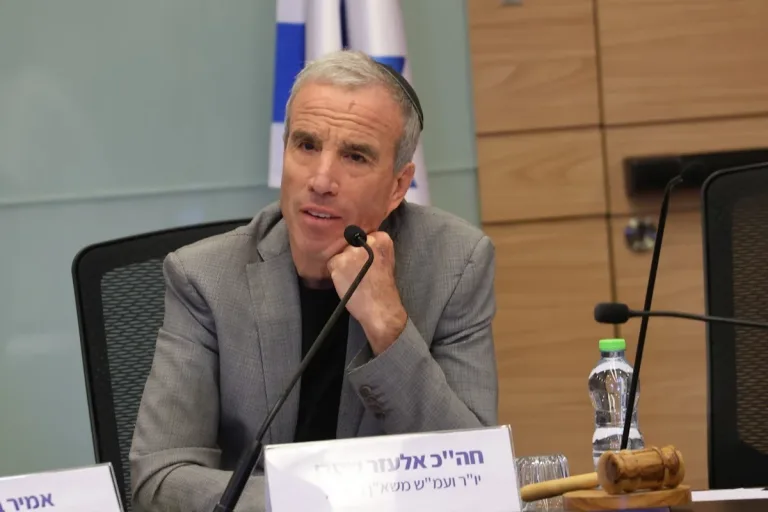
The foreign affairs and Defense Committee’s Subcommittee for IDF Human Resources, chaired by MK Elazar Stern (Yesh Atid), convened on Sunday for a debate on the measures the IDF is taking to prevent suicidality.
The IDF was asked to present the conclusions of the Almoz Commission, which reviewed the support to be provided to the families of discharged soldiers or reservists who are not in active duty, who take their own lives after their release from military service, under circumstances that may be related to their service. Subcommittee Chair MK Stern said, “I have great respect for the soldiers who work to save lives, but in order to reach everyone who needs help, we must continue to invest more in budgets, professionals, and appropriate accessibility for those in need. The fight against suicidality is not an individual struggle, it is our collective battle as a society. We will not leave anyone to fight alone. It is our duty to help, listen to their distress, and be there for them.”
Brig. Gen. Amir Vadmani, Chief of Staff for the IDF Personnel Directorate, said, “The [Almoz] Commission recommended maintaining the unique status of fallen IDF soldiers and preserving the distinction between civilians and soldiers. However, given the consequences of the Swords of Iron war and the exceptional circumstances, it recommended a unique and tailored response for this war. The response includes two stages – if someone takes their life after their military service and there are circumstances related to their service, it will be brought before the head of the Personnel Directorate, who will assess whether the suicide meets criteria such as the duration of service, the nature of the role, exposure to extraordinary events during service, the timing of the death in relation to service, and whether there were indications of mental distress during service. The information is immediately verified between the IDF and the police. If the head of the Personnel Directorate determines that there are unique circumstances, in accordance with the family’s wishes, military symbols may be included in the civilian funeral ceremony.
“In the second stage, the IDF assists the family in the process with the Ministry of Defense to receive rights according to the law. If the Ministry of Defense accepts that there was a causal connection, commemoration is added, including placing the name on the memorial wall at Mount Herzl, on the Yizkor memorial website, the placement of a candle and flag on memorial day, and the presence of a military cantor at the memorial ceremony,” he said.
According to IDF data, in 2025, 22 suicide cases were recorded, including 12 soldiers in compulsory service, one soldier in standing army service, and nine reservists. In comparison, 21 cases were recorded in 2024. Among soldiers in compulsory service, there was an increase from seven to 12 suicides, while among reservists, there was a decrease from 12 to nine. In 2022, there were 14 cases – 13 among soldiers in compulsory service and none among reservists. The IDF explains that the rise in suicides among reservists in 2024 and 2025 is due to a massive activation of reservists.
Fifty-percent of the suicides in 2025 were committed by combat soldiers, 75% of those who committed suicide had not been treated by a mental health officer (Kaban), and 85% of the cases involved suicides with weapons.
MK Ofer Cassif (Hadash-Ta’al) presented data from a report by the Knesset Research and Information Center, written at his request. The report shows that between 2017 and 2022, the percentage of combat soldiers among all IDF soldiers who committed suicide ranged from 42% to 45%. In 2023, this rate dropped to 17%, and in 2024, it rose significantly to 78%. Between 2024 and 2025 (until the end of July), 17% of the soldiers who committed suicide had met with a mental health officer in the two months prior to their suicide.
Regarding suicide attempts, between January 2024 and July 2025, 279 soldiers attempted suicide – meaning, for every soldier who committed suicide in the IDF, seven more suicide attempts were recorded. According to the IDF Medical Corps’ clinical report, 12% of these suicide attempts were classified as severe (i.e., actions that could have led to death or significant injury), and 88% were classified as moderate (suicidal actions with low risk potential).
Lt. Col. Dr. Carmel Kala, head of the Clinical Branch in the IDF Medical Corps, said, “Regarding treatment for soldiers in their first year of standing army service, there is the Unit for the Designated treatment of a Young Commander. We are engaged in awareness efforts to reduce the stigma attached to seeking help, and we are seeing an increase in requests. It is important to clarify that the primary goal of mental health officers is to provide treatment.'”
Related Topics