











Knesset Press Release • January 25, 2026
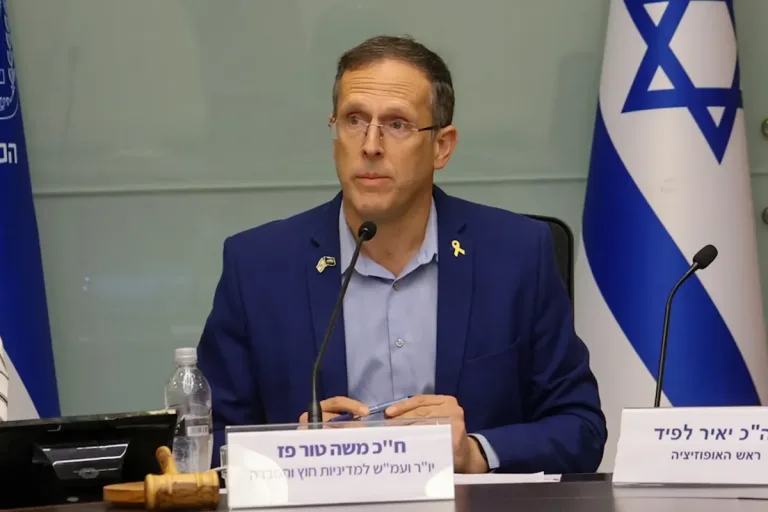
The Subcommittee for Foreign Policy and Public Diplomacy, chaired by MK Moshe Turpaz (Yesh Atid), convened on Sunday for a debate on the economic system in Gaza. The first part of the meeting was held as an open debate, whereas the second part was classified.
The subcommittee asked to learn from representatives of the Ministry of Defense, the Ministry of foreign affairs, the national security Council (NSC), the IDF, and the Bank of Israel about the characteristics of the economic system in Gaza, which includes cash, banking, salary payments, businesses, digital money, smuggling, the international financial mechanisms of Hamas’s overseas network, and more. The subcommittee also sought to examine what the Government’s directive on the issue is, and what steps were being taken to dismantle the economic system in Gaza and Hamas’s network abroad.
Subcommittee Chair MK Turpaz said that based on open-source materials, during the war Gaza received international aid totaling around $7 billion – more than the annual aid Israel receives regularly. This aid was transferred mainly through UN organizations, but also with American funds. He added that Gaza’s economy is intertwined with Israel’s economy, with the shekel being the most common currency in Gaza, and that until October 7, 2023, the Bank of Israel supplied new cash to the Strip to replace worn-out bills.
Subcommittee Chair MK Turpaz further stated that the cost of reconstructing Gaza is estimated at $50–70 billion – more than the total official aid the Palestinian Authority has received since the Oslo Accords. He noted that since June 2010, after the Mavi Marmara incident, Israel has significantly eased the blockade. This, he said, has allowed Gaza’s economy to grow but, consequently, it has also strengthened its terror capabilities.
Ehud Levy, who previously headed a Mossad unit tasked with combatting terrorism through economic means, detailed Hamas’s sources of funding. Among other things, he explained that beyond the well-known “cash suitcases,” Qatar finances Hamas in Gaza and abroad in various ways. Hamas also receives money from Iran, the Muslim Brotherhood, and through internal taxes.
An NSC representative stated that they are aware Hamas has managed through various means to acquire resources and grow stronger, and that consistent efforts have been made over the years to track aid channels and reduce Hamas’s ability to gain power through them. He noted that even humanitarian assistance has contributed to Hamas’s strengthening. Alongside interministerial teams working on the issue, there is an effort led by the NSC focusing on foreign funding routes, he said.
Representatives of the Bank of Israel clarified that Israeli banks do not operate directly with the Gaza Strip, and that existing activity takes place only with banks in the Palestinian Authority. They added that banking activity with the PA is primarily a political and security matter, not an internal decision by the banks.
A representative from the Ministry of foreign affairs reported that since October 7 – and even before then – there has been a directive to prevent Hamas’s empowerment. The ministry focuses mainly on Hamas’s economic growth abroad, tracking fundraising activity and trying to prevent funds from reaching Gaza. Some of the ministry’s efforts include diplomatic campaigns aimed at convincing foreign countries to designate Hamas as a terrorist organization. He noted that until October 7, 2023, some 40 countries had done so, and since then another five joined. Subcommittee Chair MK Turpaz pointed out that this means over 150 countries do not view Hamas as a terrorist organization, calling this a “shocking statistic.”
In conclusion, Subcommittee Chair MK Turpaz said, “An entity that mounts an attack with [the equivalent of] of two divisions, based on intelligence, combining ground and naval forces with artillery, does not operate with just flip-flops and Kalashnikovs; it operates as a quasi-state apparatus, with lots of money – money that was transferred, among other sources, by the State of Israel. The current decisions to reopen the Gaza Strip without determining who will replace Hamas are a large part of the problem. We are in a new and very problematic reality in the Gaza Strip.
“This is not how you run an economic war. The main problem is the lack of decision-making. If you want the Palestinian Authority – then the PA. If you want Egypt – then Egypt. Failure to make a decision means Hamas continues to rule, while Qatar and Turkey enter through official channels. This is what diplomatic failure looks like,” he said.
Related Topics