













Knesset Press Release • January 28, 2026
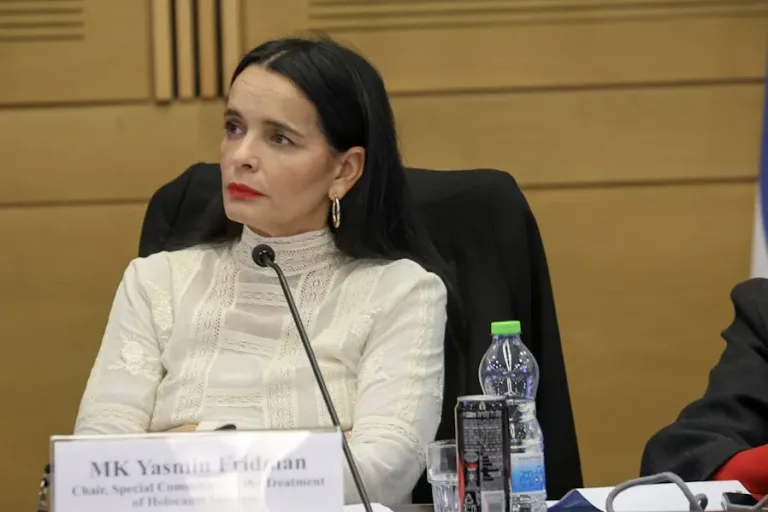
The Special Committee on the Treatment of Holocaust Survivors, chaired by MK Yasmin Fridman (Yesh Atid), held a special debate on Tuesday to mark International Holocaust Remembrance Day, under the banner of “The Jewish Family During the Holocaust – Loss, Remembrance and Continuity.”
Committee Chair MK Fridman opened the debate and said, “For me, as chair of Special Committee on the Treatment of Holocaust Survivors, this day is especially moving. But beyond my public role, this is a human moment – a moment that reminds us that the Holocaust is not merely a chapter in history; it lives in the memories, in the bodies and souls of those who survived it, and it continues to resonate through succeeding generations.”
Gideon Zaira of the knesset Research and Information Center noted that as of mid-January 2026, approximately 111,000 Holocaust survivors and victims of antisemitic persecution live in Israel and receive compensation or an annual grant.
During the debate, three Holocaust survivors shared their personal stories, among them Shoshana Trister, a Holocaust survivor who immigrated to Israel in 1950: “There was no one to help us after the war. My mother made me swear not to tell anyone what we went through, because she said no one would believe what we experienced. Our hostages knew that we have the best army in the world. It took time, but there was hope. There were moments when we lost hope.”
MK Meirav Cohen (Yesh Atid) said, “Holocaust survivors are an important reminder of what we are fighting for. Our mission is to remember and commemorate for the benefit of future generations, and also to allow these people to grow old with dignity in the state of Israel. There are still Holocaust survivors in Israel living in poverty. In the coming days, another state budget will be approved. From here, I issue a clear call: after all that has been said here, the most basic step must be taken – to prioritize the survivors and their rights.”
Shir Levy, a representative of Zikaron BaSalon (Hebrew for “remembrance in the living room”), an initiative operating in Israel for a decade, said, “The initiative enables Holocaust survivors to tell their stories, and allows us, the younger generation, to listen to them. The data presented at the beginning of the committee meeting show how great the responsibility on us, the younger generation, truly is. Each and every one of us must take this memory and continue passing it on.”
Colette Avital, chair of the Center Organizations of Holocaust Survivors in Israel, said, “International Holocaust Remembrance Day is a day on which parliaments, legislatures, and governments around the world try to remember not only the victims, but also the lesson. We constantly hear about antisemitic incidents around the world. Today, we are living with the same hatred that caused the Holocaust, perhaps even greater hatred. We must ask ourselves what we can do to fight this hatred.”
Another Holocaust survivor, who was born in Budapest, Hungary, shared:
“My mother lifted me in her arms, because I couldn’t stand on my legs, and hid me and my sister deep inside the garbage in the ghetto. She told us not to cry or speak until she returned to take us out. My sister and I held hands, cried, and fell asleep. And our mother came back and took us out. I have no idea how she managed to get us out of the ghetto.”
She added that her parents, like all the survivors, can be very proud that they “fought for the land and established communities. Everyone can be proud of the second and third generations. Am Yisrael Chai [the nation of Israel lives].”
Outside the committee hall, an exhibition of paintings was displayed, presenting the perspective of two survivors, Fanny Ben-Ami and Shoshana Trister. At the conclusion of the debate, certificates of appreciation were awarded to the Holocaust survivors who shared their personal stories.
Related Topics