


















Knesset Press Release • July 6, 2025
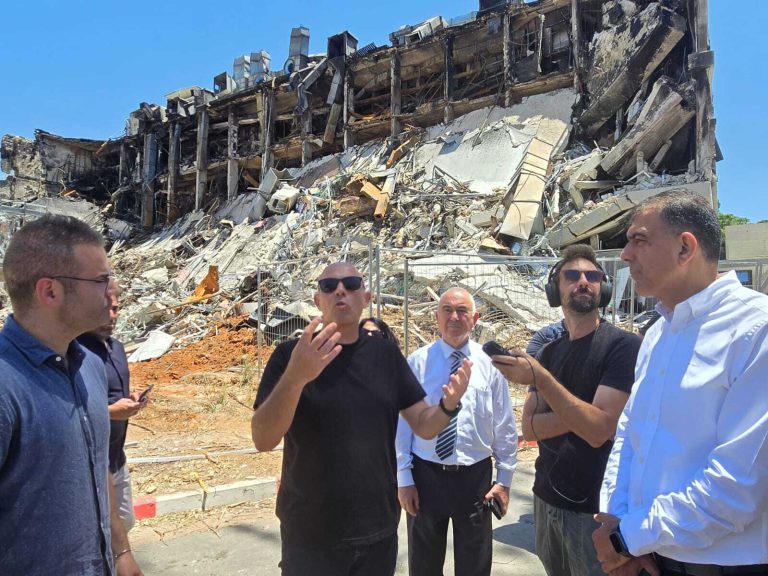
Members of the Science and Technology Committee, chaired by Yasir Hujeirat (United Arab List – Ra’am), toured on Sunday the destruction sites from the Iranian missile attack that struck the Weizmann Institute of Science. The tour was led by the institute’s management, headed by President Prof. Alon Chen, who presented the unprecedented extent of the damage to the committee chair and to MKs Eli Dallal (Likud), Yorai Lahav Hertzanu (Yesh Atid) and Matti Sarfatti Harcavi (Yesh Atid).
During the tour, the committee members were informed that approximately 112 structures on the institute’s campus were damaged. Five structures were severely damaged, including one that collapsed completely. Dozens of other structures were damaged to varying degrees, critical infrastructure was shut down, and 52 research laboratories, along with six service laboratories, were rendered inoperable.
Following the tour, the committee held a meeting in the office of Weizmann Institute President Chen. In the meeting, Committee Chair MK Hujeirat said “Unfortunately, this visit is taking place in the wake of such serious damage caused by an Iranian attack. We would have liked to come here under different circumstances, to see your magnificent work for ourselves. However, we have come here today to express a clear position: the work that is being done here is a national asset for science and technology. The committee will act decisively to ensure that this work continues, grows, and flourishes. We are examining how to repair the damage and ensure adequate funding, because you are at the forefront of the scientific work of the State of Israel. It is no coincidence that you were seen as a target, and we will work tirelessly to support you.”
Weizmann Institute President Chen said, “This is unprecedented damage – estimates range from NIS 1.5 billion to NIS 2 billion. Some of the laboratories were completely shut down as a result of the blast caused by the missile strikes. This is a significant blow to the core of Israel’s scientific research.
“The Weizmann Institute is a national asset – and the attackers viewed us in this way as well. Our sense is that there is now broad and independent support for us, which is essential because this place works for the benefit of the entire world. There is a consensus that we are a beacon of science and innovation, but it is important that this also translates into real support. Current government support accounts for only 20–25% of the budget. We award full scholarships, with no tuition fees. Forty percent of the budget comes from a [savings and investment] fund that was created from patent revenues and philanthropy, and another 30% from the scientists’ own income. This is a unique model that sustains the institute, but it is now under threat. The institute’s annual budget is NIS 4 billion, and we are considered the leading institution in Europe in terms of success in funding research – five times the European average, with a success rate of 63% in the past year – the highest since the institute was founded.
“About 60% of the international researchers left in the aftermath of the Iranian attack, and we believe they will return soon. We do not have a regular government budget for developing or purchasing equipment; everything currently falls on the shoulders of donations – and that is a huge burden. Even before the war, we were working to double our research spaces. Today, we operate 300 research teams, but physical limitations prevent growth – even though there is three times more talent in the country. This is a national interest of the highest order: the state must double the size of the Weizmann Institute, or establish another research institution. Every dollar invested here will yield a tenfold return to the economy. If we are optimistic, property tax may cover 50% of the damage – but we will still need to raise an additional NIS 1 billion. We have already had to exceed the budget and have transferred tens of millions from the fund for reconstruction.
“The time parameter is crucial – we have requested advances for this. Without additional funding, the entire recruitment mechanism will be compromised. Also in terms of equipment, there is no adequate compensation. For example, if we purchased an advanced microscope at a cost of NIS 5 million, it would be valued at only NIS 200,000 due to depreciation – and this gap does not cover the damage to knowledge and capabilities. This is an investment in [the country’s] future, in its scientific base, and in the growth engine of the future generation,” he said.