


















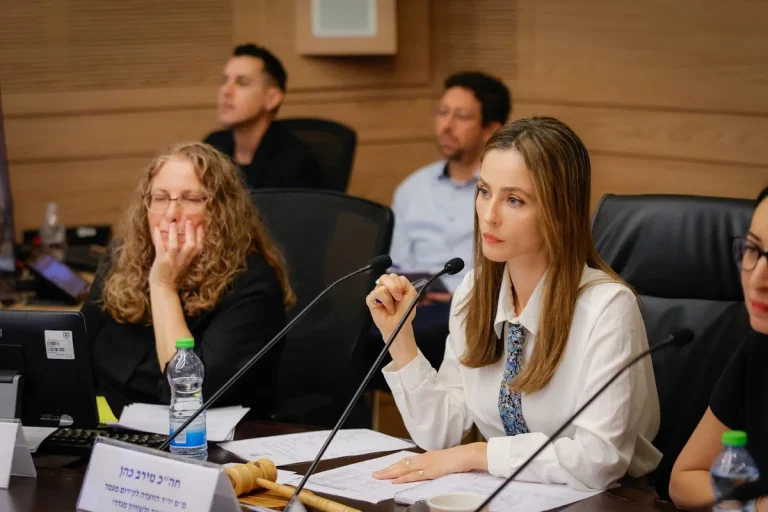
Knesset Press Release • November 5, 2025
The Committee on the Status of Women and Gender Equality held on Wednesday a debate on the topic of proper representation of women in senior positions in the civil service.
MK Meirav Cohen (Yesh Atid), who began her tenure as chair of the committee, opened the discussion by stating: “I chose to begin my term with a topic that is a touchstone of true equality and optimal public service: The representation of women in senior positions in the civil service. This is not just another issue among many. When women are not represented in senior positions, the decisions that are made are less equal, they are made from a limited perspective, and therefore, they are simply not as good. Women in senior positions also have a dramatic impact on how decision-makers relate to women and their status.”
According to her, this reality ultimately affects how bus stations are planned, in terms of lighting and the safety of women standing in them in the dark. “It also affects which medicines are included in the health basket and even which mannequins are used in car crash tests,” she said.
Committee Chair MK Cohen presented the findings of a new report published by the Knesset Research and Information Center, which reveals a bleak reality. According to the report, as of the end of 2024, women make up 64% of the civil service workforce, but the higher the rank, the lower the female representation. “At the top of the pyramid, at the highest levels, the percentage of women is only 9%,” she said. “When we look at female directors general of government ministries, the picture is even worse: In the current government, only two women have been appointed as directors general — 4% of all appointments — and today, there is no permanent female director general. This is not a fate or ‘the way things are’ — it is a choice. If anyone thinks this is an isolated problem, here is an example that shows how systematic it is: In the Ministry of Finance, there are 11 division heads, and all of them are men. The most central position in setting national priorities, the head of the Budget Department, has been vacant for three months because the minister insists on appointing a man, even though the Appointments Committee of the Civil Service Commission has already rejected the appointment three times and explicitly stated that the minister has not acted properly when it comes to seeking women for the position. Just yesterday, the Minister of Finance said that he ‘does not feel good’ about not appointing women. So, Mr. Minister of Finance, I have a way to help you feel better — simply appoint women.”
Jerry Almo Kapital of the Knesset Research and Information Center, who authored the report, noted that as of 2024, 88,000 people are employed in the civil service, including 64,000 women, but their relative share decreases consistently as one moves up the hierarchical structure. “At the senior levels, women are a minority. At the highest senior level (130), only 9% are women, and at level 120, the percentage of women is less than a third,” she said.
Adv. Anat Thon Ashkenazy of the Israel Democracy Institute said, “Since 2003, 246 directors general have been appointed to government ministries, including only 38 women. The Defense, foreign affairs, Health, and National Security ministries have not had female directors general. In the current government, the data on the appointment of female directors general is embarrassing. The significant advantage of women serving as directors general is that women appoint other women. There is a breakdown of male and female ministers, and it is evident that female ministers appoint more women to director general positions, and in general. As the size of the ministry increases, the representation of women decreases.”
Nissim Mizrahi of the Civil Service Commission said, “Today, out of 2,160 senior officials in the civil service, 48% are women. The problem with directors general speaks for itself, and the difficulty in compelling the government to appoint women is greater. Following the High Court ruling, the Civil Service Commissioner issued an interim directive. The Commissioner set very strict guidelines regarding what the committee must examine. Women make up 27% of employees at the highest level.”
Committee Chair MK Cohen asked: “After the High Court ruling, what mechanism did you create to ensure proper representation of women?” Mizrahi responded: “We issued an interim directive on what the committee needs to examine. This requires ministers to interview several women and document the process.”
MK Adi Ezuz (Yesh Atid) said, “Today’s discussion is insulting — it’s so difficult to find women for senior positions, it’s so hard to locate us, find us, and document us. The change has already occurred, and now we are in regression.” Oshra Friedman, Deputy Director General of the Authority for the Advancement of the Status of Women, said, “We had a short time to assist in finding candidates for the head of the Budget Department position. We sent the job listing to 70 women, and only one candidate was unqualified for the role. Once we forwarded the details, we received no feedback. We had two days to find the candidates. For most positions, we have 12 days. It’s not enough just to send a job listing to women, we need to support them and prepare them for the process, and the reasonable time frame needs to be broader.” Eyal Zandberg, head of Public Law at the Ministry of Justice, said, “This is the first time I’ve heard that you had only two days.”
Senior Ministry of Foreign Affairs official Hamutal Rogel Fuchs said, “In the [ministry], there are nine female deputy directors general, equal to the number of male deputies. There are 74 female department heads, far more than the number of male department heads. There are 77 male heads of missions, including political appointments, compared to 22 female heads of missions. We have a lot of work to do in this area. Women have a significant role in diplomacy. Women submit fewer applications for heads of missions. We discovered that the barriers facing women are more numerous. It’s harder for a man to follow his wife abroad, and women are the ones who take care of their parents.”
MK Karine Elharrar (Yesh Atid) said, “We are all surprised that they are unable to appoint women, but what’s the surprise? This is the Knesset with the lowest percentage of women, with 29 female Knesset Members, and in 2025, we have five female ministers, after a government with nine female ministers and directors general. What are we surprised about? It is true that legal advisors provide all the guidelines to appoint women, as ruled by the High Court, but the government does not see legal guidelines as something to rely on; on the contrary. The discussion is not disconnected from what happens in this building, where legal opinions are sidelined.”
MK Shelly Tal Meron (Yesh Atid) said, “It’s clear that professional [back-and-forth] is very important, but what happened this week in this House to female elected officials is a clear example of why women are not at the forefront of decision-making. The mere fact that ministers used severe verbal violence against female Knesset Members, almost physical violence, is something we cannot take lightly. It’s extremely serious.”
Ofra Ash, CEO of Forum Dvorah, said, “Our petition led to change. One of the areas that has the greatest impact is the security sector. In the Foreign Affairs and Defense Committee, there are three women out of 13 members. There one of the 32 members of the IDF General Staff Forum is a woman. We conducted a survey in 2024 on whether a woman could be the Minister of Defense in Israel, and 78% said a woman could be as good as a man, but only 21% believe it will happen in the next 15 years. Over 120 women have served as ministers of defense worldwide.”
Racheli Sonego of the Israel Women’s Network said, “There are zero female directors general, and it is highly unlikely that there will be any legislation to correct this. On the Knesset’s agenda, there are bills aimed at weakening the Civil Service Commission. The small representation of women is being weakened further.”
MK Ezuz said, “There are zero female directors general in government ministries. This government hates women. I cannot participate in a discussion about what women contribute to the role. The Equal Rights Law needs to be amended.”