













Knesset Press Release • July 1, 2025
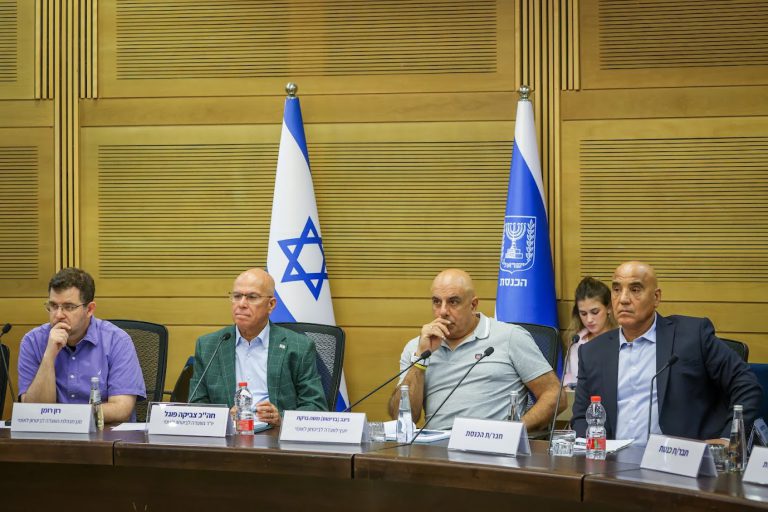
The National Security Committee, chaired by MK Tzvika Foghel (Otzma Yehudit), convened on Tuesday for an urgent debate on the topic of violence and threats against heads of local authorities in the Arab sector, at the request of MK Yoav Segalovitz (Yesh Atid), MK Afef Abed (Likud), former MK Youssef Atauna and MK Gilad Kariv (Labor).
Committee Chair MK Foghel said, “I served for a number of years as the head of the Tuba-Zangariyye Council and experienced firsthand the phenomenon of threats against local government within the Arab sector. When shots were fired at me during my time in office, not a single senior Israeli police official came to investigate the case. If we will not sever this phenomenon in time, we risk paying a very heavy price. As far as I’m concerned, heads of local authorities are symbols of governance and must be protected. Legislation and enforcement must be deepened in order to safeguard them.”
MK Segalovitz said, “Since the beginning of the year, more than 120 Arab citizens of Israel have been murdered. We need attention, funding, and legislation to stop the wave of murders in the Arab sector. The committee must receive detailed reports on the steps being taken on the ground. In recent years, we’ve witnessed a troubling trend of increased threats and violence against heads of local authorities in the Arab community. This phenomenon undermines the foundations of the rule of law, harms symbols of governance and threatens the ability of elected officials to perform their duties properly. Attacks on symbols of governance, whether Jewish or Arab, must be met with a determined and equal response from law enforcement. A thorough approach is needed, including significant enhancement of enforcement and punishment, greater protection for threatened public officials and providing effective tools to local authorities to withstand pressure from criminal elements.”
Sakhnin Mayor Mazen Ghnaim said, “Every year, we break records for murders in Arab society in Israel. When we file complaints with the Israel Police, they claim that they do not have enough personnel — but when there’s a need to demolish illegal structures in my city, suddenly there are hundreds of Yasam (Special Patrol Unit) officers. This situation cannot continue. Fourteen-year-old kids are carrying guns, and the day will come when this violence will spill into Jewish society as well. I receive threats day and night. If there is no fundamental solution to the problem of illegal weapons in the Arab sector, we will all pay the price. How long can this go on?”
Hatem Shibli, head of the Shibli Local Council, said “I am under 24-hour security due to concerns for my safety. The vast majority of illegal weapons in the Arab sector come from the IDF. The Shin Bet (Israel Security Agency) should be involved in preventing violence in the Arab sector. A head of an Arab local authority is the most vulnerable and threatened public figure. We came to serve the public, but criminal elements are preventing us from doing so.”
Rahat Mayor Talal Alkernawi said, “I promised my residents personal security, and I’m failing to deliver. There have been dozens of assassination attempts against me. Just recently, an explosive device was placed near my office in City Hall. I expect the Israel Police to know how to protect me. Public officials and symbols of governance are being harmed. The violence against public officials in the Arab sector also occurs on social media, but not enough is being done to prevent it. In my current term, violence in Arab society is significantly worse than in the past. The Israel Police must be given every power needed to prevent violence in the Arab sector.”
Arraba Council head Ahmad Nassar said, “Local authority heads in Arab society are targets for criminal elements. I want to lead change in Arraba, but some elements in the city oppose it. Criminals are shooting at the new garbage trucks we bought, shooting at my house and at municipal employees. Complaints were filed with the police, but nothing was done. We want to live peacefully and quietly — not under threat.”
MK Hamad Amar (Yisrael Beitenu) said, “I expect the committee chair to demand that the Israel Police send its highest-ranking representatives to discussions of this kind. Local government in Arab society is afraid to do its job. Heads of Arab local authorities live under criminal terror. If they will continue to live in fear, the whole state will suffer. Every murder that solved by the police encourages the next one.”
MK Waleed Alhwashla (United Arab List-Ra’am) said, “The levels of violence and murder in Arab society keep rising. The Minister of National Security is not interested in what’s happening in the Arab sector. We need a government that cares for all its citizens. It’s time for the Prime Minister to make concrete decisions to prevent violence in the Arab sector.”
MK Ahmad Tibi (Hadash-Ta’al) said, “If these were threats or assassination attempts against Jewish heads of local authorities, the most senior officials would have attended the debate. The blame lies with the police and the minister in charge, (MK) Itamar Ben Gvir (Otzma Yehudit). Failure to solve attempted murders will increase the amount of murder victims in the future. The murder of an Arab local authority head is just a matter of time. The police have the tools to eradicate this violence — but they are simply not using them.”
Adv. Rawyah Handaqlu, head of the Emergency Headquarters to Combat Crime in Arab Society, said “We are living in a jungle. In June alone, there were 28 murder victims […] No young person today wants to become a public servant because they’re afraid for their lives.”
Committee Chair MK Foghel summarized the meeting, saying “I turn to the local authority heads and urge you not to be misled and not to bring politics into the [effort to prevent] violence in Arab society. We will continue to deal with this issue, and our next discussion will be classified, with all relevant parties present. I am working to have criminal organizations designated as terror organizations. The solution does not lie solely with the police or the Ministry of National Security, but must come through the cooperation of all parties involved.”