














Knesset Press Release • July 1, 2025
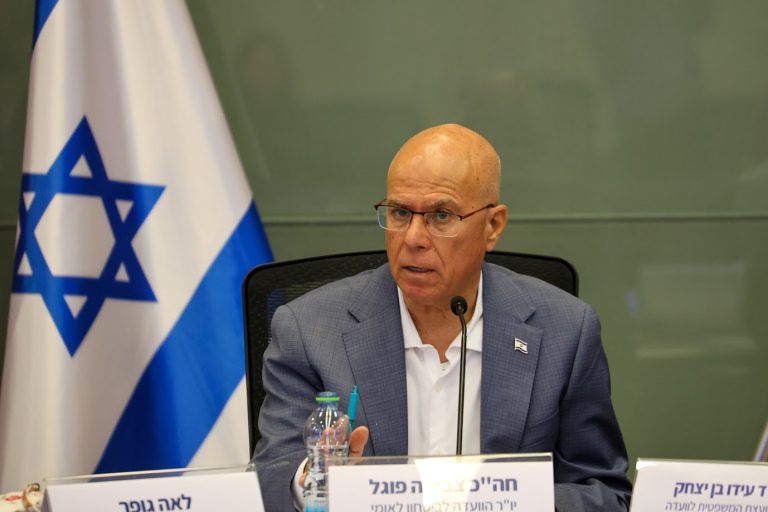
The National Security Committee, chaired by MK Tzvika Foghel (Otzma Yehudit), convened on Tuesday for a debate on the enforcement of the demolition of illegal structures in the Arab sector.
Enforcement of the demolition of illegal structures is a key component in preserving sovereignty, the rule of law, and restoring governance. For years, there has been widespread planning-related anarchy in Arab society, reflected in massive illegal construction while ignoring the authority of the state. In the Negev in particular, illegal construction has become a strategic threat, a basis for serious crime, a hub of criminal activity, illegal seizure of state land, and an obstacle to the implementation of large-scale development plans.
Committee Chair MK Foghel said, “A house that is built illegally cannot receive basic services. Illegal construction represents a lack of governance and we must tackle the problem from its root. The increase in enforcement of demolition orders is a positive and important trend, and a correction to a longstanding distortion. We must ensure that this trend continues and that enforcement elements have all the tools they need.”
Yuval Turgeman, director of the Authority for Development and Settlement of the Bedouin in the Negev, said “We are providing a regulatory solution and an alternative for Bedouins living in the Negev. Today, there are thousands of available housing units to serve as an alternative to illegal construction. In the eastern Negev, excluding Be’er Sheva, over 50% of the area is populated by Bedouins. The main problem has to do with the settlement of unrecognized Bedouin villages outside the legal localities. We try to reach agreements rather than enforce. Most of the unrecognized Bedouin villages can come to us and request to be regulated in the existing localities, but people from the unrecognized Bedouin communities want to settle where they currently live without regard for the land designation. There is a very large gap between the plans we promote and the desires and expectations of the [residents of unrecognized Bedouin villages].”
National Security Council official Vered Polak said, “One of the main national and security challenges facing the State of Israel is the settlement in the Negev. About a third of the Negev’s population is a Palestinian population originating from Judea and Samaria. The biggest weapons smugglers in Israel come from the Bedouin sector. The State of Israel must regulate the Bedouin sector. The state must promote enforcement in support of regulation, as most of the problems in the Negev come from the Bedouin sector.”
A resident of the Bedouin town of Lakiya said, “No Bedouin wants to live in an illegal home. I have been waiting a full year to receive authorization that I meet the criteria for construction. People in Bedouin villages need answers. The issue of home demolitions is very painful for the Bedouin sector. No one wants to live in a house with a leaking roof and no electricity.”
MK Yasmin Fridman (Yesh Atid said, “People in the Bedouin sector cannot submit requests to build legal structures, so it’s incorrect to compare their data to other sectors in Israeli society. I want to understand in this discussion how the demolition of illegal structures contributes to the sense of security in nearby communities. The State of Israel is enforcing heavily without carrying out regulation at the same time.”
Yoni Cohen, Head of the Southern Directorate in the Ministry of National Security, said “Each enforcement body issues orders according to its enforcement policy. The Bedouin population concentrated in the south needs regulation. Enforcement of the old construction is meant to assist in regulating Bedouin society. We are seeing changes on the ground in line with the Minister of National Security’s policy to increase enforcement against illegal construction. The Authority for the Regulation of Bedouin Settlement in the Negev asks us to demolish illegal structures in a number of Negev localities. There has been a very large increase in the issuing of demolition orders and in actual demolitions across the Negev. In 2024, there was an 82% increase in demolitions of residential structures, a 7% increase in orders that were passed on to the Directorate by enforcement agencies, a 47% increase in self-demolitions following preliminary enforcement, with such demolitions making up 71% of the activity. Additionally, in 2024 there were evacuations of 33 housing clusters, compared to only eight in 2023. Since the beginning of 2025, 26 housing clusters have already been evacuated — a very significant increase. Every demolition is carried out with strict adherence to the law.”
A Ministry of Justice official said, “Enforcement alone is not enough — there is a need to promote planning that will reduce illegal construction. We are pushing for approval of plans through the National Planning and Building Council and are taking a range of additional measures to ease the advancement of plan approvals.”
A representative of the Israel Land Authority said, “We enforce property laws and the invasion of state-owned land. In cases of new illegal construction, we issue an administrative order for evacuation. We issue thousands of such orders a year, and if the recipient does not comply, demolition and evacuation take place. In recent years, we have been working hard to increase the number of evacuations of illegal structures.”
Commander Sasson Shlomo, head of the Israel Police’s Yoav Unit, said “In 2024, we cleared over 3,000 dunams that are designated for development. We need to expand the number of personnel positions in order to fulfill our missions in the best possible way.”
Committee Chair MK Foghel concluded the debate: “The State of Israel is a state of law that wants to manifest its governance everywhere. If there will be no cooperation from residents of Arab localities, we will continue to see a rise in demolition of illegal structures. The State of Israel cannot surrender to the wishes of every resident who decides on his own where he wants to live. Members of Knesset from the Bedouin sector do not want regulation of the unrecognized Bedouin villages. Whoever refuses to cooperate with the state in the regulation process, in compliance with the letter of the law, will have to face the enforcement arm of the state.”