
















Knesset Press Release • November 3, 2025
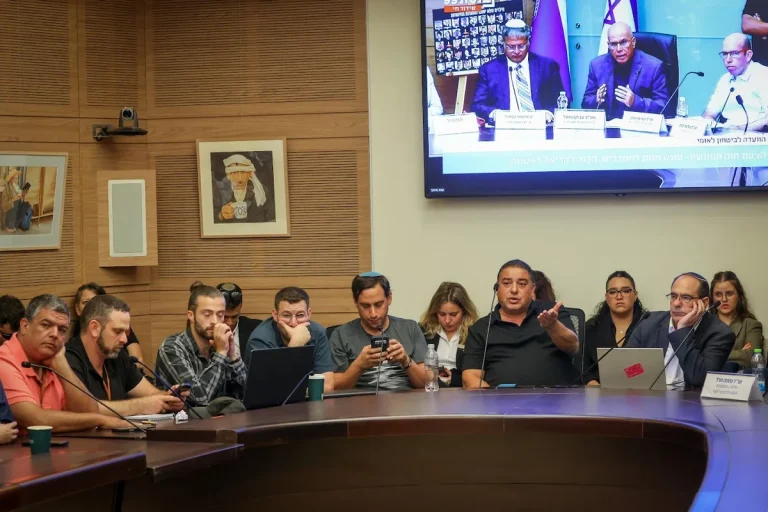
The national security Committee, chaired by MK Tzvika Foghel (Otzma Yehudit), convened on Monday and voted to approve for first reading two bills entitled the Penal Bill (Amendment—Death Penalty for Terrorists). The debate held on Monday was an additional debate (part of which was classified) on the bills, after in the previous debate they were approved for first reading despite the objection of the committee’s legal team. The Penal Bill (Amendment—Death Penalty for Terrorists), 2023, sponsored by MK Limor Sonn Har Melech (Otzma Yehudit), and another bill sponsored by MKs Oded Forer, Avigdor Liberman, Evgeny Sova, Sharon Nir and Hamad Amar (Yisrael Beitenu) were approved for first reading by the committee, but were not merged.
The explanatory notes to the bill state that its purpose is to curtail terrorism and create a weighty deterrent. It is proposed that a terrorist who is convicted of murder from a motive of racism or hostility against a population, and under circumstances in which the act was committed with the aim of harming the State of Israel and the national revival of the Jewish people in its land, will be sentenced to a mandatory death penalty. This will be neither optional nor with [judicial] discretion. Additionally, the bill proposes that it will be possible to impose a death sentence by majority opinion, and that the penalty imposed on a person who was given a final sentence cannot be commuted.
Adv. Ido Ben-Itzhak, the committee’s deputy legal advisor, presented a position with regard to the various issues in the bill and the difficulties that they pose. Among other things, he commented on the inability to rectify the legal procedure after the sentence is carried out, and the fact that the bill not only does not propose a higher evidentiary threshold, it proposes to make the penalty mandatory, without discretion, and proposes to stipulate that the panel of judges will be able to impose the sentence by majority opinion and not unanimously. Adv. Ben-Itzhak said in summation that if the committee should decide to advance the bill, it is necessary to clarify the wording of the first section, which amends the Penal Law, to omit the end referring to “harm to the national revival of the Jewish people in its land,” and include in it provisions enhancing the evidentiary requirements allowing a death penalty to be imposed. As for the second section, he stated that there was a difficulty in the two revisions proposed in it, and said that the recommendation to the committee was not to approve it.
Gal Hirsch, Coordinator for Hostages and Missing Persons in the Prime Minister’s Office said that in the previous debate he had voiced adamant opposition to even holding the debate, and to dealing with this issue, due to the unequivocal danger that was posed to the living hostages. “Since the living hostages are here [in Israel], the objection I raised in the previous debate has been rendered unnecessary,” he said. Hirsch said that the Prime Minister was in favor of the bill. “I see this bill as a tool in the toolbox that enables us to [wage] the war on terrorism and free the hostages,” he said. Hirsch requested that the Coordinator for Hostages and Missing Persons and the security services have the right to turn to the court and submit a classified report to them before the ruling is handed down.
Minister of National Security MK Itamar Ben Gvir (Otzma Yehudit) said in response that there would be no discretion in this bill. “The doctrine has changed. Everyone admits that a death penalty for terrorists law can deter, and as soon as you grant discretion, you diminish the deterrent effect. I want their motivation to kidnap to disappear, and as soon as a terrorist who has murdered knows that he falls under the death penalty law, there will be no questioning and deliberation here, and that reflects the change in the State of Israel’s security doctrine. Let every terrorist who goes to murder know that he can expect one penalty—the death penalty.”
MK Sonn Har Melech, who sponsored one of the bills, said that the outline proposed in the debate conveyed a terrible message, because the enemy knows how to read laws and would take advantage of this. “In any case, the judges’ motivation today is not so high to reach a proceeding that concludes in a death penalty. The legislation should be clear and unequivocal. A dead terrorist will not return to terrorism and to the cycle of blood, and certainly will not be freed in a terrorist deal,” she said.
MK Forer, a sponsor of one of the bills, said that this was not legislation [motivated by] revenge, but rather by deterrence and punishment. “This legislation is necessary for the State of Israel’s security. This is not a populist event, and I have been advancing this bill since 2016,” he said.
MK Gilad Kariv (Labor) said that the debate on this bill should not be held by the committee. “I am opposed to the bill, which goes to the highest extreme in every respect, beyond my principled opposition to the death penalty. This bill is unbefitting for the book of laws in a Jewish and democratic state,” he said.
Minister of the Negev, Galilee and National Resilience MK Issac Wasserlauf (Otzma Yehudit) said that the bill should be clear—that the sentence is not the judge’s choice. “There is guilty or innocent. If he has been found guilty, then it is an automatic execution. Those who murder us will know that we will settle the score with them. I am not afraid of the word revenge. This is of very important value,” he said.
Committee Chair MK Foghel said in summation that the conception that had accompanied us for a very long time had collapsed and vanished. “When we implement the death penalty, the world will be cleaner and safer. This will not prevent the last of the terrorists [from acting], but even if it saves the life of one Jew, the bill is worth it. And it was said correctly that a dead terrorist will not be freed, either in a deal or otherwise,” said MK Foghel.
After a vote and rejection of motions for a renewed debate, the committee voted to approve the bills for first reading and they will be turned over to the knesset Plenum.