














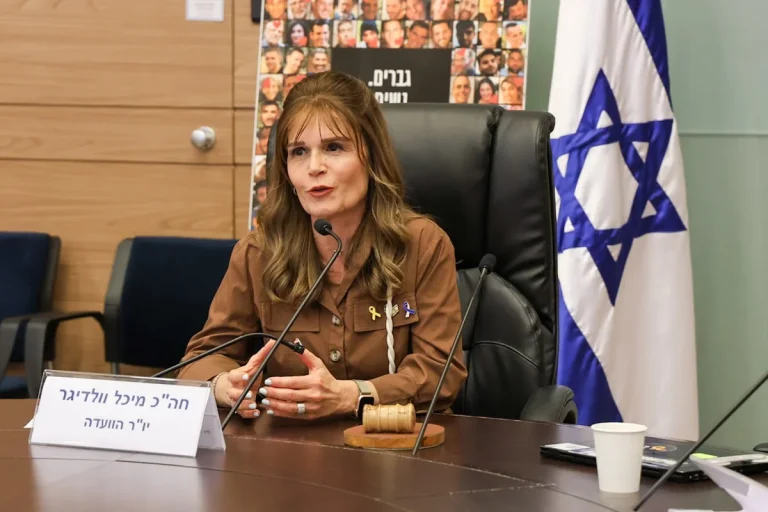
Knesset Press Release • September 15, 2025
The Labor and Welfare committee on Monday held a debate on the topic of suicide prevention and treatment. At the opening of the discussion, committee chair MK Michal Woldiger (Religious Zionism) said “Since the outbreak of the war, we are seeing a sharp increase in the number of requests for help, in the sense of distress, and in the number of suicide cases—both in civilian society and among IDF service members. Already in previous discussions, we warned of gaps in the areas of identification, prevention, and treatment, but matters were not advanced and improved sufficiently.
MK Woldiger called on representatives of the Ministry of Defense and the IDF to expedite the publication and implementation of the conclusions of the Almoz Commission, which examined the support provided to discharged soldiers and reservists in the areas of mental health support and suicide prevention.
The first part of the debate focused on suicide prevention among IDF soldiers. Combatants coping with post-trauma and family members shared with the committee the difficulties they face and suggested solutions for improving support and preventing further suicides. Among other things, many called on the army to accompany and monitor the mental state of soldiers not only during their service but also after discharge and between tours of reserve duty.
The fighters described the difficulty of returning to normal civilian life after traumatic experiences, especially given the ongoing fighting and the possibility of being called up for another round of service.
Shlomi Damari, a physically and mentally wounded combat veteran representing an organization of IDF reservists, said “Every IDF fighter knows that if they take a bullet in the leg, a tourniquet will be applied, but when a bomb explodes inside the soul, there’s no solution. When an incident takes place and a team comes to evacuate the dead, no mental health officer arrives with them. No one approaches the soldiers who just saw indescribably horrific sights. There must be mental health officers within the units—someone permanent who talks to the fighter during operations and in between. This injury is real. Just as you don’t release a person with a hole in his leg to bleed to death, we cannot release a person with such an injury—because then we no longer see them, and sadly afterwards we see them in obituary notices.”
Ido Gal Razon of the Fighters for Life organization said, “It makes no sense that fighters returning from battle are given only a phone number to call, but no one who physically comes to them when needed. A national authority must be established for suicide prevention among fighters returning from combat. Combat PTSD raises the risk of suicide by tens of percent. People cannot function. If we do not go into the field, meet the person, see how he lives, what’s happening with his family—we won’t be able to solve the problem.”
Tom Wasserstein, brother of reservist Roi Wasserstein, who took his own life this past July while he was between tours of duty, said “My brother served over 300 days evacuating wounded and fallen soldiers, and was exposed to extremely traumatic events. They let him return home without requiring him to attend processing days. He went right back to studies and work. Until the day he took his own life, we never thought it could happen. There is no guidance—not for commanders, not for the family, not for society—on what to look for, what signs to notice. Some mental health officers do their jobs faithfully, and some just brush it off. In Roi’s case we contacted a mental health officer, who said he checked and everything was fine. Later it turned out it was just a WhatsApp message.”
During the discussion, several shell-shocked soldiers threw a large quantity of medication onto the committee table, crying out against the lack of adequate treatment for combat trauma and the lack of sufficient funding. One fighter warned that the upcoming holiday season could be especially difficult and lead to further suicides.
MK Sharon Nir (Yisrael Beitenu) said, “It is the duty of the State of Israel to be a strong wall for those brave fighters who risked their lives for us and defended us. If they experience a combat reaction so intense that it causes dysfunction and even suicidality, it is our obligation to be there for them.”
According to data presented by IDF representatives at the discussion, in 2024, 24 service members—soldiers, active reservists, or career personnel—took their own lives. In 2025, the current figure stands at 18. However, it was emphasized that these figures do not include cases where the act occurred after discharge or between tours of reserve duty.
It was further reported that the Combat Reaction Unit is currently treating 650 people. Last week, a northern branch was opened, expected to increase capacity to about 1,000 soldiers simultaneously, and in early 2026, a southern branch will also open. The average wait time for an assessment call is one week, and about a month for treatment, with prioritization based on urgency.
Lt. Col. Dr. Carmel Kala, head of the Clinical Branch in the IDF Medical Corps “Hundreds of mental health officers and reserve mental health officers have been deployed in all units to provide an initial response within the units. There is a dedicated center for conscripts, called Ta’atzumot, which treats combat reactions. There is a center for career soldiers’ families, which provides support to permanent service members and an expanded package for fighters. The Combat Reaction Unit provides treatment to soldiers and reservists released from active service without conditions or recognition requirements. The treatment includes individual therapy, group therapy, psychological therapy, assistance with recognition processes, and psychiatric care. Referral to the Combat Reaction Unit is made through an online form, by phone, or via the Casualty Department. In addition, there is a 24/7 hotline for regular and reserve IDF soldiers.”
Shifra Shahar, CEO of A Warm Home for Every Soldier, said “The state has not yet woken up, and currently it is the NGOs that are bearing the burden. In the U.S., after the Vietnam War, there was a similar situation—people were ashamed to seek help, they were pushed to the margins, until in 1979 Congress made it a national issue and turned things around within three years. An excellent work plan was implemented there. It costs a lot of money, but the state has not yet placed this at the top of the national agenda.”
The second part of the discussion dealt with prevention and treatment of suicides among civilians. Representatives from the Ministry of Health, the police, as well as NGOs and social workers reported on ways of addressing the phenomenon and on future programs.
At the conclusion of the discussion, committee chair MK Woldiger said: ”Alongside the many difficulties and challenges of this period, today we heard from many people who are doing important, difficult work to confront the phenomenon of suicide in both the military and civilian spheres. Much work remains, and it is complex. I expect the government ministries, the health maintenance funds, and the IDF to act with full force so that the numbers will decrease. The vast majority of cases can be prevented—if we will only know how to identify the signs, locate the person at the critical moment, and show him that he is not alone.”