









Knesset Press Release • July 14, 2025
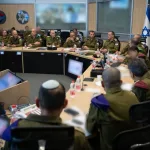
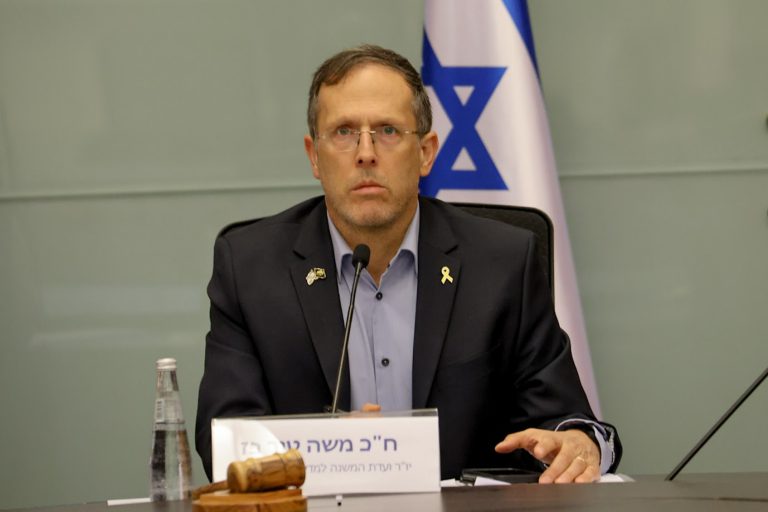
The Subcommittee for Foreign Policy and Public Diplomacy, chaired by MK Moshe Turpaz (Yesh Atid), convened on Monday for a debate on public diplomacy in the wake of publication of the Dinah Project’s report on Hamas’s sexual crimes.
In the debate, testimony was presented by Ilana Gritzewsky, a former hostage and partner of Matan Zangauker, who is currently being held in Gaza. She said, “I am a woman who was kidnapped, survived and returned to serve as a voice for those who are still in hell, and for those who were murdered and no longer have a voice, and for those still don’t have the courage—and I won’t be silent. I am one of those who are described in reports with graphs and headings, but these things are engraved in my body.
“When I came to Israel 16 years ago, I was a teenager. I came here from Zionism, from the love of the country, of this people. I came to a country of solidarity, of mutual responsibility, of one simple promise, that if you fall someone will pick you up, if you’re taken then someone will bring you back, and if you’re trampled then someone will fight for you.
“But today, after everything I have been through, after everything we have been through, I ask you—where is that promise? Where is that someone? It has been six hundred and forty-seven days, and no one has brought back my Matan and all those who remain there.
“I was a captive for fifty-five days; fifty-five days of indescribable hell, endless pain and bottomless humiliation, fear that scorches from within. My body suffered but my soul was crushed.
“I remember a gun pressed to my head, I remember them laughing as they dragged me and pulled me by the hair, I remember dirty hands stealing from me everything that I was before. I became property, I became a captive that people could come and touch and leave me in my underwear whenever they chose,” said Gritzewsky.
Prof. Ruth Halperin-Kaddari, head of the Rackman Center and one of the report’s authors: “Our initial goal was to issue [the report] in English so that all the international institutions to which we are directing our words would be able to become involved immediately.
“Our vision and our main objective from the start was to combat denial. We found ourselves stunned by the silence of most of the international human rights organizations. At a fairly early stage we understood that October 7 was a test case for the coping of the world, the international justice systems, the international institutions—every time that this atrocity occurs of sexual violence as a tool of war.
“This immunity is not unique to the Hamas terrorists, it exists almost all over the world. So our message is universal, it is intended both inwards, to those who are in charge of prosecution, and outwards, to the international institutions,” said Prof. Halperin-Kaddari.
Retired judge Nava Ben Or, one of the report’s authors: “If there is any need for an explanation of why we embarked on the Dinah Project, it lies in Ilana’s statements. During our work, we understood that we were looking at a completely different phenomenon from ‘ordinary’ sexual offenses, which is a phenomenon that we had dealt with for many years. We thought that we knew everything about sexual offenses, but when October 7 arrived we understood that we didn’t know anything. And this is a phenomenon that requires a completely different attitude.
“This is a phenomenon that is part of a campaign that aims to dehumanize the population being attacked, part of an act aimed at genocide. It is directed not only against the direct victim, but effectively against the entire community that is attacked. That is the meaning, the desire to harm the living core of humanity. The symbol of life and vitality is turned into a symbol of death; ‘you won’t survive.’ That is why it is so important to make present what happened and to prosecute,” she said.
Adv. Col. (res.) Sharon Zagagi Pinhas, the former IDF Chief Military Prosecutor and one of the report’s authors: “We have almost no testimonies, because on October 7 most of the victims were murdered, and even those who survived are silenced because of the trauma. Most of the stories come from people who returned from captivity.
“If we look at this as regular sexual violence, we won’t be able to secure convictions and the perpetrators will have complete immunity. We aren’t asking to change evidentiary rules; [we want] to use existing rules, but to change the need for reliance on the victim’s testimony. Contrary to ordinary sexual offenses that are usually committed secretly, in this case the acts were committed publicly and openly, in order to harm the community and heighten [the harm]—and this should serve as evidence,” she said.
Gal Ilan of the National Public Diplomacy Directorate: “This is an important and significant project that serves as a significant public diplomacy tool for us. The campaign was disseminated by all the means we have as a state.”
Ministry of Foreign Affairs official Jonathan Barel: “The ministry has been dealing with the issue of [gathering testimonies on] the sexual violence by Hamas since October 7. Even before the report was published, we established contact with its authors. At the minister’s instructions, we launched a powerful campaign to disseminate the report and heighten the exposure, both through paid advertising and through the ministry’s official channels, and in cooperation with civil society organizations.”
Chief Supt. Mirit Ben Mayor of the Ministry of National Security: “The State Attorney’s Office is called upon to show legal courage that has not been required of us until now, and to give broad interpretation with regard to sexual violence. Despite the fact that we don’t reveal testimonies during an ongoing investigation, we sent a representative of the police to the UN with testimony of an eyewitness, because of the urgent need when we saw that the world wasn’t paying attention to this, and then an opening was created and [the media] started to cover it around the world.”
Lt.-Col. Nadav Shoshani, International Spokesperson at the IDF Spokesperson’s Unit: “The IDF is not at the forefront of this issue, but behind the scenes the IDF is doing everything it can, including gathering testimonies. It also allowed the media to go into certain areas for the purpose of coverage. The IDF has also assisted various bodies, and we will continue to do so.”
Subcommittee Chair MK Turpaz said in summation, “The committee will address a letter to the UN Secretary General ahead of his decision, so that he will blacklist Hamas. The committee calls upon the government ministries to continue to increase the use of this important report. The committee requests that the Ministry of Justice and the State Attorney’s Office make use of this tool and employ it to secure convictions. The committee believes that the voices heard here do not have sufficient resonance in the public space.”