















Knesset Press Release • July 10, 2025
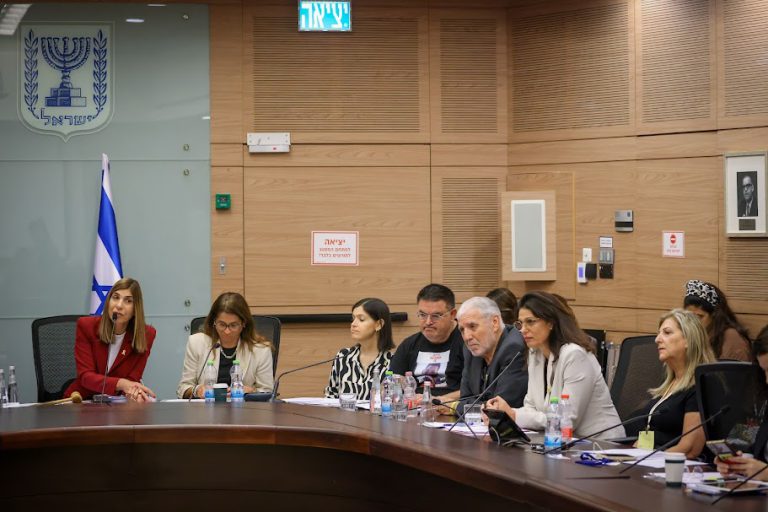
The Foreign Affairs and Defense Committee convened on Tuesday for a quick debate on the topic of calling up PTSD sufferers for reserve duty. The debate was held at the request of MK Efrat Rayten Marom (Labor), who wrote in the request that according to an investigative report published by Haaretz, the army calls up for reserve duty many soldiers who suffer from psychological injuries. It was reported that a Ministry of Defense official estimated that “among the tens of thousands of soldiers who reported for reserve duty over the past two weeks, there are hundreds of people with psychological injuries… perhaps even thousands.”
According to the report, none of the relevant agencies—the IDF Manpower Directorate, the IDF Medical Corps’ Mental Health Department and the Ministry of Defense Rehabilitation Department—hold information with regard to the number of people with psychological injuries who were called up for reserve duty. A military official said that the IDF does not keep records on the total number of people with psychological injuries who are currently under the care of the Rehabilitation Department. Moreover, the investigative report shows that the IDF does not have records on soldiers who were recognized as disabled veterans due to mental health issues in the past.
The reports show that that the Ministry of Defense has not transferred information to the army regarding the injured veterans under the Rehabilitation Department’s care since March 2024, and that the information transferred was partial, and did not indicate the fitness of the injured veterans to serve in reserve duty. It was also reported that an officer in the Manpower Directorate admitted that proposals raised with the aim of coping with this problem were rejected for personnel considerations.
MK Rayten Marom stated further, “The fact that soldiers are sent into the battlefield who suffer from serious psychological injuries is unreasonable to an extreme degree. Their return to warfare could increase their morbidity and its symptoms, as well as the risk of suicidality. The statistics show an increase in the number of suicides by soldiers, along with an increase in the proportion of people with psychological injuries among the total number of injured.”
Jenny, mother of Eliran Mizrahi who had taken his own life, said in the debate, “My name is Jenny and I’m the mother of Eliran Mizrahi, a hero of Israel, a brave combatant, beloved son and father, a dear friend who took his own life a year and a month ago, on June 7, 2024, with two shots to the head.
“Eliran was an alpha male with a huge heart and an even greater soul; a devoted family man with a professional and satisfying job, a promising future and a promotion in the offing. He had sweeping charisma and lots of friends, and he was always the heart of every event.
“He was the complete antithesis of the profile of a person who was liable to commit suicide, but even these strengths weren’t enough to stop the PTSD. After 187 days of active and intensive reserve duty at the heart of the war in Gaza, Eliran came home a different person. Eliran was a dedicated and committed reservist, a professional of the highest caliber, a tactician who played a significant part in the warfare.
“In the first days of the warfare, Eliran participated in the evacuation of Route 232 and in the area of the Nova music festival in Re’im. This was a highly traumatic experience that left a profound and weighty impression on him, and apparently an irreversible one.
“Eliran returned home, but he didn’t succeed in getting back to himself. Eliran came out of Gaza, but Gaza did not come out of him. We saw a change, but we didn’t observe and understand to what extent the pain was deep and strong in Eliran’s heart. He concealed and put on a brave face, saying that everything was fine, while inside he was broken to bits.
“I am standing here as a mother in pain to cry out what is obvious—we must not call up combatants suffering from post-traumatic stress for reserve duty. This is not heroism and it’s not necessary, this is a danger, a bomb that will blow up in our face,” Jenny said.
Col. Dr. Yaakov Rothschild, commander of the IDF Mental Health Center: “Since the start of the war, 1,135 people have received a mental health exemption from reserve duty and regular service due to PTSD. In addition, there are service personnel who have received an exemption from reserve duty due to other psychological issues.
“We treat with gravity all information that reaches us. The only consideration that is weighed is the medical professional consideration, and decisions are made on this basis only. I am in charge of the mental health services, under which about 1,000 mental health officers in regular service and in reserves operated throughout the war. There is an order stating that a service member must report any change in his medical condition, and we pay attention to every medical information that arrives. It’s not necessarily people who have only reported a medical diagnosis they received, but also people who reported signs of distress.
“We encourage combatants to reach out, to report and treat mental health issues. In this context, we have posted mental health officers who are deployed at a high level of availability in the field, and that has proven itself. In addition, warfare processing practices have been introduced, which have become part of the protocol. This also enables the mental health officer to see the people. In every large system there are irregular cases in which the conduct was incorrect, and we learn from them and improve. There is also a new order on this issue for commanders, and we teach commanders and friends how to identify signs of distress.
“The Medical Corps invests many resources in the mental health field, and very significant measures are taken, within a war that is without precedent. Along with this, synchronization work is being done with the Manpower Directorate to improve coordination, and for information to be transferred. If an individual demands to report for duty despite his condition, then there is a certain measure of autonomy, up to a certain limit. The professional opinion is the deciding factor.
“We know from studies that one of the only things that prevent chronic morbidity is maintaining permanence and continuity, so it’s all right that some of the PTSD sufferers continue to serve, but up to a certain level, and depending on the case and professional scrutiny,” said Col. Dr. Rothschild.
According to information provided by the Ministry of Defense Rehabilitation Department, the department has received since the outbreak of the war about 19,000 injured men and women from the IDF and the security forces. Over 10,000 of these are coping with mental health responses and PTSD. In addition, there are over 7,500 new cases who are coping with psychological injuries from past wars. As of today, the Rehabilitation Department handles about 80,000 injured IDF veterans from all of Israel’s wars, and over 30,000 of them are coping with mental health issues.
Guy Gilad of the Ministry of Defense Rehabilitation Department: “The Rehabilitation Department takes care to transfer to the IDF Manpower Directorate ongoing information on soldiers who have been recognized [by the department] or are in a recognition procedure. [The army] has to know the medical condition of each reservist and to ensure that he is indeed suitable to the military post to which he was called up, and medically fit to perform his duties. It’s important to understand that an injured person with mental health issues who is called up for reserve duty stops the treatment continuum and his rehabilitation is harmed.”