









Knesset Press Release • October 29, 2025
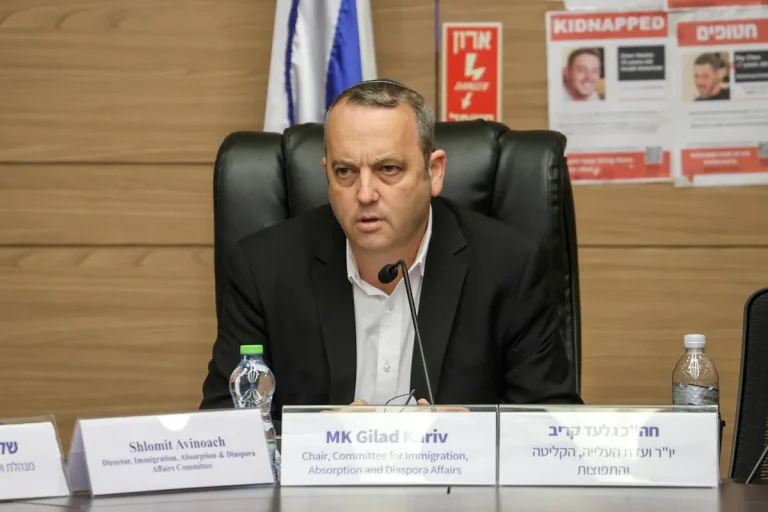
The committee for Immigration, Absorption and diaspora affairs, chaired by MK Gilad Kariv (Labor), convened Wednesday for a follow-up debate on the emotional and mental distress of new immigrant children and the state’s response to their needs.
This week, the Ministry of Education marks Aliyah Week in recognition of Aliyah Day, which is celebrated today according to the date set by law – the 7th of Cheshvan. In a discussion held at the beginning of September, the mother of 12-year-old Milena Bobkova shared the painful events that led to her daughter’s tragic act of suicide.
In Wednesday’s debate, Committee Chair MK Kariv said “Milena should have blossomed and put down roots in Israel, but that didn’t happen. We will continue to focus on providing mental health support for new immigrants, with an emphasis on teenagers. We need to refine procedures and strengthen efforts across all relevant ministries. We will hold a follow-up debate in a month. There are municipalities with a very large number of immigrants in schools under their jurisdiction, and we need to tailor solutions in the most optimal way. We are calling for the establishment of an inter-ministerial team to coordinate all relevant parties to improve the situation for immigrant children. We are not seeing a proper learning process from the Ministry of Health regarding this incident. A teacher in Israel should not have to know how to treat a pupil who has been released from psychiatric hospitalization – there needs to be proper support from all responsible organizations and ministries.”
MK Vladimir Beliak (Yesh Atid) said, “The follow-up meetings that this committee holds are valuable. Our parliamentary monitoring leads to tangible results. The child studied in the Israeli education system.”
MK Yosef Taieb (Shas) said, “The responses provided so far, which will improve in the future, are good but not enough. When dealing with mental health for new immigrants – it should be in their native language. As Members of Knesset, we should set an example for the entire Jewish people on how to address the immigrant community in Israel. As a coalition member, I say that we need to learn how to talk to each other.”
The Ministry of Health noted ahead of the meeting that the initial investigation process, which included data collection and an initial inquiry, has already been completed. Several important issues were raised during this process and will be brought before an inquiry committee of the Ministry of Health, which will operate under Section 21 of the Patient Rights Law, 1996.
Ministry of Health official Yonatan Amster said, “A review committee has been established in the Ministry of Health. This process could take several months. There are already appointed members for the committee, and it will begin its work soon. A preliminary examination of the incident was carried out, and it revealed initial findings that I cannot disclose here.”
The Ministry of Welfare and Social Affairs stated that an emergency multidisciplinary committee on suicide prevention has been convened to enhance coordination among all relevant authorities dealing with the treatment of immigrant children and teenagers, and to minimize and prevent high-risk situations whenever possible. As part of inter-ministerial work between the Ministry of Welfare and Social Affairs and the Ministry of Health, a subcommittee was established about a year ago to focus on mental health for children and teenagers. A structured work procedure has been formulated to regulate and create a continuous treatment pathway for children and teenagers in anchor frameworks and post-hospitalization settings.
In a response submitted to the committee, the Ministry of Education stated that lessons on resilience and seeking help have been integrated into all stages of education as part of a spiral program, adapted to developmental stages and the characteristics of various communities and sectors. The “Choosing Life” program was expanded in 2023 to 3,000 ninth-grade classes. Support and training are provided to psychologists who conduct risk assessments and provide culturally appropriate treatment for immigrant populations. Guidelines have been distributed to Educational Psychology Service personnel to expand emotional support for new immigrant pupils who display emotional difficulties, using additional resources allocated to these counseling services.
Ministry of Education official Michal Englert said, “The education system is a cornerstone for functional continuity and building identity, a sense of belonging, and a sense of capability. We will continue to refine the support services for all immigrants integrated into our education system. When we encounter distress among students in the education system, the initial inquiry is carried out within the internal circles, and then, according to the need, we conduct a risk assessment. On average, we perform 3,000 suicide risk assessments each year. At the start of each year, we inform teachers about potential signs of distress among pupils, with a focus on immigrant pupils.”
Ministry of Education official Carine Barda said, “In the education system there are about 48,000 new immigrant pupils from kindergarten to 12th grade, spread across more than 6,000 educational institutions. We must strengthen the native language of the immigrant pupil. We have distributed a document to all schools in Israel stating that immigrant pupils should not be prohibited from speaking their native language.”
Concluding the debate, Committee Chair MK Kariv said, “The committee calls for the immediate establishment of an inter-ministerial team to clarify the boundaries between the various authorities. We will send this request to the directors-general of the relevant ministries. We want to understand what mandate the committee that will be formed in the Ministry of Health will have. We ask to know what the procedures are regarding the release of minors from psychiatric hospitalization. We ask the Ministry of Education to update the procedures for speaking the native language of new immigrant pupils. In the next follow-up debate, we will focus on the educational system in the cities absorbing the immigrants. We ask the Ministry of Education to provide in the next follow-up debate the educational programs for integrating new immigrants. We want to know how many Russian speakers there are in the school counseling services, and we also request the procedures for working with the mental health system. I want to know if the Ministry of Aliyah and Integration, in collaboration with the Ministry of Education, is maintaining a support center in various languages for the parents of new immigrant pupils.”