















Knesset Press Release • August 14, 2025
The 2025/26 school year is due to open in two and a half weeks, with 2.5 million schoolchildren slated to attend the education system, including children in day-care centers. A total of 27,407 educational institutions are scheduled to open, including 5,807 schools and 21,600 preschools.
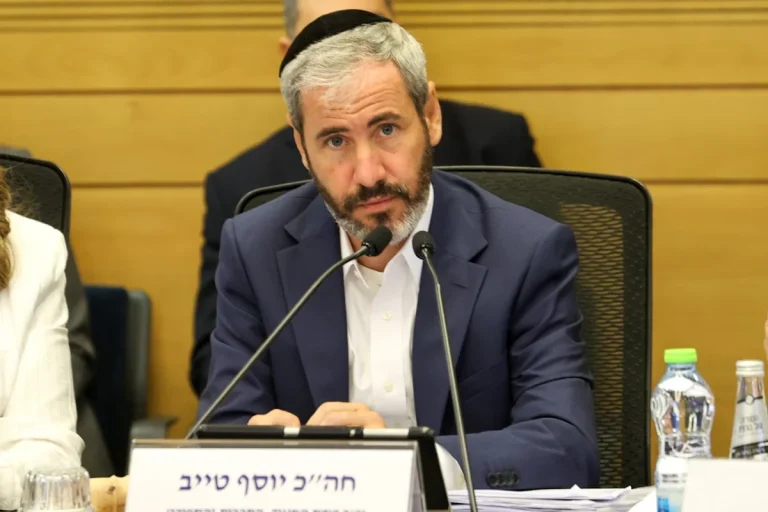
The Education, Culture and Sports Committee, chaired by MK Yosef Taieb (Shas), convened on Wednesday for a debate on preparations for the coming school year. At the start of the debate, Minister of Education Yoav Kisch voiced a threat with regard to the start of the year: “Without security for educational institutions, we won’t open the school year, because until now the security for the first quarter hasn’t been budgeted. The budgeting is supposed to be finalized between the Ministry of Finance and the Ministry of national security. If we don’t work for even a single day, that is already more than the required budget for the period in question. The responsibility lies in the hands of the Ministry of Finance and the Ministry of National Security.”
committee chair MK Taieb supported the minister’s position, saying, “After October 7, how can parents leave their children without security?”
Zohar Orman Yehezkel of the Ministry of National Security said about the lack of budget for providing security for educational institutions, “The money is finished. There’s no more money. The gap was created during the preparation of the budget, while Minister Haim Katz served as the substitute minister. The Minister of National Security is working to resolve the problem.” A Ministry of Finance representative said that discussions were being held between the Ministry of Finance and the Ministry of National Security, and that the issue had not been finalized.
A key issue that was addressed in the debate pertained to the Shapira Committee, which examined the special education issue and presented its conclusions, namely: Top priority for early childhood, ongoing training of educational staffs, reducing the size of the classes to 19 students per class and a transition to a five-day school week. Minister of Education Kisch said that he and the Ministry of Education supported the Shapira Committee’s conclusions. “The committee’s recommendations require an investment of NIS 15 million, but it’s worth it in terms of the cost-benefit analysis. In any case, it’s not an initiative that the Minister of Education can launch on his own, because it’s filled with complexity and challenges. This is a mega-event that requires a comprehensive initiative. I’m glad to say that my demand from the Government was accepted and a team headed by the director general will be formed for implementation of the conclusions,” said Minister Kisch. committee chair MK Taieb called unequivocally to adopt the conclusions of the Shapira Committee.
Ministry of Education Director General Meir Shimoni said, “The shortage of teachers will not be dramatic relative to last year. The focus will be in Tel Aviv, and in a few municipalities in central Israel. The problem is not only the teachers who are lacking, but also the quality [of the existing teachers].” He also told about successful retraining programs for teachers: “A webinar held yesterday was attended by most than 210 officers from the Israel Air Force, who inquired how they could enter [the system] and make a difference.” As for the shortage of teachers, the minister said that there was no shortage in the Arab sector and in the periphery, but rather closer to central Israel.
Representatives of the Manhigim (Leaders) organization said that there was a shortage of several dozen school principals. Director General Shimoni replied, “This is from a total of 5,700 principals, and the numbers will drop as we approach the start of the school year.”
Minister Kisch also addressed the Ofek Hadash program for teachers in Haredi society: “The Ofek Hadash program isn’t happening in Haredi society. We have failed in this initiative. The Attorney General posed many difficulties, a large share of which stem from a worldview that opposes the Government. The attempt to obstruct Haredi society is a severe mistake, in my opinion. There was an opportunity here to elevate all of the education in Haredi society, and she is preventing us from doing so.”
Ministry of Education Director General Shimoni presented the main initiatives slated for 2025/26: The Shorashim (“Roots”) program for boosting Jewish identity studies (“Every week at least one hour of Bible studies will be required,” he said); a science-oriented program with targets for STEM education (science, technology, engineering and mathematics); the “First semester in high school” program, with over 37,000 students in 40 academic courses, with a focus on outlying areas.
Dror Cohen, chair of the National Student and Youth Council: “This year, the number of extreme incidents and suicides among young people has skyrocketed. According to data from the Ministry of Health, one in five teenagers has coped with suicidal ideation. The entire state has to provide more responses to us, the young people, and to address the real shortage of guidance counselors and psychologists in schools.” MK Kathrin Shitrit (Likud), Co-Chair of the Caucus for Mental Health and the Prevention of Suicidality, called upon the Ministry of Education to announce a plan for the first days of the coming school year, in which the students’ emotional experience would be processed with them.
Israel Teachers’ Union Secretary General Yaffa Ben-David: “The status of the teacher has been eroded over the years, and there are many teachers who have retired their posts. Regrettably, the teacher has become a jack-of-all-trades. They also distribute food, clean and escort school buses. There were municipalities that told the teachers to board the school bus and buckle up the students for the ride. What more will you ask of them, to read the children a bedtime story? We also need a director general’s circular to address the blatant intervention of the parents.”
Regarding the budgetary demands that arose in the debate, Ministry of Finance official Dan Pickman said, “There has to be an order of priorities of the Government of Israel that is expressed here. We are not facing a budget of additions, but rather a budget in which there is no choice but to make cutbacks.”
Committee Chair MK Taieb: “If I were the Minister of Education, I wouldn’t open the school year in this situation. There is no construction of educational institutions, no school buses, no training programs, early childhood is not taken seriously, special education is not taken seriously. Shut it down and go home.” MK Taieb leveled criticism at the Ministry of Finance: “Is there anything more important to the Government than Israel’s children? First of all security. Then comes the pedagogical issue and all the rest.”