













Knesset Press Release • October 20, 2025
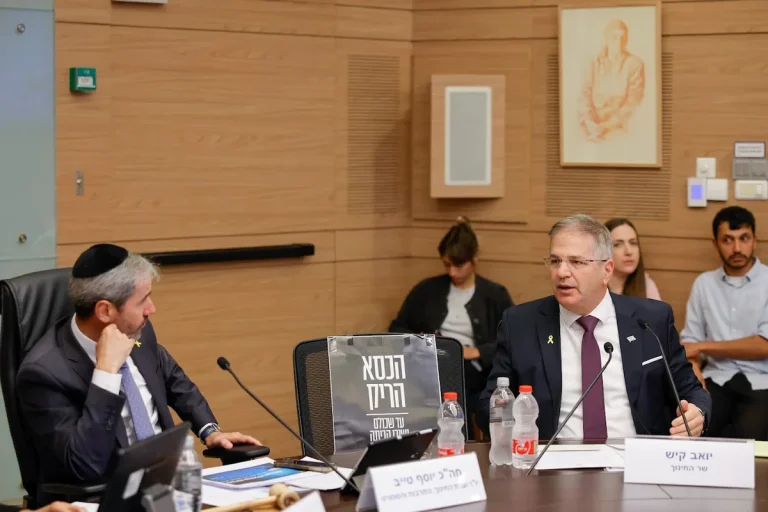
The Education, Culture and Sports Committee, chaired by MK Yosef Taieb (Shas), convened on Monday for a debate on preparations for the 2025/26 academic year.
Minister of Education Yoav Kisch, who serves as chair of the Council for Higher Education, commented on the draft bill: “I have heard that there are academic institutions in which the student union decided to strike over one bill or another. It’s unacceptable that the faculty will decide to strike in that institution. If they strike, they won’t get a salary. We won’t allow a political strike. I expect the administration of the academic institutions to keep the institution free of political strikes. Let them not enter into this field at all.” Committee Chair MK Taieb reinforced Minister Kisch’s statement.
Sivan Koren, Chair of the National Union of Israeli Students: “The Government can’t pass a draft-dodging bill under our noses. The only way to ease matters for those who serve is not to allow an exemption for certain populations. The whole pretty package that we made here, with the accommodations and the easements for those who serve, won’t be relevant on the day the war ends. How is this passing under your radar? The academic year can’t start with 70,000 students serving in reserves.”
Minister Kisch also addressed the issue of easements for combatants and reservists in admission requirements for higher education, saying, “We have made a dramatic change. Previously, this wasn’t regarded as a value at all. Previously, 10% could be admitted based on equality data. Since then, we have increased the percentages, and last year, 70% of those who were admitted through easements were from the category of combatants and reservists, and that is a change that I am proud of.”
Committee Chair MK Taieb congratulated the Association of University Heads, the Board of Public Academic Colleges and the IDF Chief Reserve Officer for the plan for reservists studying in academic institutions, which was drawn up with the Education Committee’s assistance. MK Taieb said, “I know this wasn’t simple and that intensive work was done.” Planning and Budgeting Committee Chair Prof. Ami Moyal presented data from the Central Bureau of Statistics showing that in 2023/24 the dropout rate among reservists was lower relative to the general population, and that more reservists completed their studies within the required timeframe.
Prof. Moyal: “The 2025/26 academic year is scheduled to start with 336,350 students in 57 academic institutions, 33 of which are budgeted by the Planning and Budgeting Committee. This year, 19,000 Haredi students will study in academic institutions—an increase of 9% from last year; in the past decade, the increase stands at 85%. A total of 19% of students in academic institutions are members of Arab society, with an increase of 56% in the past decade.” The Planning and Budgeting Committee chair referred to the medical studies in the coming year as a “revolution in training physicians,” and noted that 1,448 students would begin their studies this year in faculties of medicine. He said about the percentage of students scheduled to study high-tech professions, “In computer science a drop has been recorded. Conversely, in information science and artificial intelligence, there has been a significant increase.”