



















Knesset Press Release • July 7, 2025
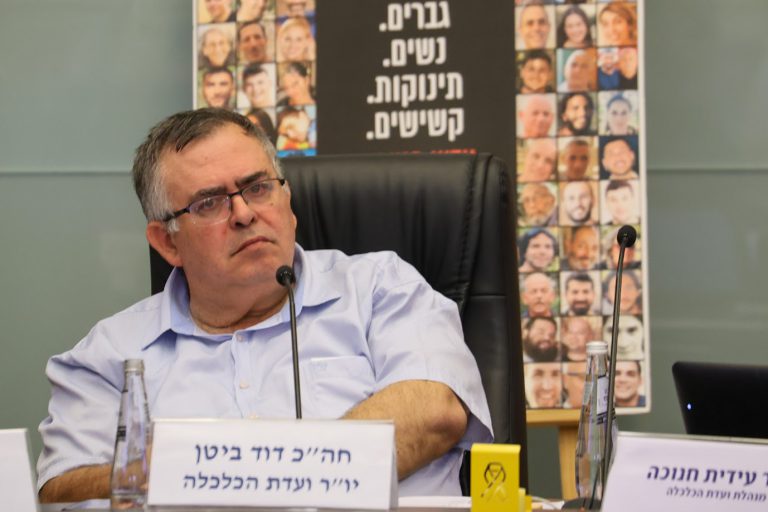
The Economic Affairs Committee, chaired by MK David Bitan (Likud), convened on Monday and heard a report from Minister of Economy and Industry MK Nir Barkat (Likud) on the activity of his ministry. Minister MK Barkat said at the start of the debate that he wanted to show that things that were dependent on the Ministry of Economy and Industry were progressing well. He stated that in the context of the ministry budget, he was pleased with the relationship with the Ministry of Finance, and had reached an agreement with it on the work plans. The minister presented the geopolitical issue to the committee, saying that the ministry was solely responsible for foreign trade, and that there were 55 economic attaches around the world. Minister MK Barkat said that the State of Israel had two foreign ministers—in the diplomatic field, it is the Minister of Foreign Affairs, and in the economic and foreign trade realm it is he and the Ministry [of Economy and Industry].
Minister MK Barkat commented on the renewed trade agreement with the United States, saying that US President Donald Trump had decided to change the entire trade policy. The minister related that on Thursday he had held a conversation with high-ranking American officials, and that Israel was cooperating fully with the Americans’ goals, while looking after the State of Israel’s interests as much as possible. Minister MK Barkat said that the US was advancing towards a trade agreement with the State of Israel, which would apparently be the “first and the best,” as he put it.
On the issue of dumping, Minister MK Barkat said that there was a dumping levy in the US against Israel’s largest industries, and that he had asked that Israel not be included in the dumping levies.
MK Yorai Lahav Hertzanu (Yesh Atid) interrupted the minister, asking him when the last time was that he had visited the supermarket. “Do you know how much cream cheese costs today? Aren’t you responsible for the cost of living? Do you know how much it has gone up? Eighteen percent. Bananas have gone up by 84% and instant coffee has gone up by 18%. You’re responsible for the cost of living and you’ve been talking for half an hour, but everything has gone up in the State of Israel. Japan’s economy minister resigned because of an inappropriate comment about rice prices, but you haven’t said a word about that. The middle class is collapsing,” said MK Lahav Hertzanu. Minister MK Barkat replied, “If you hadn’t interrupted me you would have heard what I have to say about that.” Committee Chair MK Bitan removed MK Lahav Hertzanu from the meeting following his outburst.
Minister of Economy MK Barkat said that the Israel Land Authority was the “most unnecessary” body in Israel, and stated that he wanted to see just one government body that would deal with this issue and that he wanted the supply of land to be enlarged on a huge scale. “What happens when there’s a supply of land? The prices drop. That is what we want to reach. We want to dismantle the agriculture holding system in moshavim, and enable them to do reparcellation of the land,” he said.
On the cost of living issue, Minister MK Barkat said that one of the things that affect the cost of living most was the lack of foreign workers. “We don’t need quotas, and we should lower the cost of their employment. We need to lower the price, forgo the quotas and have a large supply of foreign workers. The Ministry of Justice insists that there should not be trade in workers.” The minister said further that consumer goods had an impact of less than 16% on the cost of living, and that the ministry had succeeded, with the committee’s help, in bringing more goods into Israel. “Due to the reforms ‘It doesn’t stop at the port’ and ‘What’s good for Europe is good for Israel,’ seven percent of the products already have a European standard, and it has worked very well. Anyone who prevents parallel imports will be given a fine of NIS 100 million,” stated Minister MK Barkat, and said that the Ministry of Economy and Industry also wanted to add a reform entitled “What’s good for the US is good for Israel.” Addressing the issue of smart consumerism, the minister said that the Haredim know how to organize and to teach a lesson to those who charge excessive prices. MK Yasmin Fridman (Yesh Atid) replied that the Israeli public was tired after the COVID-19 period followed by a war, and that it could not be expected to organize. “You can’t cast the responsibility on the public,” she said.
Minister MK Barkat also presented to the committee issues in which the ministry had not succeeded, such as dismantling monopolies. He said that the Ministry of Finance had objected, and had formed the Slavin Committee, which was dissolved, and that he did not see the establishment trying to complete [its work]. Minister MK Barkat also mentioned the bill for reining in prices during the war, which passed thanks to the committee chair. “The legislation has been emasculated, and the Ministry of Finance stated explicitly that it is against,” he said. A third issue in which the ministry had not succeeded was replacing the director of the Israel Competition Authority.
MK Simon Davidson (Yesh Atid) congratulated the minister for his overall activity, but said that in the end there are citizens who can’t buy food. MK Eli Dallal (Likud) said that Israeli industry should be encouraged, and that everyone saw its importance during the war. “People should buy wisely and should know where to shop. The issue of the cost of living is not only the Government’s [responsibility]. This should be shared both by the Government and by the consumer,” he said.
MK Shelly Tal Meron (Yesh Atid), commenting on the cost of living issue, said that many debates were held on the issue, but she felt that it was like tilting at windmills, and the prices kept rising. MK Meron stated that the MKs’ expectation from the minister was to initiate a discussion with the Minister of Finance on the issue. Committee Chair MK Bitan replied that he would invite the Minister of Finance to a [committee] debate.
Lobby 99 CEO Linor Deutsch responded to Minister MK Barkat’s report, saying that she had a difficulty with the presentation that was given, showing that everyone was to blame except for the Minister of Economy, as she put it. Addressing the minister, Deutsch said that he had explained that [consumer goods] were only 16% of the consumption basket, but this was incorrect. “As for the solutions you propose, you’re the Minister of Economy, you’re supposed to bring macro solutions, and it’s unacceptable for you to say that it’s the consumer’s responsibility. Your job is to provide systemic solutions. You repeatedly blame the Minister of Finance, but your job is to rally people to work with you and to lead to cooperation,” she said.
Minister MK Barkat replied, “In American films, the general says ‘Go win the war’ and he doesn’t care how it’s done. I prefer to sit down with people who have ideas and to translate them into work plans. I haven’t heard new plans, and I am inviting everyone to sit down with the ministry’s professionals and to raise practical proposals. I am transparent in terms of the areas in which we have made progress regarding the cost of living and the areas in which we are stuck.” Committee Chair MK Bitan said, “If a ministerial committee had enabled us to move ahead without the Ministry of Finance’s restrictions, believe me that we would have moved the cart forward.”