



















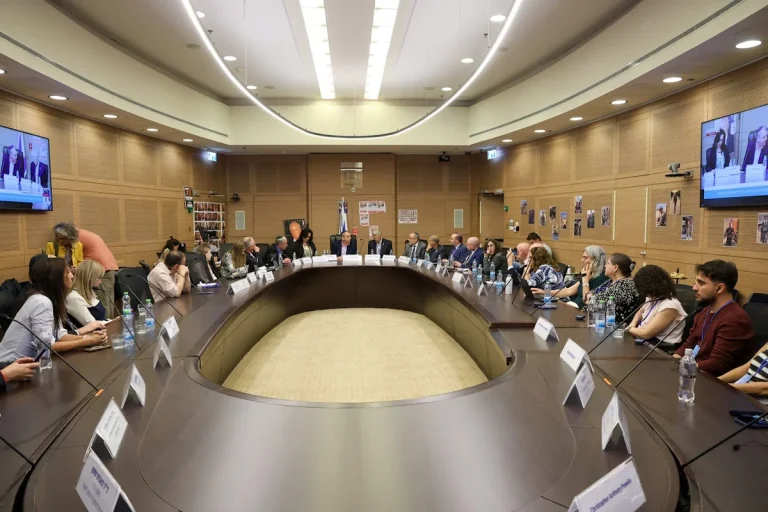
Knesset Press Release • November 3, 2025
The committee for Immigration, Absorption and Diaspora Affairs, chaired by MK Gilad Kariv (Labor), convened on Monday for a debate on the topic of Israel‘s relations with liberal Jewish communities worldwide.
Committee Chair MK Kariv opened the debate and said, “Today we mark the memorial day for Yitzhak Rabin, of blessed memory. We must create a new Israeli agenda in relation to the legacy of the late prime minister and, alongside that, learn the lessons from the assassination. Rabin understood that the State of Israel was established by immigrants, and for future immigrants who will arrive in the coming generations. Israel has a responsibility toward its Jewish and Zionist brothers in the Diaspora. Rabin’s government took upon itself the responsibility of absorbing the large wave of immigrants from the former Soviet Union in the 1990s. In this committee, we carry the memory and legacy of Prime Minister Rabin.
“This is the first time that a discussion is taking place under the title of relations between Israel and liberal Jewish streams worldwide. Such discussions have been held before here in the knesset, but they were always marked by a constant confrontation between the various streams. For the first time, we are coming together for a joint discussion about the full scope of relations between Israel and the diverse Jewish communities worldwide. Israel must engage more with the liberal Jewish communities across the world. I thank all the Jewish communities worldwide that mobilized for Israel during the war. I am not sure the citizens of Israel fully understand the depth of the support the Jewish communities worldwide provided in our hardest times. The egalitarian plaza at the Western Wall has always been a litmus test that the Israeli government provided to the wide variety of Jewish communities worldwide. Sadly, the Prime Minister’s Office refuses to meet with me or participate in committee discussions on this issue. In the committee, I will not give up on the effort to make the Ezrat Israel [section] accessible to all. We face a great challenge to expand the number of liberal Israeli Members of Knesset who seek to strengthen relations with the Jewish communities abroad. We need to deepen the connection between Israel and the liberal Judaism of the Diaspora. The elections in New York are making headlines here in Israel as well. I truly hope that the political figures in Israel will know how to be sensitive and sophisticated in their responses regarding the results of the elections in the important city of New York,” he said.
Rabbi Rick Jacobs, President of the Union for Reform Judaism, noted that there are about two million Reform Jews in the U.S., including approximately 2,000 Reform rabbis. The last two years, he said, have been very difficult for Reform Jews, who are connected to Israel, committed to its values, and involved in the processes it undergoes. Rabbi Jacobs said many in the Conservative movement in the U.S. choose to enlist in the IDF. One of the movement’s members was attacked in Israel on Holocaust Remembrance Day, and if such an incident had happened in the U.S., he said, it would have gotten very negative headlines, but in Israel, there was barely any response or condemnation.
Since the war began, Rabbi Jacobs said, members of the community have proudly expressed their Jewish identity and have done everything possible to support Israel. Anti-Semitism is rising worldwide, and the movement greatly appreciates what the Trump Administration has done for Israel, Rabbi Jacobs said. However, he said, in the U.S. there are many efforts to weaken democracy, and in its values, the Reform movement stands with democratic Israel.
Rabbi Jacob Blumenthal, CEO of the Rabbinical Assembly and of the United Synagogue of Conservative Judaism, said the Jewish community in Israel should cooperate with all Jewish communities around the world to achieve proper advancement. The war that broke out following the October 7 massacre caused the Jewish communities abroad to neglect the task of deepening ties with Israel, he said, noting that when he speaks with colleagues from different communities around the world, they often feel that the connection with Israel is not reciprocal. Jews abroad fully support Israel, but when they visit the country, they are not received as one would expect, he said. There is Ezrat Israel at the Western Wall, but Jews from abroad cannot touch the main Western Wall or fully sense the sanctity that emanates from the Temple Mount, Rabbi Blumenthal said. Conservative and Reform Jews, he said, cannot celebrate their joy as they would like to here in Israel, as community members cannot touch the stones of the Western Wall. This situation must be changed, said Rabbi Blumenthal. Jews are in the midst of an existential battle against antisemitism, and all Jewish communities worldwide, together with the Government of Israel, must join hands and take action against the existential threat to Jews, he stated.
MK Elazar Stern (Yesh Atid) said, “I tried to include the issue of the Western Wall in the coalition agreements of the Government of Change, but they stopped me. If we properly open and renovate Ezrat Israel, we will see many families from all sectors of Israeli society using this space, and that is the main concern of the Rabbi of the Western Wall. Minister [of Finance Bezalel] Smotrich took religious Zionism and turned it into a political term—something that had never happened before him. The last two years of the war have strengthened the bond of fate between the State of Israel and all Jewish communities worldwide. We need to protect Jewish communities around the world from both weapons and statements made by ministers in the Israeli government. The stance taken by Jewish communities alongside Israel in our difficult time is admirable, and we salute them. There is a proposal circulating in the Knesset to cancel the grandchild clause in the Law of Return—the appropriate counter-response to this is a bill that will add the great-grandchild clause to this law.”
MK Moshe Turpaz (Yesh Atid) said, “We are in very difficult times for liberal Jews, and the conclusion we must reach is that we need to work together. We do not deny the strength of the Reform and Conservative Judaism movements worldwide. We need to maintain a spiritual and ideological dialogue, especially within the Knesset. Like MK Stern, I made a great effort on the issue of the Western Wall. I would like to pray at a mixed prayer section at the Western Wall as well as at the Orthodox one. My commitment is that all streams of world Jewry should feel they have a place at the Western Wall, the last remnant of the Temple.”
Ken Bob, global chairperson of Brit Etz, the World Labor Zionist Movement, said Israel needs to decide how it will receive, if at all, progressive Judaism worldwide. He said that from his experience, Israelis are not always sensitive to what every Jew across the Diaspora wants and needs. Israeli politics, Bob argued, differ from many of the views held by Jews in the Diaspora, but this does not undermine the connection between the different streams of Judaism and the state.
Rabbi Sergio Bergman, President of the World Union for Progressive Judaism, said a distinction must be made between the State of Israel and the Government of Israel. The values of the Declaration of Independence are the common denominator of all liberal Jewish communities worldwide, he said. The issue of the Western Wall, Rabbi Bergman said, is a symptom of a deeper problem. He called for a return to the basic values of the State of Israel. In order for Israel to be a true Jewish and democratic state, there needs to be a full separation between religion and state, and this must happen through the establishment of a constitution for the State of Israel, he argued.
Rabbi Hillel Skolnik, senior rabbi of the Tifereth Israel congregation in Columbus, Ohio, said 190 members of the community he leads have visited Israel since October 7, 2023, including 40 who visited for the first time. Jews in small communities in the U.S. are just as important as those in the large, central communities, he said, while calling to leverage sister city connections to strengthen ties between Jewish communities in the U.S. and Israel.
He said two-thirds of Ohio’s Jews are either Reform or Conservative, and the children of members of the community face severe antisemitism in public schools. Rabbi Skolnik also mentioned that he named his daughter Hadar, after Hadar Goldin, of blessed memory.
Anna Kislanski, CEO of the Israel Reform Movement, said, “Israeli Jewry cares deeply about Diaspora Jewry. The majority of the Jewish public in Israel supports liberal Zionism, and a large percentage views the Reform Movement in Israel as a bridge to strengthen ties with Diaspora Jewry.”
Yizhar Hess, Vice Chair of the World Zionist Organization, said “We are seeing a more than 400% increase in antisemitic incidents worldwide since October 7th. Antisemitism is rising, but this is happening alongside a strong State of Israel and strong Jewish communities around the world. We cannot compare today’s security reality with the dark periods of Jewish history. We are currently in the golden age of the Jewish people, and it is important to maintain cautious optimism.”
Adv. Orly Erez-Likhovski, director of the Israel Religious Action Centre, said “Thanks to the judicial system, we have started to receive support from government ministries, but it is still not enough. The Conservative and Reform communities suffer not only from discrimination, but also from negative treatment that often borders on criminal actions. Reform Jews in Israel must be able to live in security, and not in fear.”
Committee Chair MK Kariv concluded the discussion, saying “I intend to convene this forum, with representatives from all streams of the Jewish communities, every few weeks. I also plan to mandate government ministries to attend the upcoming discussions. In the near future, I plan to convene a follow-up debate on the issue of the Western Wall. We need to start discussing the bills proposed by the liberal Zionist movement in the Knesset. I call on my colleagues to oppose absurd bills that propose canceling the grandchild clause in the Law of Return and to bring alternative proposals to the table. We need to begin preparing work plans to be ready for entering the next government.”