














Knesset Press Release • July 21, 2025
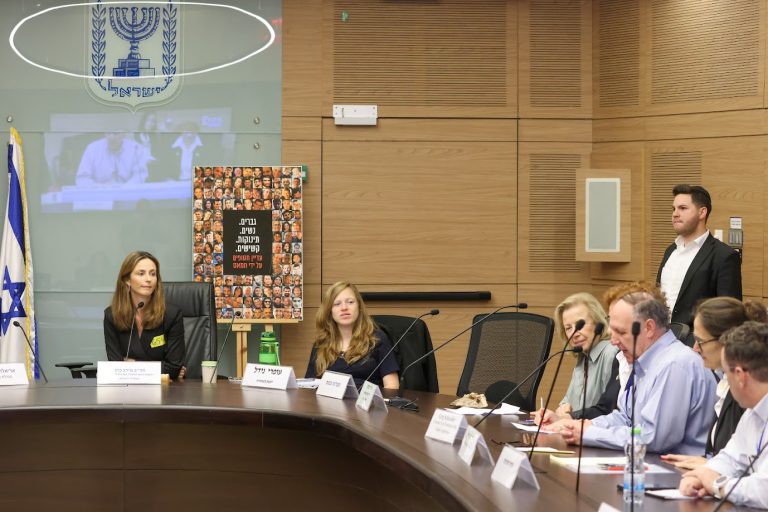
The Special Committee on the Treatment of Holocaust Survivors, chaired by MK Meirav Cohen (Yesh Atid), convened on Monday for a debate on the topic of “Urgent mapping of fortification infrastructure for elderly people and Holocaust survivors in preparation for future emergency situations.”
Committee Chair MK Cohen said, “The State of Israel planned Operation Rising Lion for 20 years, gathered intelligence, and the targets were very accurate and impressive. But the preparation of the home front was close to zero. They weren’t able to say where people without fortification and people with disabilities lived, and even when they knew where they lived—there was nothing to offer them. One of the most vulnerable populations to harm from missiles is, of course, the elder population, including the Holocaust survivors. Many of them live in apartments without a protected space, suffer from mobility difficulties and are unable to reach a protected space within a short alert time, because of distance or lack of accessibility. This reality exacted a high cost, and during the war with Iran two Holocaust survivors were murdered as a direct result of lack of fortification.”
MK Cohen stated that the gaps and the difficulties in reaching a protected space were relevant to any elderly person or person with a disability, and explained that the goal of the current debate was [to respond to] the focused need to map the gaps and the fortification needs of the Holocaust survivors, so as to enable the Claims Conference to submit requests for financing the fortification by the Government of Germany, which assists the needs of the Holocaust survivors. “This is an urgent need. Regrettably, the threats are not behind us, and we cannot find ourselves again in a state of helplessness and lack of solutions. We have an opportunity here to help with raising budgets that will help to reduce the fortification gaps,” said Committee Chair MK Cohen.
Greg Schneider, Executive Vice President of the Claims Conference, said that the past two years had been particularly challenging for the Holocaust survivors in Israel and worldwide, and that the Claims Conference had done everything in its power to provide a response and support. Beyond the regular compensation payments, which stand at about NIS 700 million annually, the Claims Conference provided additional funding of about NIS 150 million since October 7, with the aim of helping the survivors to cope with the new reality. Since the Second Lebanon War, he said, the Claims Conference has been working in partnership with the Government of Israel to finance the construction of shelters in four hospitals and in Amigour housing projects, with the understanding that many of the patients in the hospitals and the Amigour residents are Holocaust survivors. Schneider said that now, 21 months into the Swords of Iron war, the Claims Conference wished to continue to strengthen its support by assessing the fortification needs, based on an in-depth national mapping plan of institutions housing large concentrations of survivors and lacking fortification infrastructure. This measure was vital, he said, to ensure the security and wellbeing of the survivors in the future as well, since the challenges with which they are coping have not ended.
Colette Avital, Chair of the Center of Organizations of Holocaust Survivors in Israel: “At the start of the war, we already understood how vulnerable the elderly population was, including the Holocaust survivors, since most retirement homes did not have fortification that was sufficient and suitable for their needs. It is the Government’s obligation to provide solutions. We have to come out with a serious mapping of these institutions, focusing on those in which there is a certain percentage of Holocaust survivors. Without this mapping we won’t be able to move forward and justify the claim to the Government of Germany, so that it will help to build protected spaces.”
Adv. Shlomit Hertz of the Holocaust Survivors’ Rights Authority: “During the war we established contact with Holocaust survivors, with a focus on survivors with high levels of [need for] nursing care and lack of ongoing assistance. We know of about 10,000 survivors in cities that were hit, and about 50 survivors whose home was damaged. In the coming days, we are supposed to receive updated information on a national level, which will help to map and understand who needs assistance. This also includes those who are near a protected space but have difficulty with mobility that prevents them from reaching it. We can ask for permission from the survivors to transfer information to the Claims Conference so that it will be able to help. As for institutions, we need to receive data from the government ministries—who is in which institution and what is its fortification situation.”
Officials from the Ministries of Welfare, Health, Housing, and Aliyah and Integration reviewed for the committee the fortification statistics for the institutions and housing facilities under their responsibility. The reports indicated that some of the ministries had performed a full mapping of the fortification gaps, whereas others held only a partial mapping.
Lt.-Col. Moshe Shlomo of the Home Front Command said that the Home Front Command was working in cooperation with local authorities and government ministries to reduce fortification gaps. “We are willing to accept any additional planning initiative and designate ‘green tracks’ in order to expedite licensing and construction of protected spaces for Holocaust survivors, for all senior citizens and for any population that needs assistance in fortification,” he said.
Committee Chair MK Cohen said in summation, “Timetables need to be set and all the information has to be gathered, with the Holocaust Survivors’ Rights Authority serving as the lead integrator. The Home Front Command is a very important element in the mapping, and after there is a budget, we will think together with it about the optimal fortification solutions for each location. We may also need to think about a special fund that will finance evacuation in time of need for elderly people for whom there is no suitable and accessible fortification solution.”
MK Cohen said that the committee would hold an additional follow-up debate on the topic soon, in order to examine the progress made in gathering and integrating the data.