












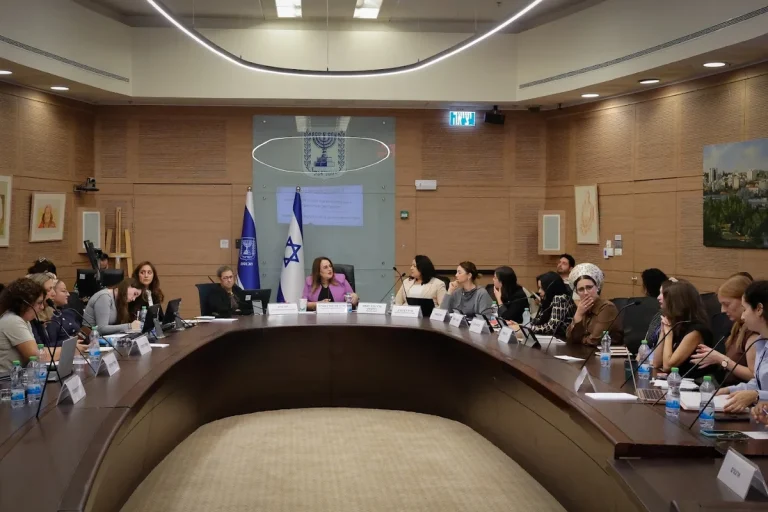
Knesset Press Release • October 22, 2025
The Special Committee for the Rights of the Child, chaired by MK Kathrin Shitrit (Likud), convened on Wednesday for a debate on the topic of prostitution among minors.
At the opening of the discussion, Committee Chair MK Shitrit said, “in the state of Israel in 2025, there are boys and girls who are forced to sell their bodies in order to survive. We are talking about some 3,000 children who have fallen between the cracks of the welfare, education, and health systems—and sometimes even within their own families. A considerable share of these assaults take place online. Social media has become a fertile ground for cruel sexual exploitation. Behind every such case there is exploitation, fear, and shame.
“In recent years, important legislative steps have been taken and rehabilitation frameworks have been established—but in practice, the reality is much harsher. The facilities are full, the budgets insufficient, and there is a severe shortage of personnel, while new cases are uncovered every week,” she said.
Yelena Divine, spokesperson and one of the founders of the Voice of Survivors of Prostitution in Israel organization, shared her personal story with the committee members:
“I don’t want to tell you about how, even before I turned 10, random adult men would approach me boldly and make me very tempting offers that were hard to refuse – ‘Your mother works so hard, don’t you want to help her?’ ‘That’s how the world works, you’re still young, you don’t understand yet, but I’m telling you—all the girls do it.’ And how, after age 10, I began agreeing to offers from men aged 40, 50, 60—fathers of children who studied with me in school.
“What I do want to talk about is reality – and this reality affects your children’s lives as well. First, it must be understood that prostitution is legitimate in the State of Israel. Yes, even in a reality where the Prohibition on Prostitution Consumption Law has been in force as a temporary provision for six consecutive years, prostitution still enjoys legitimacy. You can see it in so many places—OnlyFans, Sugar Daddy, shady chatrooms, social networks, and even dating apps – there is always someone offering ‘support.’
“It’s true that girls from difficult home environments are more at risk of falling into prostitution and accepting such ‘support’ from these ‘nice’ people, but your sons and daughters also receive these offers,” she said.
A review by the Task Force on Human Trafficking and Prostitution, based on data from rehabilitation and assistance organizations and field organizations, estimates that about 3,000 minors are currently engaged in prostitution in Israel. According to these organizations and various Israeli and international studies, the average age of entry into prostitution is 13–14. In most cases, there is a background of sexual abuse in childhood, whether inside or outside the family, along with intergenerational parental neglect.
Findings from the accompanying study conducted by the Myers-JDC-Brookdale Institute clearly indicate the severe psychological harm caused by prostitution: About 79% of people in prostitution suffer from post-traumatic stress disorder (PTSD) as a result of their experiences; about 44% reported suicide attempts; and about 46% have been diagnosed with eating disorders.
Moria Rodal Silfen, CEO of the Task Force on Human Trafficking and Prostitution and Lior Rosenbaum, the organization’s Director of Government Relations, said early and effective prevention of entry into the cycle of prostitution is critically important. The main way to achieve this, they argued, is through law enforcement and identifying those who draw young girls and boys into the world of prostitution. Yet despite this being a serious crime, law enforcement and the initiation of criminal proceedings against offenders are extremely limited, they said, noting that since the law’s enactment, only a few dozen indictments have been filed against consumers of child prostitution.
The ELEM – Youth in Distress organization stated that there is no official, data-based mechanism for early identification of youth involved in prostitution in online spaces, particularly in closed apps. Israel lacks a regulated legal, technological, or ethical infrastructure to guide aid organizations on how to act effectively and safely in digital environments. As a result, service providers either refrain from intervention or act sporadically and without coordination.
In practice, this creates a vacuum in which prostitution takes place without regular data collection or the ability to provide assistance to populations that do not seek help or are not aware of it.
ELEM added: “Without systematic data collection and investment in prevention, we will continue to address only the tip of the iceberg. We will not reach minors who are at the early stages of vulnerability or those involved primarily in virtual prostitution. There is a need for reliable data on the scope of the phenomenon, as well as structured training for educational and therapeutic staff in various frameworks, so they can identify and read the signs.”
Toda’a, an NGO fighting prostitution and human trafficking, in cooperation with the ministry of Welfare and Social Affairs, operates the Turning Point initiative to prevent entry into and consumption of prostitution in Israel. The project includes training sessions, workshops, and awareness programs for schools and informal education frameworks. So far, 4,032 educational staff and 1,545 adolescents have participated.
The Israel Police has held nine training days attended by 1,170 officers, and the health maintenance organizations have held 13 training sessions with a total of 455 medical personnel participating.
Committee Chair MK Shitrit said, “It was important for me to go and see the distress with my own eyes. During a visit to a Welfare Ministry shelter in Be’er Sheva for girls who have fallen into prostitution, I saw firsthand that the therapeutic framework urgently requires funding and reinforcement.
It is the duty of the State of Israel to ensure that no child – boy or girl – will ever be forced to sell his or her body to survive. Not because of poverty, not because of abuse, and not because of indifference.”