
























Knesset Press Release • October 21, 2025
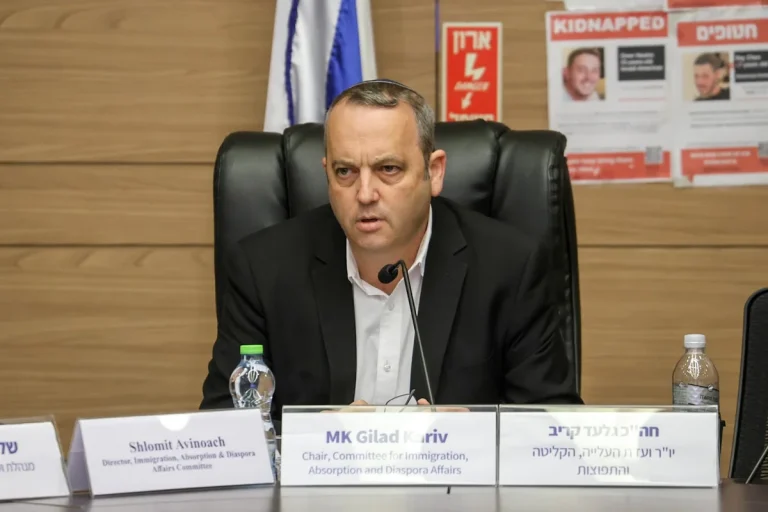
The Committee for Immigration, Absorption and Diaspora Affairs, chaired by MK Gilad Kariv (Labor), convened on Tuesday for a follow-up debate entitled “Policy of the Israeli Government and the knesset towards extremist political parties with antisemitic roots, and the effect of this policy on Jewish communities in the Diaspora.”
A British right-wing activist known as Tommy Robinson came to Israel last week for a visit, at the invitation of Minister for Diaspora Affairs and Combating Antisemitism Amichai Chikli. Major organizations representing the British Jewish community expressed their objection to the invitation extended to Robinson to visit Israel.
Committee Chair MK Kariv: “The campaign being led by a number of ministers and Members of knesset to legitimize nationalist figures worldwide is incompatible with the state of Israel’s values. The State of Israel has enough supporters around the world in the moderate right wing and also in the moderate left wing, and we don’t need to encourage controversial extremist elements. The invitation extended to Tommy Robinson to Israel and to the Knesset has been condemned by major organizations in Britain. The Government of Israel is well familiar with the position of the Jewish organizations in Britain. Despite the objection of the British Jewish organizations to Robinson’s visit to Israel, the Minister for Diaspora Affairs chose not to listen to the organizations’ position. What kind of message is the State of Israel conveying to the 250,000 Jews in Britain? The Minister for Diaspora Affairs disregarded the position of the Jewish organizations in Britain, and the Ministry for Diaspora Affairs also refused to take part in the debate we are holding today in the committee. This is rudeness and disrespect towards the Jewish communities in Britain and towards the State of Israel’s democratic values. We in the committee will continue to battle against granting legitimacy to controversial people from all ends of the political spectrum. I call from here upon Minister Chikli to apologize to the Jewish organizations in Britain, which were offended as a result of Robinson’s visit to Israel.”
Committee Chair MK Kariv asked the representative of the Ministry of foreign Affairs at the debate whether there was a consultation or inquiry by the Ministry for Diaspora Affairs or the Office of the knesset speaker with regard to Robinson’s visit to Israel. Dr. Yacov Livne, Deputy Director General for Public Diplomacy at the Ministry of Foreign Affairs, said, “To the best of my knowledge, the issue of Robinson’s visit to Israel was not brought before us.”
Dr. Livne said further, “No one expected or predicted the level of antisemitism and hatred of Israel that has taken place in the past two years, including in key countries that share the same values with Israel. We are currently engaged in a thinking process on how to cope with the phenomenon of antisemitism. Condemnation is important, but actions are more important. There should be accountability for every antisemitic act that is committed around the world. In the past months, we have upgraded our relationship with the Jewish communities of the Diaspora by setting up the J50 system that coordinates the relationship with the 50 largest Jewish communities around the world.”
Michael Wieger, Chief Executive of the Board of Deputies of British Jews, said that Robinson did not enjoy a political consensus in Britain either on the right or on the left. He said that several cases had been opened against Robinson, and that [the Board of Deputies] was shocked to learn that the Minister for Diaspora Affairs had invited him to be his guest in Israel. Wieger said that he knew that Robinson also had Jewish supporters in Britain, but stated that a majority of the Jewish organizations in the UK condemned him.
Rabbi Charlotte Baginsky of the Movement for Progressive Judaism in Britain said that the relationship between Israel and Diaspora Jewry was reciprocal, and that when the Israeli Government used a discourse of exclusion, it affected the way in which Jews were perceived around the world. When Israeli figures stand with Tommy Robinson, it weakens the Diaspora Jews, she said.
Michael Ziff of the London Jewish Forum said that the Minister for Diaspora Affairs should not have invited Robinson to Israel, and that the Ministry for Diaspora Affairs should have consulted with the Jewish organizations prior to Robinson’s arrival in Israel.
Jewish Agency official Yigal Palmor: “Robinson’s invitation to Israel caused great diplomatic harm to the State of Israel. Robinson does not represent any party or any constituency, so he should not have been invited, and his extreme positions should be rejected. The State of Israel did not gain anything from this visit.”
Committee Chair MK Kariv said in summation, “The invitation extended to Robinson for an official visit to Israel is a slap in the face to the Jews of Britain and the Diaspora. I intend to issue a letter to the Minister for Diaspora Affairs, and we will demand to know whether the ministry participated in funding Robinson’s visit to Israel. We are requesting that the Ministry of Foreign Affairs present to the committee a position with regard to Robinson’s visit, and I am requesting that this position be made clear to the other government ministries. In addition, the committee requests that the Ministry of Foreign Affairs present criteria that should be met by people who are invited from abroad for official visits. We expect the Minister for Diaspora Affairs and his ministry to recognize the status of the representative Jewish organizations in Britain.”