

























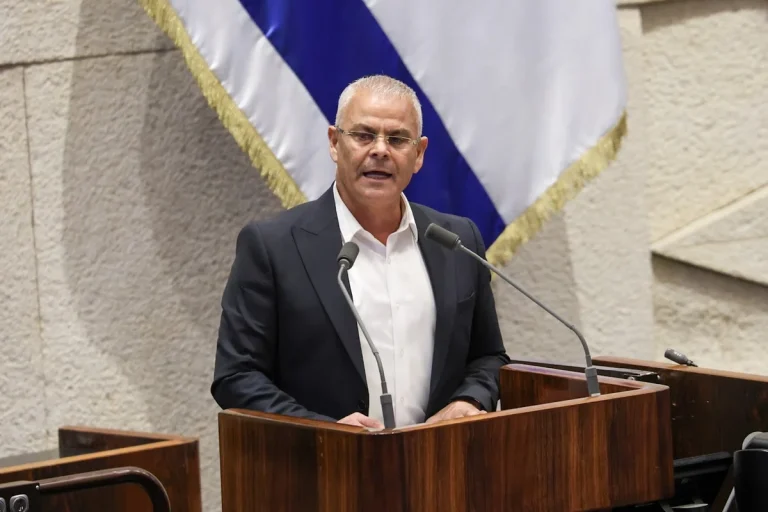
Knesset Press Release • October 29, 2025
In its sitting on Wednesday, the knesset plenum voted to approve in preliminary reading the Splitting the Post of the Attorney General Bill, 2024, sponsored by MK Mishel Buskila (New Hope—The United Right). In the vote, 61 Members of Knesset supported the bill, versus 46 opposing votes, and it will be turned over to the House Committee to determine the committee in which the bill will be deliberated.
Several additional bills, sponsored by MKs Eli Dallal (Likud), Yitzhak Kroizer (Otzma Yehudit), Nissim Vaturi (Likud) and Eliyahu Revivo (Likud), which were attached to MK Buskila’s bill, also passed in preliminary reading and will be turned over to the House Committee to determine the committee in which they will be deliberated.
Under the bill sponsored by MK Buskila, it is proposed to advance a separation between the different “hats” of the Attorney General, and to transfer the power to make a decision on launching an investigation or a decision on prosecution of the Prime Minister, ministers and Members of Knesset from the Attorney General to the State Attorney, subject to the approval of a three-member committee. The committee will be composed of a former Supreme Court judge to be appointed by the President of the Supreme Court, a former Attorney General to be appointed by the Minister of Justice, and a private defense attorney to be appointed by the National Public Defender.
MK Buskila: “The existing situation, in which one person serves both as the Attorney General and as the Prosecutor General—creates a built-in conflict of interest and causes long-term harm to the public’s confidence in the law enforcement system. These are two posts that are different in nature, with different goals and different approaches. The Attorney General is supposed to advise the Government and provide support for it. The Prosecutor General is supposed to employ independent judgment and decide whether to prosecute. The bill is not only a worthy one, it is vital. It does not harm the democratic balance, it strengthens it.”
Minister of Justice MK Yariv Levin (Likud): “The institution of Attorney General, as it exists in Israel, does not exist anywhere else in the world. We have a distorted system, in which an Attorney General is forced upon the Government who has been appointed by a previous Government, whose positions are the complete opposite. This is done in a situation in which draconian and unprecedented powers are concentrated in the hands of this Attorney General, which include the power to advise, imposing a veto on advancing government legislation, representation of the Government or against it in court, and criminal enforcement powers. When all the power is given to one agency in an uncontrolled fashion—this power corrupts. The institution of the Attorney General’s Office has been utterly corrupted during the term of the ousted Attorney General, and in all fields. The Attorney General’s Office operates systematically to thwart the Government’s policy. The institution of the Attorney General’s Office has gone completely bankrupt.”
MK Benjamin Gantz (Blue and White—National Unity Party) opposed the bill, saying, “I think that splitting the post is a mistake, because there is significance for the Attorney General’s Office and the prosecution to be part of the Government’s work, in the sense of the necessary balances in the prosecution’s decision-making, particularly on issues of senior position holders. [We] should not appoint a prosecutor who may be a good jurist, but is detached from everyday practice.”
The explanatory notes to the bill state: “The Attorney General serves as the attorney for the Government, and accordingly, assists it in legal terms to fulfill its policy and its objectives within the boundaries of the law. The role of the Attorney General requires close and daily cooperation with the Government and its ministers, whom he advises and represents in court.
“In conjunction with this, in the Attorney General’s role as head of the General Prosecution, he is called upon to make decisions in the stages of launching an investigation and filing indictments against ministers and Prime Minister, with whom he has close acquaintance and working relations. This is in spite of the fact that in the Attorney General’s capacity as Prosecutor General, it would be best to maintain a maximum degree of objectivity and distance from the people whose fate is determined by his decisions.”