















By Pesach Benson • June 9, 2025
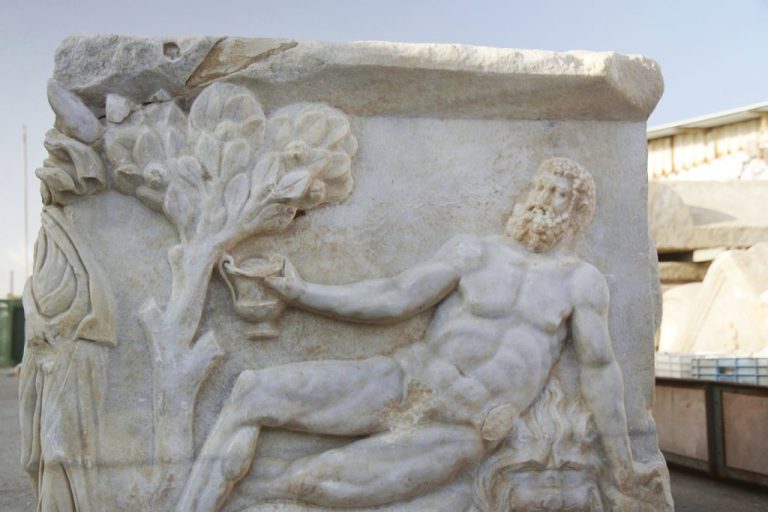
Jerusalem, 9 June, 2025 (TPS-IL) — An unusual and remarkably well-preserved Roman marble sarcophagus, estimated to be 1,700 years old, was uncovered in Caesarea, the Israel Antiquities Authority announced on Monday. This is the first time a sarcophagus depicting the specific mythological drinking contest between Dionysus and Heracles has been found in Israel — a level of Roman cultural expression previously undocumented here in funerary art.
“It was like a scene out of a movie,” recalled IAA archaeologists Nohar Shahar and Shani Amit. “We began removing the soft, light sand of the dune when suddenly the tip of a marble object popped up. The entire excavation team stood around excitedly, and as we cleared more sand, we couldn’t believe what we were seeing—parts of a sarcophagus, upon which figures were carved: gods, animals, and trees.”
In Roman culture, Dionysian imagery often symbolized celebration and the transcendence of earthly life. “It seems that the figures are not only celebrating – they are, in fact, accompanying the dead on his last journey, when drinking and dancing are transformed into a symbol of liberation and transition to life in the next world. This sarcophagus offers an unusual perspective of the idea of death – not as an end, but as the beginning of a new path,” Shahar explained.
“This is the very first time we find the Dionysus and Hercules wine competition scene on a burial coffin in our region,” Shahar added. “While processions of the wine god are a familiar motif on sarcophagi from the 2nd and 3rd centuries CE, this specific drinking contest scene is mostly known here from Roman mosaics, such as those discovered in Zippori and Antioch.”
As for the outcome of the mythical contest, the artwork offers a clue. “Hercules’ condition, depicted on the sarcophagus as someone who is no longer able to stand, points to the obvious answer: Dionysus,” she noted with a smile.
The location of the sarcophagus adds further intrigue. “The sarcophagus was found within an area where archaeological remains were located outside the well-known walls of Caesarea,” said Shahar. “This means that the space leading into it was actually much wider and thus richer in finds than we thought until now.”
Caesarea is one of the most historically and archaeologically significant cities in Israel. Located on the Mediterranean coast between Tel Aviv and Haifa, it was a major port city and administrative center in antiquity, and today it’s both a national park and a popular tourist destination.
“This is a thought-provoking discovery reflecting how life and faith were perceived in the Roman world,” said Antiquities Authority director Eli Escusido.
The sarcophagus will be unveiled to the public as part of the IAA’s annual Central Region Conference at the Eretz Israel Museum in Tel Aviv on June 12.