










By Shalhevet Eyal • December 18, 2025
Jerusalem, 18 December, 2025 (TPS-IL) — As the cool Jerusalem air settles over the courtyard of the HaMif’al building, the artists’ space turned bar begins to fill with people. Under warm lights on the inner stone floor, a circle of eight people — Jews and Arabs, religious and secular — sit close together, leaning into a lively conversation in Arabic about faith. Even from a distance, their hands move animatedly, the rhythm of their voices rising and falling in a shared language.
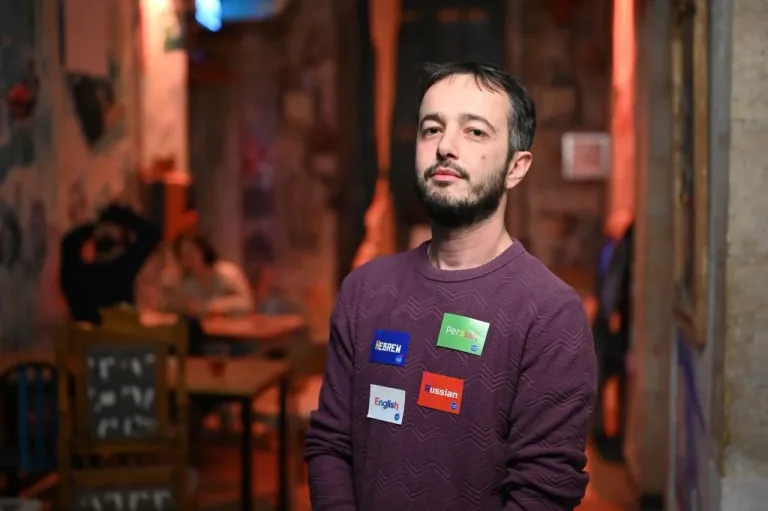
On the patio, a group of Russian speakers sit together, their conversation flowing with the ease of a familiar tongue. Not far away, a cluster of young Turks stand in a loose circle, talking with quick gestures, their voices threading through the winter air. Dozens more people drift between groups in the courtyard and inside, guided by the colorful stickers on their jackets announcing the languages they speak or hope to learn.
This is JerusaLANG, a weekly gathering where Jerusalem’s patchwork of cultures becomes visible, audible, and unexpectedly intimate.
“One thing I take from these events, and what gives me the strength to keep going, is seeing how people meet each other without media or politicians in the middle,” JerusaLANG’s founder, Avner, tells The Press Service of Israel. “Most people, I believe, are good, and you can see it here.”
Avner started the event in 2023, shortly before the war. The inspiration? He was walking through Jerusalem when he realized how many languages he heard — Spanish, English, Arabic, Hebrew, French, Chinese. “I thought: let’s put them in one place and just let people talk,” he recalled.
For Julieta, a Ph.D. student from Argentina, the weekly get-togethers opened unexpected doors. “I met Korean girls here for the first time,” she says. “We ended up meeting again and going on a trip. It was amazing. I love Korean culture.”
Aaron, a Hebrew teacher who immigrated from Uzbekistan, says the evening feels like “real Jerusalem — young people from different backgrounds, full of good interactions and good vibes.” He speaks Hebrew, English, and Bukharian Persian, a Jewish dialect of Persian, and is always struck by the variety of languages he hears around him.
Leigh, who recently moved from New York, stands near the edge of the space and watches people move between groups, switching languages mid-sentence. “Speaking Hebrew fluently helped me connect with people here,” she says. “Language is how you understand someone’s perspective.”
Inside, near the bar, Evyatar and Suhail — friends who met here about a year ago — laugh as they recall how their friendship grew. Evyatar, a Jewish Israeli, came wanting to learn Arabic. Suhail, a Christian Arab from Amman, wanted to practice Hebrew. “Sometimes it’s just chemistry,” Evyatar says. Suhail remembers how that chemistry once led them, after a late trip to Tel Aviv, to spend the night sleeping at the yeshiva where Evyatar studied. “Even the Shabbat dinner was really good,” he recalled.
As the night deepens, the mix of voices becomes a soft chorus — English from the inner courtyard, French from the patio, Mandarin and Spanish rising from small groups inside. People hold beers or hot cider against the cold, peel language stickers from their coats, and drift from one conversation to the next, accents wobbling, words gently corrected — with a smile.
Related Topics