






















By Pesach Benson • December 15, 2025
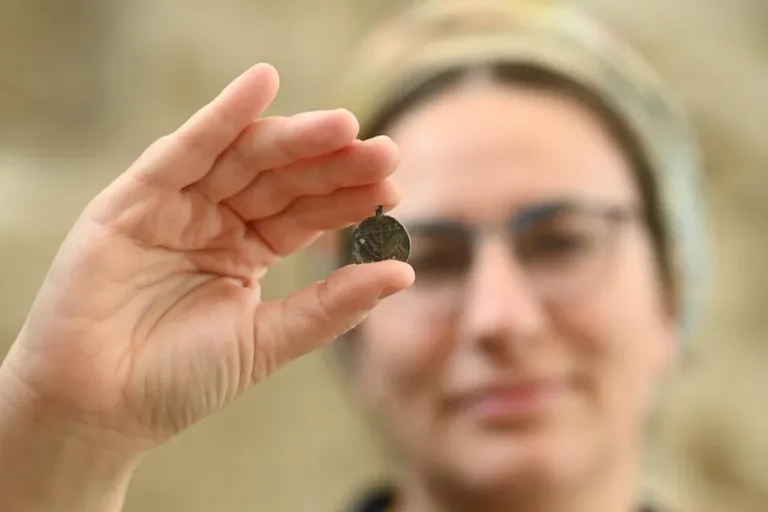
Jerusalem, 15 December, 2025 (TPS-IL) — A remarkably rare 1,300-year-old lead pendant bearing a seven-branched menorah has been uncovered in Jerusalem, shedding new light on Jewish presence in the city during a period when imperial authorities officially barred Jews from entering, the Israel Antiquities Authority announced on Monday.
The discovery was made in an archaeological park adjacent to the Temple Mount during large-scale excavations conducted in recent years.
The small, disk-shaped pendant dates to the 6th to early 7th centuries CE, during the Late Byzantine period. Cast almost entirely of lead, it is decorated on both sides with an identical image of a menorah framed within a circular border. Only one other ancient lead pendant bearing the menorah symbol is known worldwide, an object of unknown provenance housed at The Walters Art Museum in Baltimore.
The pendant was discovered by chance inside the rubble of a Late Byzantine structure that had been buried beneath an approximately eight-meter-thick layer of fill. That fill was deposited in the early 8th century as part of extensive construction work connected to the erection of monumental Umayyad buildings in the area.
“One day while I was digging inside an ancient structure, I suddenly saw something different, gray, among the stones,” said Ayayu Belete, a City of David worker who uncovered the artifact. “I picked the object up and saw that it was a pendant with a menorah on it. I immediately showed the find to Esther Rakow-Mellet, the area director, and she said it was an especially rare find. I was deeply moved and excited!”
Archaeologists determined that the pendant was designed to be worn on a necklace, with a loop cast at its top. One side of the object was well preserved, while the other was partially obscured by patina, a natural weathering layer. Each menorah features a central shaft with three arms extending from each side, topped with horizontal bars and stylized flames. An XRF test carried out at the Israel Antiquities Authority’s analytical laboratories found the pendant to be composed of approximately 99% lead.
According to Israel Antiquities Authority researchers Dr. Yuval Baruch, Dr. Filip Vukosavović, Esther Rakow-Mellet, and Dr. Shulamit Terem, the object is exceptional not only for its iconography but also for its material.
“A pendant made of pure lead, decorated with a menorah, is an exceptionally rare find,” they said. “The double appearance of the menorah on each side of the disc indicates the deep significance of this symbol, and the central place of the menorah in the visual expression of connection to the Temple and its memory, even in periods long after the destruction of the Temple.”
The historical context of the discovery raises intriguing questions. During the Byzantine period, Jews were formally prohibited from entering Jerusalem, making the presence of a personal Jewish object in the city difficult to explain. Scholars are left to consider whether the pendant belonged to a merchant, an official visitor, a clandestine pilgrim, or someone who managed to reside in the city despite the ban.
“This is an unusual find,” said Dr. Baruch, who has directed excavations at the site for nearly 25 years. “This pendant, bearing the symbol of the menorah, is not just a material object; it is a personal seal, an emblem of memory and identity, which probably belonged to an anonymous Jew who chose to wear it around his or her neck.”
He added that the choice of lead suggests the pendant may have served as an amulet rather than jewelry, noting that lead was commonly used for amulets in the Byzantine period. “During the Byzantine period, the menorah became a symbol of national memory, and it expressed the expectation of national revival among the Jewish communities in the Land of Israel and the Diaspora,” Baruch said. “Despite prohibitions and difficulties, Jews did not stop coming to Jerusalem.”
Israeli Minister of Heritage Rabbi Amichai Eliyahu said the find reinforces a broader historical narrative. “The exciting find of the menorah pendant joins a series of testimonies that continue to be discovered in Jerusalem, and that tell the story of the continuity and devotion of the Jewish people in the city,” he said.
A menorah is a seven-branched candelabrum that is one of the oldest and most important symbols of Judaism.
In antiquity, a menorah of pure gold stood in the Jewish Temple in Jerusalem and was lit daily by the priests. It took on greater symbolism in the 2nd century BCE after the Maccabee revolt. When they sought to rededicate the Temple, the Maccabees found only one small jar of ritually pure oil — enough for a single day. Miraculously, the menorah remained lit for eight days, enough time to prepare more.
The pendant will be displayed to the public during Chanukah in Jerusalem.
Related Topics