
























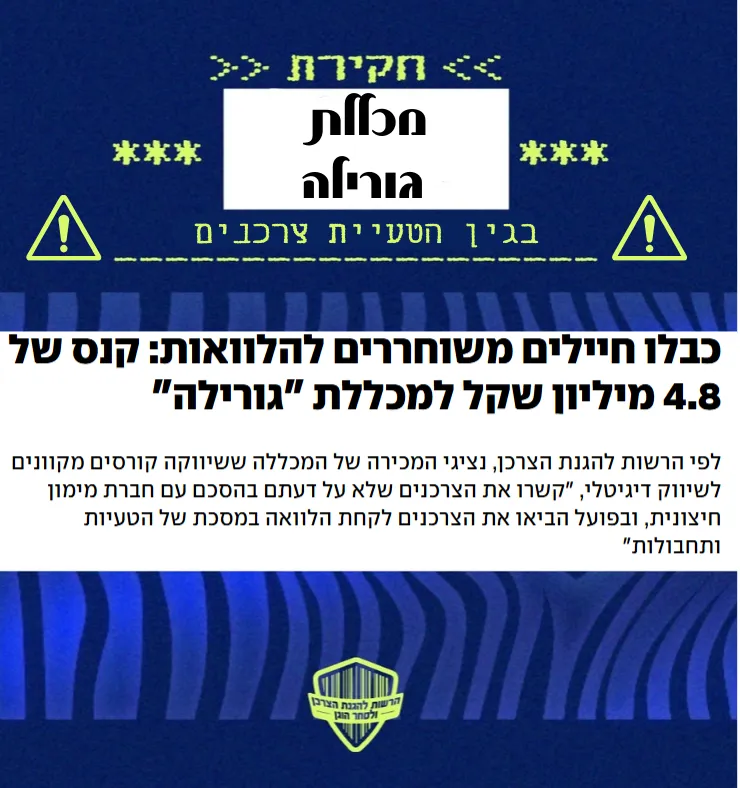
The Consumer Protection and Fair Trade Authority announced to Gorilla College Ltd., A.Sh. Marketing Center Ltd., and Pozailov Yaakov
its intention to impose a financial sanction of ₪4,867,184 after finding reasonable grounds to believe that they violated the provisions of the Consumer Protection Law, 1981.
The financial sanctions are divided as follows:
- Gorilla Ltd. – ₪1,439,840
- A.Sh. Marketing Center Ltd. – ₪2,760,760
- Pozailov Yaakov – ₪666,584
Total ₪4,867,184
It should be emphasized that the companies and the dealer have the right to be heard within 45 days of the notification, according to the provisions of the Consumer Protection Law, and they are entitled to raise legal and factual arguments, both against the intention to impose a financial sanction and regarding its amount.
Background:
Gorilla College provides online courses for digital marketing studies.
The Authority has received numerous complaints about the company. From these complaints and the Authority’s investigation, it appears that the companies and dealers violated various provisions of the law against consumers, engaged in deceptive and unfair influence practices against them, and failed to disclose information required by law.
Findings of the Authority’s Investigation:
Consumers who were exposed to various advertisements on the internet and expressed interest in the company’s course left their details on landing pages, Facebook, etc. Subsequently, telephone representatives contacted these consumers.
The representatives stated that Gorilla College co-finances the course, promised consumers future employment with high salaries, informed them that they were eligible for various scholarships to fund their studies, as well as studies funded by their military deposit.
The sales representatives offered consumers to undergo a “check” to see if the applicant was eligible for a scholarship or funding assistance from the college. In practice, through a series of deceptions and stratagems, the sales representatives, without the consumers’ consent, bound them to an agreement with an external financing company, effectively leading consumers to take out a loan and become entangled with an external financing company without their request, thereby binding them unknowingly to long-term loans.
The sales representatives informed consumers that the entire transaction could be canceled, but in practice, when consumers requested to cancel, the representatives claimed it was not feasible as service provision had begun.
The representatives did not disclose various details to consumers that were required by law.
The “Financing Check” process and the loan taken by consumers:
The sales representatives urged consumers to perform a “check” and “submit the application,” presenting the financing as a rare opportunity not available to everyone. In practice, as stated, this was not a “check” but a fait accompli of taking out a loan in the consumer’s name, even when the consumer had not expressed any willingness to purchase the course. In fact, while the sales representatives did not present it as a loan at all, consumers were unknowingly bound to a long-term loan without any hint of it.
During the loan process, which occurred towards the end of the call presented as a “check,” the sales representatives repeatedly clarified that consumers would not be charged at this stage and that they had time to consider. The representatives guided and assisted consumers step-by-step through the messages received from the financing company during the call between the sales representatives and the consumers, instructing them which documents to attach, which key to press, where to sign, etc. When consumers received an SMS message with a code to approve the loan, the sales representatives told them it was only for identity verification, while in reality, it was a complete process of taking out the loan, which was ultimately concluded without full knowledge and understanding.
Sections of the Consumer Protection Law that were violated:
- Section 2(a) – Prohibits providing information that may mislead a consumer on any material matter.
- Section 2(a)(10) – Stipulates that sponsorship, encouragement, or authorization given for the production or sale of a product or provision of a service is a material matter in a transaction. Any act that may mislead a consumer regarding sponsorship, encouragement, or authorization given for the sale of a product or provision of a service constitutes a violation..
- Section 2(a)(21) – An act that may mislead regarding the terms of cancellation of the transaction.
- Section 3(b)(8) – Supplying a product or service to a consumer for payment not at their explicit request constitutes unfair influence..
- Section 3(b)(9) – Creating an impression for the consumer that a benefit exists when in fact no benefit exists constitutes unfair influence..
- Section 14c(a) – Failure to disclose details during distance marketing.
Kobi Zerihan, Commissioner of the Consumer Protection and Fair Trade Authority:
“This is a serious case of exploiting innocent consumers who fell victim to a sophisticated sales tactic that led them to take out loans they did not request. Consumers are entitled to transparency, fairness, and informed consent in every transaction, especially when it involves a long-term financial commitment. Cases where consumers are signed up for loans without fully understanding that it is a loan are fundamentally flawed. The Authority views such cases with severity and will continue to act assertively to protect the public of consumers.”
Related Topics