




















Minister of Education Yoav Kisch: “The Israeli education system must lead, not react. This conference marks a conceptual shift – moving from thinking about technology as a tool, to thinking about artificial intelligence as a strategic component in shaping the future of education. Our responsibility is to ensure smart, ethical, and beneficial use, one that places students and teachers at the center.”
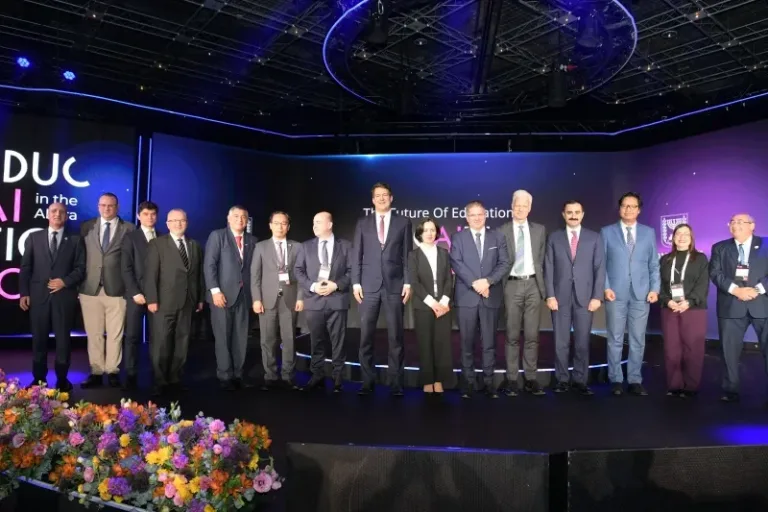
The EducAItion conference is the first international conference led by the Ministry of Education and is entirely dedicated to the integration of artificial intelligence in the education system. The event is held under the auspices of the Minister of Education Yoav Kisch, and led by the Deputy Director-General of the Ministry and Head of the Innovation and Technology Administration, Meirav Zerbib.
Approximately 30 delegations from around the world are participating in the conference, including about 500 senior figures from the high-tech, academia, and government sectors, alongside thousands of students and educators from Israel.
Among the participants:
- Prof. Andreas Schleicher, leader of global education policy at the OECD;
- Dr. Michael Gabor, one of the leaders in artificial intelligence at global Microsoft;
- Yossi Matias, Vice President of global Google and Head of Google Research;
- Prof. Susan Cho, an expert in ethics and discretion in the age of artificial intelligence from Singapore University, and others.
Ministry of Education’s Program 720 – First Reveal:
During the opening day of the conference, the Ministry of Education revealed for the first time the pilot of Program 720 – a strategic initiative to promote personalized, skills-based learning using artificial intelligence tools. This is a broad systemic approach aimed at creating a personalized learning experience for every student, while simultaneously strengthening and empowering the teacher’s role as an educator and leader of learning processes.
The name “720” represents a holistic concept: 360 degrees on the student and 360 degrees on the teacher. The program is designed to enable each student a learning path tailored to their needs, skills, and personal pace, while simultaneously providing teaching staff with advanced tools for professional development, deepening educational impact, and precise learning management in a heterogeneous classroom.
The concept underlying Program 720 is based on the understanding that personalization has proven effective in various fields, and now it is time to bring precision and personalization to the education system as well.
As part of the pilot, a technological learning system is being implemented that includes a personal AI-based learning assistant for each student. The system identifies real-time points of difficulty and strengths, assists in targeted gap filling, and enables dynamic and flexible learning, while maintaining pedagogical continuity and meeting learning objectives.
Students choose areas of interest and preferred learning styles, and the system builds a personal learning path for them.
Concurrently, teachers receive real-time insights into the learning status in the classroom – where students are struggling, who needs immediate intervention, and which students are ready for the next challenge.
The Ministry emphasizes that artificial intelligence does not replace the teacher, but rather gives them “new glasses”: the teacher becomes the designer and manager of diverse learning experiences, assists in setting personal goals, accompanies students in developing self-management skills, and guides each student on a precise and tailored path for them.
The 720 pilot program was launched this year in 7th-grade classes in 28 schools in 15 local authorities, in collaboration with major technology companies, and is expected to expand next academic year to an additional 50 schools, while continuing to support students in 8th grade as well.
The program operates on a Design Partnership model, in which the Ministry of Education develops the product together with field teaching staff and selected high-tech providers. Among the partnerships: Matach and Microsoft, Edtech, Amit Network and Google, Sanunit and Milgo.
In parallel with the conference, the Ministry of Education is holding a large-scale innovation fair, which includes approximately 230 booths, live demonstrations, and practical solutions in areas such as personalized learning, integration of artificial intelligence in the classroom, special education, sustainability, STEM, space, language, and projects developed by students and teachers.
The fair aims to expose Israeli education teams to existing tools in the field and encourage intelligent implementation in educational frameworks across the country.
Words of the Mayor of Jerusalem, Moshe Lion: “It is a great honor for me, as the Mayor of Jerusalem, to welcome you to our city and to host this important international conference. Jerusalem is home to the largest education system in Israel, with over three hundred thousand students from a wide variety of backgrounds, cultures, and communities; this diversity is our source of strength.
By embracing innovation, responsible use of advanced technologies, and strengthening values, Jerusalem is not only preparing its students for the challenges of tomorrow but is also helping to lead educational change far beyond its borders.
Jerusalem, the capital of the State of Israel, is also leading educational change throughout the entire country, and we are proud to be a center of learning, innovation, and inspiration for Israel and the entire world.”
Meirav Zerbib, Deputy Director-General and Head of the Innovation and Technology Administration at the Ministry of Education: “Israel, known as a global innovation hub, has gathered here the leaders in the field of artificial intelligence. In doing so, we have paved the way for a promising yet challenging field. The 720 pilot, which we are launching today, is a significant step in adapting the Israeli education system to the needs of the next generation. We are embarking on this journey with the understanding that along the way we will learn, refine, and improve – for the benefit of students, teaching staff, and the Israeli innovation industry.”
Related Topics