









IDF Spokesperson • January 6, 2026
The first thing that will likely catch your eye is a launcher with a gaping muzzle, alongside a collection of old Kalashnikovs and a motorcycle missing its front end. But as you delve deeper into the tour of the captured spoils, you will discover fascinating facts that the items confiscated from terrorist elements in Gaza, Lebanon, and Syria since the beginning of the war reveal.
By the end, it will be difficult for you to understand why, even with tens of thousands of findings already in their possession, the reservists of the Spoils Evacuation Unit (Yachpesh) are still deeply engaged in the collection effort.

Right: An Iranian ‘Badr’ rocket in the exhibition yard, Left: The same rocket in a Hamas show of force in the Strip
One of the most striking aspects of the spoils throughout the war is the fundamental difference between Hamas’s munitions and those of Hezbollah. “In the Strip, the weaponry primarily comes through the ‘black market’,” begins to explain Lt. Col. (Res.) A., deputy commander of the unit. “It passes through such convoluted trade networks that even if the country of origin is known to us, like Iran for example – it’s likely the weapon passed through several stations and perhaps countries before reaching its destination.”

An Iranian imitation of an American TAW launcher
But even when the country of origin is in doubt – the affiliation with the terrorist organization is usually clear, as they tend to brand and even mark their weapons distinctively and consistently. While this action might seem like assistance to Israeli intelligence personnel – pride and the need to threaten the rest of the population take precedence. And thus, one can learn about the differences between the organizations and the various fronts.

Lt. Col. (Res.) A. with simple activation mechanisms for launchers
One phenomenon that is significantly more common in Gaza than on the northern borders is the production of hybrid weaponry from accessible civilian objects. Take, for example, the ‘Al-Yassin’ RPG rocket launcher: “Basically, it’s a pipe with a trigger mechanism. The only sophisticated part is the notch that precisely positions the rocket in front of the firing pin. The terrorists saw off traffic signs, attach wooden pieces to them for ‘protection’ of the user’s shoulder, and connect everything with vehicle clamps.”

‘Al-Yassin’ launchers: Traffic signs, wooden pieces, vehicle clamps, and inscriptions
Alongside the rocket launchers, in the section of weapons from the Strip, one can also find Kalashnikov rifles, some very old, rusted, or burnt. “They all still had a round in the chamber when we found them,” testifies Lt. Col. (Res.) A., and immediately points to slightly different machine guns: “This is a model known to Hamas as ‘Bin Laden’ and is reserved only for senior operatives. It’s the only one in their arsenal that fires small caliber ammunition, and it essentially serves more as a status symbol than a rifle for effective attack.”

But the northern front, as he explains, is entirely different: “Hezbollah operates completely differently. There, it’s not unusual to find a series of weapons marked with consecutive numbers. That is, those that arrived directly from Iran in factory-sealed packages.”

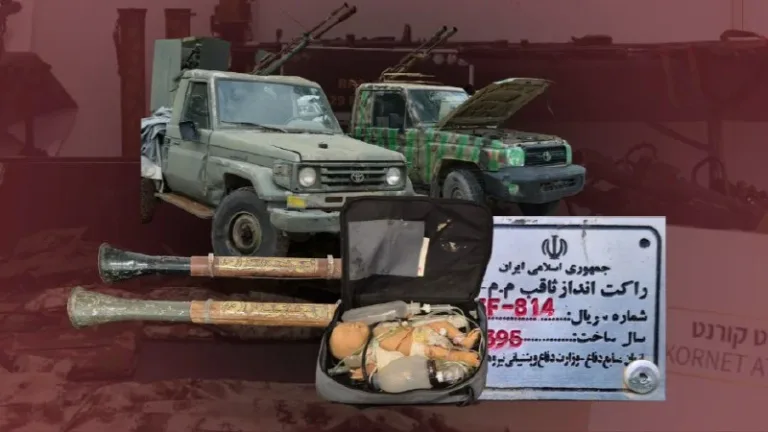
Translation from Persian: “The Islamic Republic of Iran, ‘Squib’ M.M.73 launcher, serial and manufacturing year”
The organizational gap is also evident in the meticulous camouflage uniforms of Hezbollah displayed on the exhibition floor at the Central Intelligence Unit, alongside a vacuum-sealed launcher with a humidity indicator and a name tag – evidence of organized military depots intended for supplying and storing long-range ammunition.

Throughout the war, the findings collected by the Yachpesh teams allow for entering the enemy’s mind, understanding how to cut off their supply lines, and also delving into the changes they are making in their combat doctrine. And as time passes and the spoils stockpile grows – broader trends can also be analyzed.


“For example, you can compare the motorcycles we found in ‘Protective Edge’ with the dozens seized in the last two years,” demonstrates Lt. Col. (Res.) A. “The vehicles from 2014 were cut to be narrow and pass easily through tunnels, and today they are larger to carry as many people as possible. At the same time, one can observe the enemy’s attempts to create remote control for launchers, improve quality control, and add more triggers – it’s easy to see this in the items confiscated from the zones.”


And of course, the seized weaponry also provides a glimpse into the minds of its operators. “For example, Hamas’s medic kits do not contain life-saving treatments, only equipment that will allow terrorists to remain ‘useful’ in combat. In Hezbollah, on the other hand, many medicines from Iran were found – while hospitals there suffer from severe shortages. This shows a clear order of priorities.”

Just before presenting one of the most shocking items in the room, Lt. Col. (Res.) A. takes a breath: “What you see here is a training kit for infant resuscitation. In a hospital or university setting, it’s natural and legitimate to find one. But this bag was found in a tunnel, in a location that clearly indicates Hamas’s intention to abduct infants and keep them alive for negotiation purposes.”

Most of the weaponry displayed here was brought by the Yachpesh reservists. They come from diverse backgrounds such as engineering, armor, ordnance, and infantry – and travel to dozens of cross-border locations following intelligence reports, often from soldiers in the field. Sometimes their mission includes towing a vehicle equipped with a launcher, and at other times it involves extracting equipment embedded in concrete, but every day it remains one of the most diverse in the IDF: for intelligence and development, as well as for documentation and public relations purposes.
“I look at the items we bring, knowing they will be transferred for further investigation and will also be seen by foreign correspondents,” adds Lt. Col. (Res.) A., “and I think, here it is, the tangible truth of our war, something that will remain and cannot be denied.”
Related Topics