



















Why is the first rank called “Private” (Turai)?
Because a Turai stands in a “line” (tur), and he is one among the ranks.
A Hebrew adaptation of an equivalent rank in the British Army.
The word itself has no inherent meaning.
Explanations:
Turai is the lowest military rank that exists in most armies around the world. In Hebrew, its meaning is derived from the word tur (“line”), in which the soldier stands during training—because he is at the very beginning of his path.
Today, “Shekem” is already a private company, but in the early days of canteen services—there were quotation marks!
Quotation marks for acronyms are placed according to their position in the original acronym—before the final letter. When inflecting the term, the quotation marks remain in the same place. The correct way to write is חפ״שן (ḥapashan) and not חפש״ן, and מ״כים (makhim) and not מכ״ים. Between a letter and a number that appear together, we always use a hyphen; therefore, we write מ-8 and not מ8.
Although this term is more commonly known in connection with physical training, there is also an economic alternative.
“Ruth, over” is the Hebrew alternative chosen for “Roger, over” when looking for a term that begins with the Hebrew letter resh. And why “Roger”? The English were looking for a word that would begin with R, like Receive, meaning “to receive.”
Acronyms that end with regular letters (not final-form letters) are pronounced by saying the names of the letters, not by their sounds—for example, מ״מ is pronounced “mem-mem.”
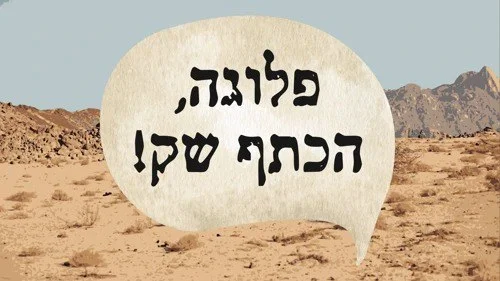
The accepted pronunciation in military formations is “ha-katef ‘shek’” (“shoulder ‘shek’”), which shortens the word neshek (“weapon”).
“For raising the flag, the formation will shoulder arms—flag ‘shek’!”
Related Topics