



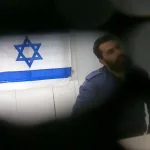
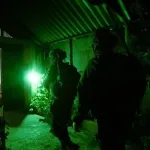



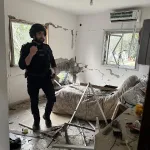
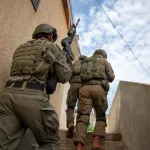

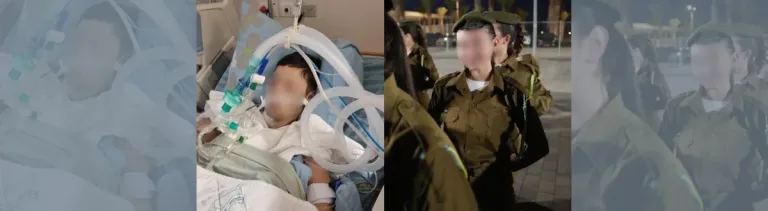
This happened almost two years ago, on 02/15/24. A’, then a combatant in the Paratroopers Reconnaissance Unit, was in the midst of the maneuver in Khan Yunis when a grenade was thrown into a structure where he was with the rest of the force. “We heard a huge explosion and a lot of dust flew into the air,” he recalls, “I tried to get on the radio to report the incident, and then they started treating me.”
A’ and the other casualties were evacuated from the scene in an armored personnel carrier, and from there a helicopter took them to the hospital. In that incident, two combatants fell, Sergeant First Class Rotem Sahar Hadar z”l, and Sergeant First Class Maoz Morel z”l.
 A’ in the hospital
At that time, N’, A”s sister, was a 12th-grade student. Suddenly, she was informed that her brother was seriously injured and undergoing emergency surgery: “The whole family rushed to the hospital. I entered the room and saw him on the bed, surrounded by doctors. It was an almost surreal situation, I didn’t know how to react. On the one hand, you expect the worst, but on the other hand, there’s also a sense of relief.”
 A’ and his team members
After the initial recovery, A’ began a long rehabilitation process, which continues to this day. His sister was a partner in the journey, and when the time came for her to decide on her path in the army, she chose to be a casualty NCO, voluntarily. “It wasn’t even a question for me,” she testifies, “it was very clear to me that this was the direction I was going, especially after A”s injury.”
“In my eyes, this is a kind of mission,” she adds, “I know what it’s like to be the family of a wounded combatant, and since then it’s important to me to turn the difficult experience we went through into something that can help others.”
 N’ at the end of the course
When N”s brother heard about her decision, the first thing he did was call his casualty officer. “We had a close relationship,” he shares, “I really remember the first time she introduced herself at the hospital and said she would accompany me. So the fact that my sister would fill this important role moved me. I had to tell her, and of course, it warmed her heart.”
And indeed, N’ enlisted in the casualty NCO course last November and completed her training about two months ago. Today, she accompanies IDF disabled veterans in the Intelligence and Border Corps. “For me, there is no more significant full circle than this,” she shares, “I see the people I accompany, and I know exactly what they are going through, because I was there, only now I can help them.”
 N’ and A’
“I look at her from the side and I’m very proud of her,” A’ continues, “It’s clear to me that she will fulfill this critical role as best as possible, and will always be there for the wounded and their families.”
Related Topics