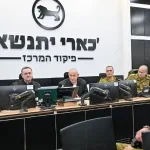




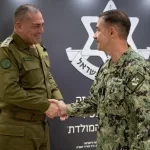











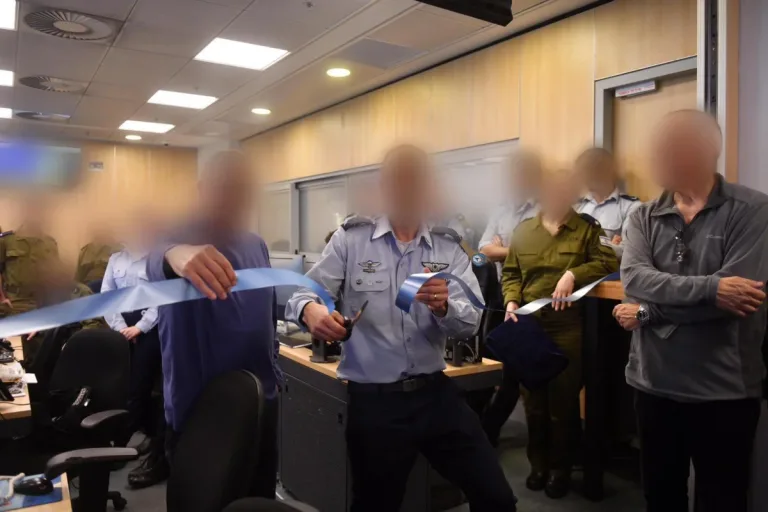
On the way to the ribbon-cutting ceremony for the Hes-She-Rem (HSH) Operations Room, we handed over our phones by the elevator leading to the entrance, and descended further and further (in the Air Force bunker, it’s hard to be sure how many floors). At the ‘ceremony’ itself, surrounded by warning screens and maps, dozens of soldiers and officers were crowded. Nevertheless, the space felt more spacious than usual – after the wall that had divided the room was folded away that day, marking the unification of the two cells – ‘Oz’ and ‘Zion’.

To help us understand why they merged last weekend, Sergeant Major N., Head of Border Defense, explained to us what their work actually looks like. “‘Oz’ is responsible for aerial fire across all commands and divisions – for example, from an aircraft, helicopter, UAV, and more. Alongside it, ‘Zion’ is in charge of airborne evacuations, aerial troop transport, and also special operations by units Shayetet 13 and 669.
Therefore, the connection between the two is natural – every evacuation by ‘Zion’ requires a protective envelope, which ‘Oz’ provides. And in the period preceding the ceasefire, as the parties testify, the need to combine these capabilities often arose, especially in ‘Red Button’ incidents (a designation for complex situations – S.Sh.).

So why the separation in the first place? It can be compared to the personal equipment of fighters in a team. In the first assault or repulse, everyone acts as a single front – as Hes-She-Rem (HSH) is designed to operate in ‘routine’. But with developments on the ground, each fighter moves to the unique missions they specialize in, whether as a sniper, medic, or communications specialist. Similarly, in the unified operations room, when necessary, the cell commanders will re-erect the folding wall.
During the ribbon-cutting, the cell officers continued to glance at the warning screens and answer phones. “Just two hours ago, we identified a Hamas launch that fell within the Gaza Strip,” shares Brigadier General (Res.) N., the cell commander. “Even in such a situation, from the moment of the report, we prepare for a response.”

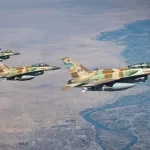
Indeed, awareness of aerial support capabilities on the ground has increased over the past two years – which is evident in the ongoing activity of the cells. “We receive real-time information from Air Force representatives deployed among the forces, and mediate between them and the relevant arrays, so that they can neutralize the threat in the best way, with precision and speed. This can be done through a bomb dropped on a target, a combat helicopter gunship firing at terrorists, or a UAV ‘hunting’ a marked target, even if it’s moving,” describes Sergeant Major N.
The new name, Hes-She-Rem (HSH), is actually an acronym for a multi-mission control room. “The ‘Hes’ [H] signifies defense and surprise, because our goal is to deal with a sudden war as well, where we can function as the central hub for initial response, and of course, be partners in defending the borders,” adds Sergeant Major N.

The unified operations room joins the last mission with increased force: “The entire Air Force is moving to a much more proactive concept, as part of the lessons learned from the war – with the biggest change being the establishment of the Border Air Wing, which is designed to work with the Ground Arm and deal with the challenges these sectors present.”
Thanks to the close cooperation, the Hes-She-Rem (HSH) commanders already know what the work of the parallel operations room looks like, and yet, a ‘two-way’ overlap awaits them, where they will learn in depth about the activities they were accustomed to performing separately. “Working together,” believes Brigadier General (Res.) N., “will improve the synchronization thinking process, and optimize the force buildup – a large part of which consists of reservists. In this new format, we will succeed in working hand-in-hand even in the long term.”
Related Topics