


















Between Gaza, Lebanon, and Syria, the battlefield is not only shifting but also transforming, even in aspects previously taken for granted until the war. Such a process has recently been observed in the Combat Engineering Corps, with the transformation of the ‘Mahsar’ (Battalion Reconnaissance Platoon) into the ‘Ma’arag’ (Battalion Autonomy and Robotics Platoon).
“During combat, we realized the immense potential of integrating robots into the battlefield,” begins Lt. Col. L., Head of Doctrine and Capabilities Branch in the Corps. “It both protects human lives and allows for the execution of more ‘daring’ or ‘tactical’ missions – in a completely different way.” But the biggest news is that this is no longer a capability reserved solely for special units, but rather an operational method for the operational battalions themselves.
To understand why this change is so significant, we need to briefly go back to the Mahsar in its previous form. “For comparison, the Mahsar is like a reconnaissance platoon in the infantry,” likens Lt. Col. L. “Its primary role, beyond unique missions, is to generate an engineering situational picture: to understand the terrain, identify obstacles in advance, and provide the details for forces to operate in the field.”
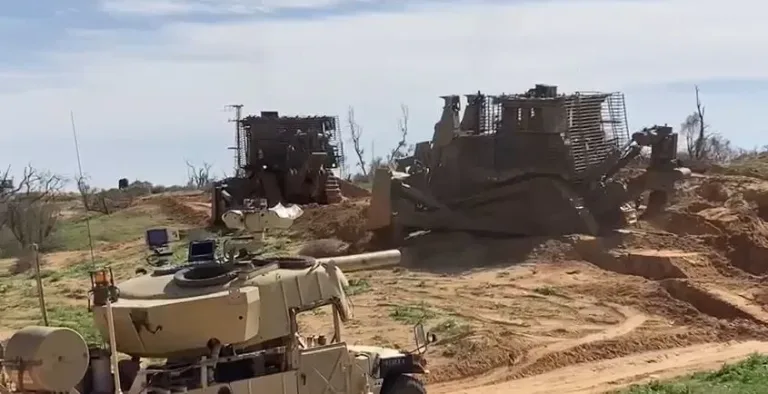
The world of robotics, which addresses this need, was not created overnight – but the war has certainly accelerated its integration into the heart of the Corps. “Every new capability we want to disseminate here begins with pre-selected experimental units, responsible for the initial operational trials,” he details. Indeed, developments you may have already heard of have been deployed: the ‘Panda’ bulldozer and subsequently additional means for observation, scanning, reconnaissance, and various remote engineering operations.
From Lt. Col. L.’s perspective, the true value lies not in the individual tool, but rather in the ability to connect them into a unified effort: “When you combine a robotic engineering vehicle with a robotic APC and a drone accompanying from above, you get a precise operational framework that reduces the risk to our soldiers’ lives. It’s possible to transport heavy explosives, tow loads, destroy assets – all remotely.”
An event he recalls from Operation ‘Chariots of Gideon’ illustrates the importance of these matters in real-time: “Forces from one of the brigades, including a regular engineering battalion, were operating in the southern Gaza Strip. They deployed a remotely controlled ‘Panda’ bulldozer to scan around suspicious structures. During the operation, the vehicle ran over a significant belly charge and was severely damaged.”
“While this is a development that cost money and invested significant time and resources,” he clarifies the lesson learned from that incident, “ultimately, and most importantly, there were no soldiers there. This is not an isolated case – anti-tank fire, snipers, and explosive ambushes that have encountered engineering vehicles have already shown us why it is so crucial for them to be at the forefront, absorbing the blow instead of people.”
Since then, the path to integrating robotics throughout the Corps has been paved. “We understood that we need to prepare differently, in doctrine, in training, and especially in thinking,” shares the Head of Branch. “It’s not just about knowing how to operate a tool – but truly building procedures and techniques, developing courses, and selecting people for specific fields.”
Today, the aspiration is to see robotics in every combat framework within the Engineering Corps. “It’s really not a one-man show,” he reminds, “but a partnership of many factors in the Corps – from the schools and various units, to the technological bodies that support the entire effort.”
As we conclude, when I ask what’s next, Lt. Col. L. remains practical but optimistic: “I hope that in a decade, there will be an entire system in the Corps dedicated to this. Ultimately, the goal is grand: to move from a world where robotics was a ’boutique’ capability held by a few, to one where it is a truly integral part of the operational and professional identity of engineering battalions. The acceleration of this change depends, first and foremost, on us.”
Related Topics