















Data presented at the conference indicates that one year after the pilot’s launch in 14 out of 15 participating municipalities, municipal prosecutors have been appointed, inspection units have been established in 13 of them, and enforcement is actually underway in 10 municipalities – a figure reflecting an accelerated transition from the establishment phase to independent operational capacity within the municipality.
The pilot, which commenced in November 2024 in 15 selected Arab local authorities, as part of a broad government program to address crime and violence in Arab society, is being promoted by the Ministry of Interior under Government Decision 549, in unique inter-ministerial cooperation led by the National Bureau for Fighting Crime in Arab Society in the Prime Minister’s Office, the Prosecution Guidance Department at the State Attorney’s Office – Ministry of Justice, and the Wage Commissioner at the Ministry of Finance.
During the conference, speakers emphasized that the pilot focuses on municipal enforcement and prosecution, a core area of responsibility for local government and the Ministry of Interior. It does not provide a comprehensive solution to all crime and violence phenomena in Arab society, but it constitutes a central component in strengthening local governance and establishing the rule of law in local authorities.
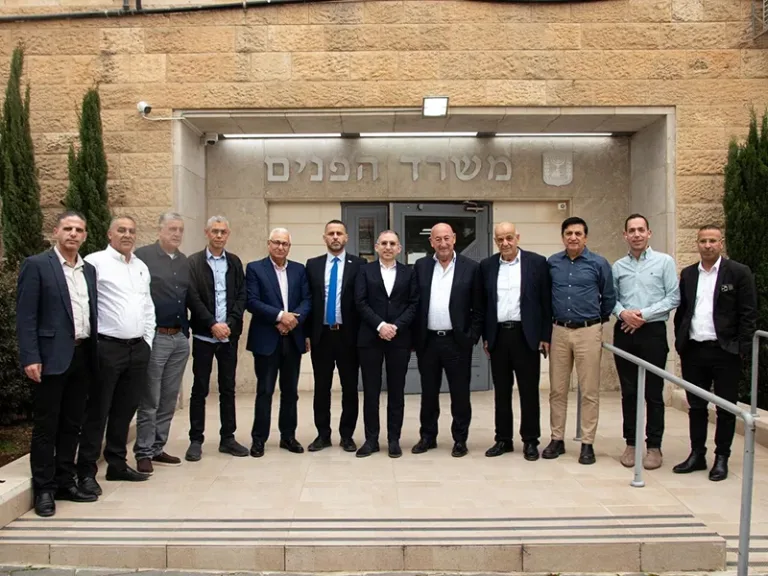
The conference was attended by heads of municipalities, CEOs, inspection managers, and municipal prosecutors from the participating municipalities in the pilot, who presented work processes, challenges, and solutions implemented in the field. All speakers praised the mobilization of the heads of municipalities and professional ranks, and emphasized that the commitment of the heads of municipalities and the professional levels in government ministries and local authorities enabled the pace of progress and the success of the pilot. Within the framework of the conference, data was presented by the team leading the project in the Innovation and Organizational Development Division – a senior division for managing human capital in local authorities at the Ministry of Interior, and the Municipal Prosecution Guidance Department at the State Attorney’s Office. Examples and successes from the local authorities were also presented.
Israel Ozana, Director General of the Ministry of Interior, stated at the conference: “We cannot ignore the scope of crime and violence in Arab society and their severe implications for daily life and residents’ sense of security. The pilot we are promoting is not a comprehensive solution to this broad phenomenon, but rather a focused initiative to strengthen municipal enforcement and prosecution systems, a central tool in the hands of local authorities to realize their powers, as part of a broad governmental picture to strengthen governance and the rule of law. The success of this initiative relies first and foremost on the responsibility, commitment, and leadership of the heads of municipalities and the professional teams. The impressive progress would not have been possible without the work, coordination, and professional implementation in the field. Even during a complex period, the authorities chose to lead this significant process with public responsibility, and the purpose of the meeting is to express appreciation for this and to continue jointly advancing the strengthening of enforcement and local government.”
Adv. Roi Kahlon, Head of the National Bureau for Fighting Crime in Arab Society in the Prime Minister’s Office: “Criminal organizations are a strategic threat to the national security of the State of Israel. Faced with such a threat, the state must utilize all the tools at its disposal. Strengthening municipal enforcement and local prosecution systems is a central component in building true governance on the ground. The progress in the pilot proves that when we work together, we achieve results. This is a national struggle, and we are determined to win it.”
The Project Manager for Arab Society Affairs in the State Attorney’s Office, Adv. Alaa Ayyoub, added: “The fight against crime is composed of five different elements and three levels of work. Establishing a local prosecution system is building a foundation of the rule of law at the municipal level. This is a long-term professional process that contributes to the authority’s ability to enforce the law within its areas of jurisdiction.”
The Mayor of Sakhnin and Chairman of the Committee of Arab Mayors, Mr. Mazen Ganaim, stated in his remarks that local authorities have taken responsibility and led the establishment of municipal enforcement and prosecution systems, as part of strengthening public order and improving residents’ quality of life. At the same time, he emphasized that a broad and continuous government policy is required to deal with the phenomenon of crime.
The “Mid-Way” conference marked a significant stage in the transition from policy to implementation, clarifying that this is a focused initiative in the area of municipal enforcement and prosecution, as part of a broad governmental response to the challenges of governance and personal security in Arab society.
List of municipalities participating in the pilot: Abu Ghosh, Umm al-Fahm, Baqa al-Gharbiyye, Julis, Jaljulia, Deir al-Asad, Hura, Tayibe, Kafr Qasim, Kafr Kara, Majdal Shams, Maghar, Sakhnin, Reineh, Shaghur-Shalom.
Related Topics