






















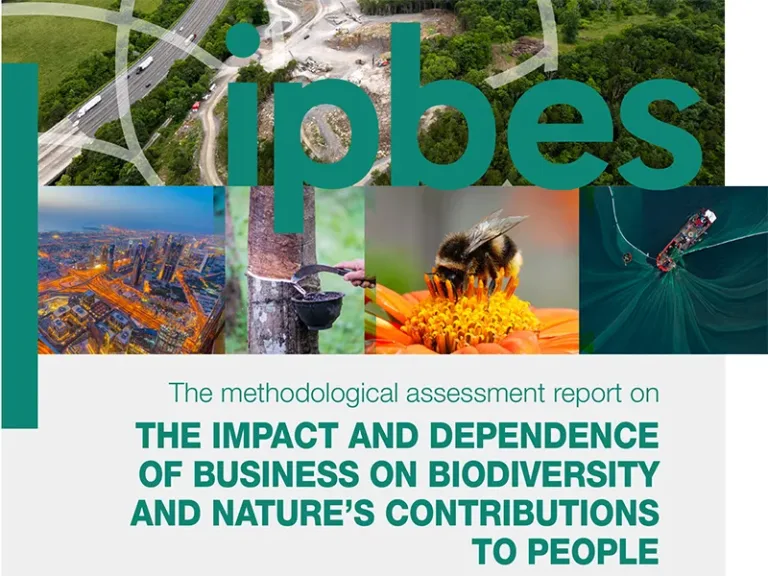
Last week in Manchester, UK, the 12th Plenary meeting of IPBES (the Intergovernmental Science-Policy Platform on Biodiversity and Ecosystem Services) concluded. At the end of the discussions, the first-ever global assessment on Business and Biodiversity was published. Representing Israel was Dr. Anna Trachtenbrot, Head of the Biodiversity Division at the Ministry of Environmental Protection, who participated in shaping the “Summary for Policymakers” (SPM) approved yesterday.
IPBES is an independent international body with 150 member states, serving as the primary scientific foundation for global nature conservation and biodiversity policy. Its assessments are utilized by the CBD (Convention on Biological Diversity) and nations worldwide to implement their targets for 2030.
Dr. Anna Trachtenbrot, Head of the Biodiversity Division at the Ministry of Environmental Protection and Israel’s representative at the discussions: “The IPBES report makes it clear that there is no separation between economic activity and the state of nature. Businesses in every sector rely on ecosystem services and impact them. Systematically integrating biodiversity considerations into business and policy decision-making is not just an environmental necessity, but a condition for long-term economic stability. The tools already exist today, and the main challenge is to implement them in practice on a large scale. In this way, the business sector will avoid significant risks and will be able to enjoy new business opportunities”.
The current report is the first global assessment examining the symbiotic relationship between business and biodiversity. Following three years of research by dozens of experts, the conclusion is unequivocal: all global businesses depend on nature. Whether through raw materials, agricultural pollination, flood regulation, or water purification – the services nature provides for free are the infrastructure for all economic activity.
The report warns that current global policies and incentives often do not encourage businesses to reduce their impact on nature and biodiversity. However, it emphasizes that using existing advanced measurement methodologies – alongside collaborative action between governments, regulators, and the business sector – can reverse this trend, reduce business risks, and create new growth opportunities.
The State of Israel is characterized by a unique wealth of biodiversity alongside significant development pressures. Israel views the IPBES report as a key strategic tool for formulating science-based environmental policy. The Ministry of Environmental Protection serves as Israel’s national focal point for the platform and has been working for over a decade to bridge science, policy, and economics in the fields of nature and biodiversity. Israel’s active participation in the plenary discussions and in formulating the recommendations reflects a commitment to applying scientific knowledge in national decision-making.
Alongside its international activities, the Ministry is already promoting a series of practical measures within Israel:
- he “TevaBiz” initiative, which has been operating since 2014 in collaboration with the Society for the Protection of Nature in Israel (SPNI), assists commercial companies in integrating biodiversity considerations into their core activities, with an emphasis on the infrastructure, tourism, and agriculture sectors. Within the framework of the initiative, professional guidance documents and dedicated standards have been published.
- The Israeli Taxonomy for Sustainable Activities, published in 2024, provides the financial sector with a tool for classifying environmental investments based on their contribution to reducing greenhouse gas emissions (mitigation), with an explicit requirement to avoid harming biodiversity (“Do No Significant Harm”).
- Strengthening knowledge bases, including support for the “State of Nature Report” by Hamaarag and the BioGIS system, which makes up-to-date information on the state of Israel’s ecosystems accessible to the public, local authorities, and the private sector.
The publication of the IPBES report marks a new stage in corporate environmental responsibility. The Ministry of Environmental Protection will continue to work together with the Israeli business sector to ensure that economic growth does not come at the expense of natural resources – but rather exists alongside them.
Related Topics