


















By Pesach Benson • December 10, 2025
Jerusalem, 10 December, 2025 (TPS-IL) — Quantum Art, an Israeli developer of full-stack trapped-ion quantum computers, has secured $100 million in a Series A funding round to accelerate the commercialization of its systems and advance toward large-scale quantum computing, it announced on Wednesday. The financing, led by Bedford Ridge Capital and joined by Battery Ventures, Destra Investments, Lumir Growth Partners, Disruptive AI, Harel Insurance, Karen W. Davidson, GTV, Yasmin Lukatz, Corner Capital, and Qbeat Ventures, brings the company’s total funding to $124 million following its 2022 seed round.
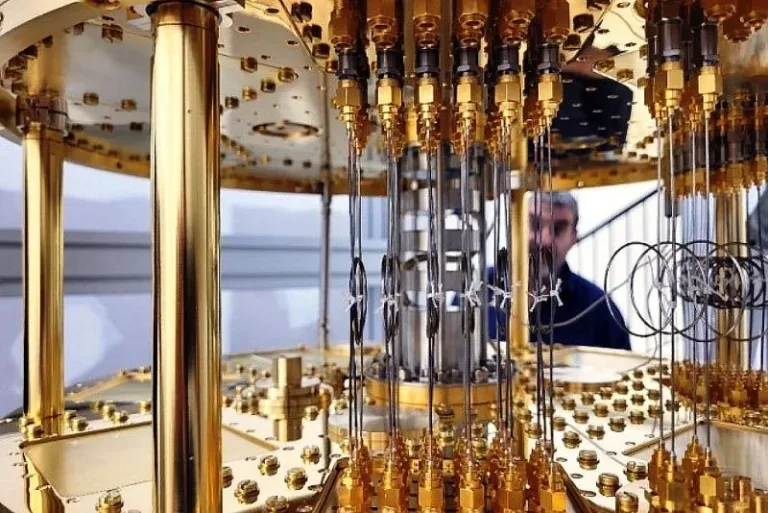
The new capital will support the development of Quantum Art’s Perspective system, a 1,000-qubit multi-core machine designed to achieve quantum advantage, and will help prototype a third-generation 2D architecture aimed at scaling to thousands of qubits for practical applications.
Existing investors Amiti Ventures, which led the seed round, StageOne Ventures, Vertex Ventures, Entrée Capital, and the Weizmann Institute of Science also participated in the round.
“Investment support at this level reflects strong confidence in our technology and products,” said Dr. Tal David, CEO and co-founder of Quantum Art. “It reinforces the momentum behind our multi-qubit gate architecture and our path toward systems that scale from hundreds to ultimately thousands and millions of qubits.”
Quantum Art’s proprietary architecture uses reconfigurable, multi-core trapped-ion chains that maintain high connectivity as systems grow. Multi-qubit gates compress complex operations into a single step, while dynamic optical segmentation allows parallel computing regions within the same ion chain. Dense 2D arrays enable significant qubit scaling without expanding the system’s footprint, creating a platform optimized for practical scalability and high-performance quantum algorithms.
Founded in 2022 as a spin-off from the Weizmann Institute of Science, Quantum Art combines scalable hardware with software designed for optimization, simulation, and complex real-world computing challenges. The company aims to transition from early revenues to full commercial scale with this latest round of investment.
The funding comes after a period of rapid technical progress. The company recently demonstrated the world’s longest fully controlled trapped-ion chain of 200 ions, highlighting the stability and scalability of its approach. Early results from a collaboration with NVIDIA’s CUDA-Q platform showed a tenfold reduction in circuit depth, while a joint project with Ayalon Highways explores potential applications for quantum computing in traffic management.
“Quantum computing advances only when extraordinary people come together,” said Dr. Amit Ben-Kish, CTO and co-founder of Quantum Art. “Our team has turned ambitious ideas into state-of-the-art systems at remarkable speed. This funding lets us strengthen this team and deepen our strategic partnerships that will accelerate our path to commercial-scale machines.”
Quantum computing is a cutting-edge field of technology that uses the principles of quantum mechanics to perform computations. Unlike traditional computers, which process information in binary bits (0s and 1s), quantum computers use “quantum bits,” also known as qubits, which can exist in multiple states simultaneously, allowing them to process a vast number of possibilities at once.
Quantum computers are particularly powerful for tasks such as cryptography, optimization, material science, and simulations of complex systems, though they remain largely experimental. Quantum computing also promises to revolutionize computing speed and capacity.
Israel rolled out its first domestically made quantum computer in 2024.
Related Topics