























By Pesach Benson • March 12, 2026
Jerusalem, 12 March, 2026 (TPS-IL) — Israel has quietly climbed the ranks to become the world’s seventh-largest arms exporter, increasing its global share even while engaged in war and facing mounting international criticism. A Stockholm International Peace Research Institute (SIPRI) report released on Monday shows that between 2021 and 2025, Israel accounted for 4.4 percent of worldwide arms sales, surpassing Great Britain for the first time. Britain’s share stood at 3.4 percent over the same period.
“Despite conducting the war in Gaza and attacks in Iran, Lebanon, Qatar, Syria, and Yemen, Israel still managed to increase its share of global arms exports,” said Zain Hussain, a researcher with SIPRI’s Arms Transfers Programme. The report highlights that Israel’s growth was largely driven by demand for air defense systems.
Israeli arms sales are concentrated in Europe and Asia, which together account for more than 80 percent of exports. The country sold to 23 European nations, including supplying 8.2 percent of Britain’s arms purchases, second only to the United States. In Asia, 10 countries purchased Israeli weapons, while North and Latin America made up 8.6 percent, and seven African nations imported Israeli arms. Morocco sourced roughly a quarter of its weapons from Israel, while other key clients include South Korea, Germany, Singapore, Denmark, and Thailand.
Sought-After Air Defenses
Some deals have made headlines for their scale. Germany purchased the Arrow missile defense system, the largest arms sale in Israeli history. India also agreed to roughly $10 billion in defense contracts with Israel for drones and air defense systems during Prime Minister Narendra Modi’s recent visit.
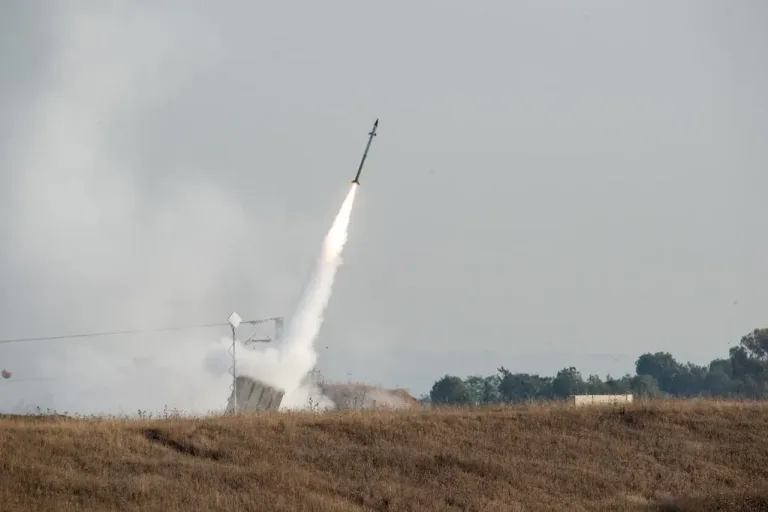
Iron Dome is the best-known system in Israel’s multi-tiered air defense network. Romania became the first European buyer of an Israeli Iron Dome with a €2 billion ($2.3 billion) deal signed in May.
Other layers include David’s Sling, designed to shoot down medium-range threats at high altitudes, and the C-Dome system, designed to protect naval assets from short-range threats. C-Dome made its first operational intercept in April 2024.
The Arrow-3 system, which is designed to intercept ballistic missiles, had its first operational success when it shot down a ballistic missile fired by Iran-backed Houthi rebels in Yemen in November 2023. It is widely believed to be the first time a missile was intercepted in outer space, though Israeli officials have not confirmed this.
Israel also became the first country to deploy a laser-based air defense system, the Iron Beam.
While exporting weapons to dozens of countries, Israel continues to rely heavily on imports for certain military needs. It ranked as the 14th-largest arms importer in the same period, with the United States supplying 68 percent of its acquisitions, Germany 31 percent, and Italy one percent. SIPRI notes that Israel received advanced fighter jets, guided bombs, and missiles even as it waged a multi-front war, including its large-scale offensive in Gaza beginning in October 2023.
Globally, the arms trade grew by 9.2 percent over the past five years, with Europe tripling its imports and emerging as the world’s top importing region. Rising tensions with Russia and escalating Middle East conflicts contributed to this surge. The United States remains the dominant global arms exporter with a 42 percent share, followed by France, Russia, Germany, China, Italy, and Israel.
Despite repeated international warnings and calls to halt sales, Israel’s weapons continue to reach foreign militaries. The SIPRI report underscores the country’s dual position as a leading supplier and a major importer of arms, reflecting both the global appetite for its technology and its ongoing need to sustain its military operations.
“The Israeli arms industry focuses on air defence systems for which there is high global demand, while the Israeli military depends on imports for several types of key equipment,” Hussain said.
Even amid war and scrutiny over civilian casualties, Israel has expanded its influence in global defense markets. The report paints a picture of a country that has not only weathered international pressure but has leveraged it to strengthen its position as both a major exporter and importer in the world’s arms trade.
Related Topics