











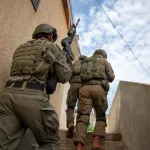


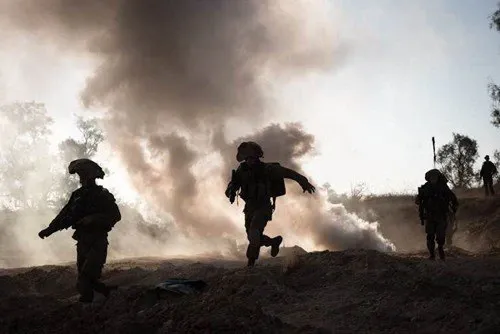
After long-term planning and preliminary preparations, the Ground Forces today announce the establishment of a new division – 38. This division is taking shape based on the lessons of October 7th and the fighting of the past two years, and as part of a series of changes aimed at adapting the force buildup to future challenges and present complexities.
The idea behind the reorganization is simple: to take all the main training frameworks of the Ground Forces, unite them under a single command, and assemble them into a division that will serve as a ‘home’ for various combatant trainings, and also as a maneuvering corps reserve for any mission that can be activated when needed.

And if you were wondering who will be part of the division, it comprises the core of the Ground Forces: from the Infantry School and Bahad 1, which train the next generation of commanders, through Shizafon (Brigade 460), Bislam (Shveta), and Bahalatz of the professional corps, to Bahalag (School for Border Defense).
In practice, this means concentrating all training brigades under a single command structure – not necessarily to operate them all together constantly, but to improve order, readiness, and the ability to deploy and fight on demand. Additionally, given that all brigades have maneuvered and gained operational experience, their unification is intended to maximize and optimize their operational deployment when needed.

Practically, in terms of training, the division will be responsible for the entire process: from the most basic stage of training combatants and commanders, to operational deployment, along with investing resources in capability development. Concurrently, the division command and the brigades under it will continue to train beyond the regular training routine, to maintain readiness and advance maneuvering capabilities.
Although it is composed of several brigades located at different bases, the division command will be located at Camp Emanuel (Julis), and will be staffed by staff officers from the Ground Forces’ Operations Brigade – who will enter their roles in the division in times of emergency. It will be headed by Brigadier General Sharon Altit, commander of basic training and the Operations Brigade in the Ground Forces.

The establishment process is also progressing to a practical stage: in July, the planning of the force components and the transition to execution began, and in recent days, an initial exercise for the division staff is taking place with brigade commanders, concurrently with the establishment ceremony. And that’s not all – later this year, a first operational exercise will be held as part of the path towards the defined goal: readiness for active maneuver by the end of next year.
And what is behind this historic decision? The move comes after the current war highlighted how much maneuvering divisions lead the fighting and directly influence the results on the ground. Based on this understanding, and concurrently with the expansion of the scope of missions and the need to coordinate efforts in various theaters, the Ground Forces decided to add a significant ‘reinforcement player’ to the field.

And when speaking of the new division, one cannot ignore its emblem – which is composed of several interesting elements. The ridge of hills, which adorns the background well, symbolizes the geographical area of the various units under its command, spread across the Negev and Arava. The book, located right in the center, indicates the division’s purpose, as one responsible for training and representing the professional foundation on which the Ground Forces’ combatants are trained.


Another significant element, or rather a pair of elements, are the sword and the olive branch, each symbolizing different principles. The sword symbolizes readiness, resilience, and mission-orientation, while the branch reflects the righteousness of the cause, defense, security, and the military’s moral commitment to the state.
Lastly are the arrows, emanating from different focal points, symbolizing the deployment of the training bases in the Negev and Arava, and despite the distance, ultimately focusing on one goal, expressing maneuver, mission focus, and purpose.

And with all the thought behind its establishment, you can already infer that its number was also carefully chosen: 38 was named after the veteran division that operated during the Sinai War and the legendary “Um Ketef” operation in the Six-Day War.
Looking at the big picture, one can understand that the establishment of the division is far from standing alone, and is part of a larger puzzle of changes being made in the IDF in general and in the Ground Forces in particular. Within that move, a structural decision was also made: to close the Corps Command, and in its place establish Division 38 – which is returning this time with the aim of building a first-of-its-kind body in the Ground Forces, that will consolidate training, and simultaneously be capable of operating in emergencies and functioning as a multi-theater force, looking towards the next maneuver.
Related Topics