





















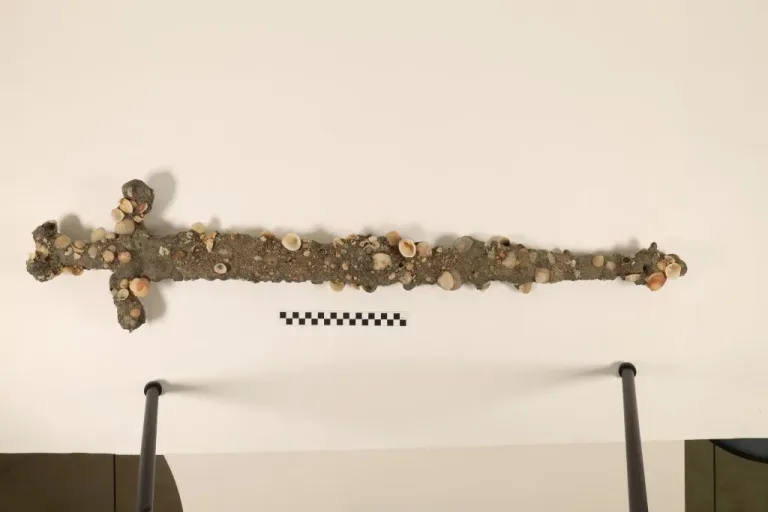
Jerusalem, 23 February, 2026 (TPS-IL) — A medieval sword that may once have hung at the side of a Crusader knight has resurfaced after eight centuries on the floor of the Mediterranean, discovered by chance off the northern Israeli coast.
“These artifacts are very rare and hard to find, because swords were not usually left behind. Swords were very precious, symbolic personal objects of Crusader knights. They were also very expensive,” Dr. Sara Lantos of the Department of Maritime Civilizations at the University of Haifa told the Press Service of Israel.
“This is definitely a European-type sword of a Frankish knight. It may have fallen off a ship or been lost during a battle. It’s another piece of evidence that enriches our knowledge of the Crusader period and the personal belongings of the knights who came here,” she added.
The one-meter-long sword was discovered last year protruding from the seabed near Dor Beach by Shlomi Katzin, a student of Maritime Civilizations who had been swimming in the area, the university said. After noticing divers using metal detectors and suspecting possible antiquities theft, he drove them away and continued scanning the seafloor, where he spotted the weapon emerging from the sand.
Recognizing its potential significance, Katzin alerted the university, which contacted the Israel Antiquities Authority. With special permission, the sword was carefully removed to prevent further damage and transferred to a conservation laboratory before undergoing advanced imaging in a nearby hospital.
Encased in thick marine deposits formed over centuries, the sword’s condition could not be assessed from the outside. Doctors and researchers turned to CT imaging at Haifa’s Medica Elisha Hospital to look beneath the hardened layers without damaging the relic.
“The CT is a non-invasive, non-destructive method to examine the sword, which was covered with shells and rocks, so it was hard to see the actual shape and condition of the iron underneath… but the CT gives us a chance to look inside and see the shape and design,” Lantos said. She added that the layer of shells cannot be removed because any exposure to air would further deteriorate the iron underneath.
The scans confirmed that the weapon dates to the 12th century and was designed for one-handed use, consistent with swords carried by Crusader knights. Researchers concluded that it was not forged locally but brought from Europe by Crusaders who established strongholds along the Levantine coast.
The imaging also revealed a fracture in the blade. Only a small portion of the original iron survived the centuries of exposure to salt water and shifting sands. As a result, it is also hard to estimate the original weight of the sword, Lantos said.
Until now, only a handful of similar swords from the Crusader period have been documented in Israel. According to Lantos, the discovery offers new insight into maritime anchorages along the coast and the daily lives of the warriors who passed through them.
“We would like this sword to be exhibited at the University of Haifa’s Hecht Museum along with several others that were found. It can show the lives and the tools used by the knights who were here,” Lantos said.
Related Topics