



















The deafening silence currently hanging over the sprawling metropolis of Tehran is more than just the physical absence of a political leader; it is the shattering of a theological shield that has stood for nearly half a century. With the elimination of Ali Khamenei, the Supreme Leader of the Islamic Republic, the world is witnessing a tectonic shift in the geopolitical landscape.
Yet, to view this event through a strictly modern lens—one of drones, intelligence breaches, and regional hegemony—is to fundamentally misread the pulse of the Middle East.
To understand why the streets of South Beirut are wailing and why the “Resistance Axis” feels an existential chill, one must look back fourteen centuries. One must travel to the dust, the basalt rocks, and the palm groves of an ancient oasis called Khaybar. The fall of Khamenei is not just a military milestone; it is the dramatic closing of a historical circle that began in the year 628 CE. For those who know the history, this is the ultimate Jewish response to the death of the hero known as “Marhab the Jew.”
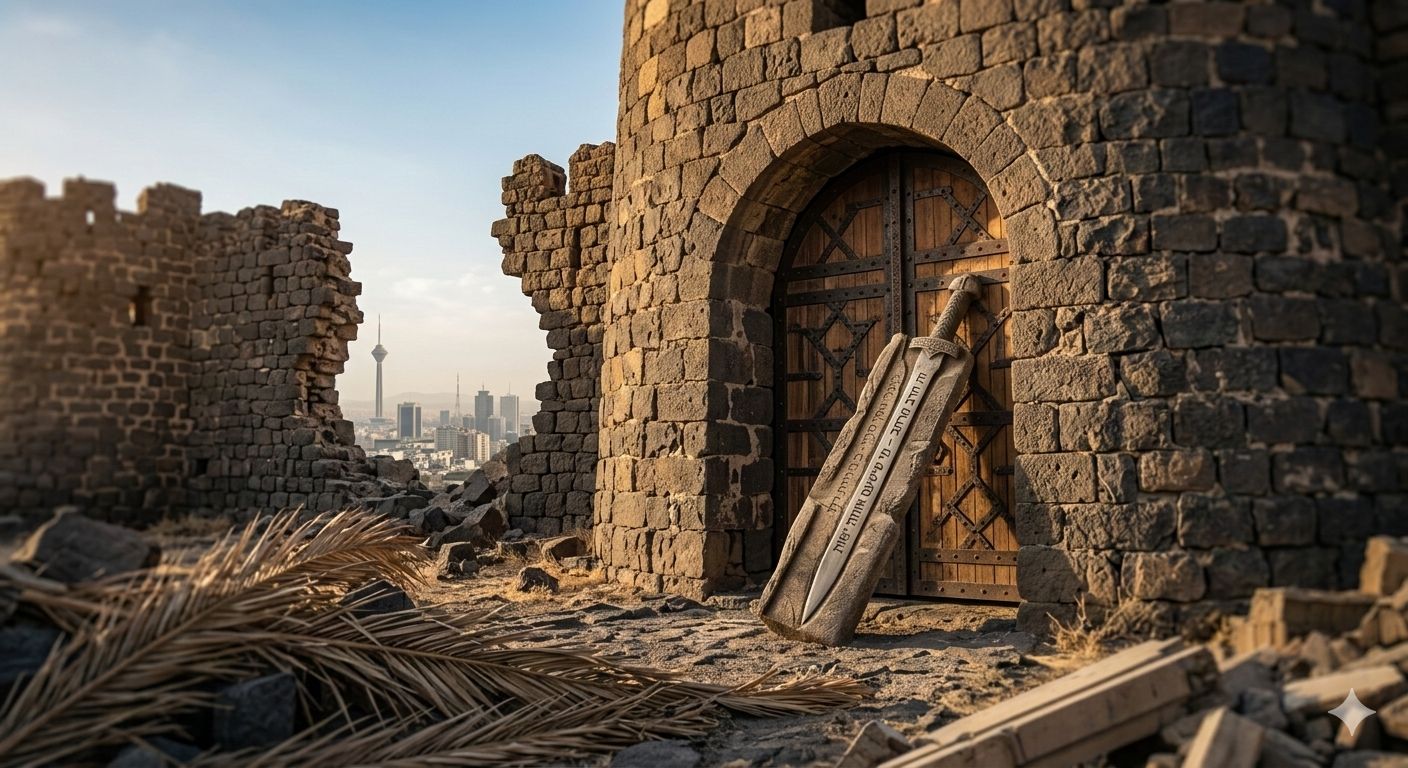
The Shadow of the Jewish Knight
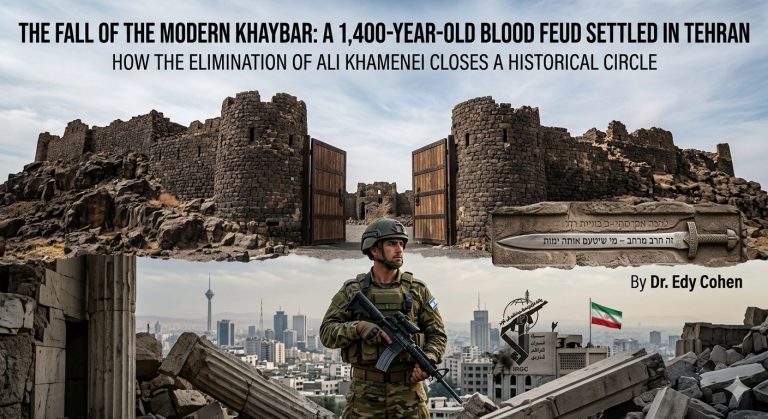
Very few in the modern West—or even within the global Jewish community—have heard the name Marhab ibn Abi Zaynab. But in the Islamic consciousness, particularly within the Shiite tradition, Marhab is a titan. He was the protector of Khaybar, a fertile and wealthy oasis located northwest of Medina in what is today Saudi Arabia. In the 7th century, Khaybar was the beating heart of Jewish power in the Arabian Peninsula, a sophisticated society of Jewish tribes living within seven massive, interconnected stone fortresses: al-Na’im, al-Qamus, and al-Shique, among others.
At the center of this power stood Marhab. Tradition describes him as a “Jewish Giant,” a knight of supernatural strength who wore a double coat of mail, a double turban, and a helmet carved from stone. On his legendary sword, a chilling inscription warned all challengers: “This is the sword of Marhab—he who tastes it, dies.” Marhab was not merely a soldier; he was a symbol of Jewish defiance. He represented an era where Jews were not subjects, but masters of their own fortified destiny in the heart of the Hejaz.
The Jewish tribes of Khaybar were wealthy farmers and merchants, guarded by walls that were thought to be impenetrable. They lived in a network of citadels built upon high volcanic hills, surrounded by fields of dates and grain. For the rising Islamic movement in Medina, Khaybar was the ultimate challenge—a “Jewish Empire” that refused to submit.
The Miracle of the Gate: The Shiite Foundation
The Siege of Khaybar in 628 CE remained deadlocked for weeks. The Jewish defenders successfully repelled wave after wave of attacks from their high basalt walls. The turning point came when the Prophet Muhammad famously declared that the banner of Islam would be given to a man “who loves Allah and His Messenger, and whom Allah and His Messenger love.”
That man was Ali ibn Abi Talib—the cousin and son-in-law of the Prophet and the spiritual patriarch of the Shiite faith. In a duel that has been immortalized in a thousand years of Shiite poetry, art, and liturgical chanting, Ali faced Marhab in single combat. With a strike that transcended human capability, Ali’s sword, Zulfiqar, split Marhab’s helmet and head.
But the most enduring symbol of that day—the one that drives the Iranian psyche today—was the gate. Islamic historiography claims that the main iron gate of the fortress was so massive that forty men could not move it. According to the legend, Ali, fueled by “divine strength” (Quwwat-i-Ilahi), ripped the gate from its stone hinges with his bare hands and used it as a gargantuan shield while he led the charge into the city. With Marhab dead and the gate torn down, the Jewish community was subjected to a crushing defeat, an event that marked the beginning of their ethnic cleansing from the Arabian Peninsula.
“Khaybar, Khaybar, Ya Yahud”: The Weaponization of History
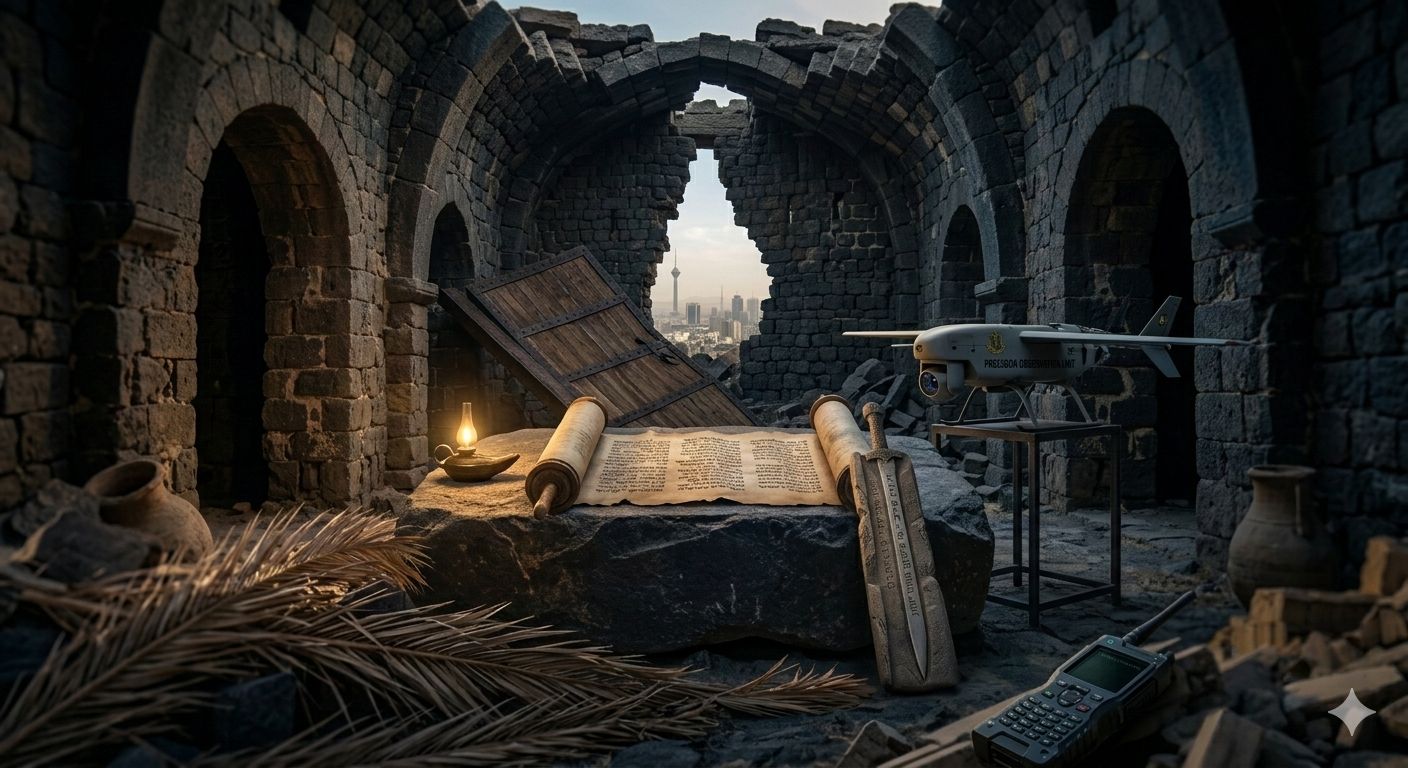
For fourteen centuries, this memory has been weaponized as a psychological tool against the Jewish people. The chant “Khaybar, Khaybar, ya Yahud, Jaish Muhammad sa-ya’ud” (Khaybar, Khaybar, O Jews, the army of Muhammad will return) is not just a rhythmic slogan. It is a staple of Hezbollah rallies in Beirut, IRGC propaganda videos in Tehran, and anti-Israel demonstrations in the streets of London and New York.
The symbolism is deliberate. It is meant to remind modern Jews of their historical vulnerability and to cast the modern State of Israel as a temporary “fortress” that will inevitably meet the same fate as Marhab’s citadels. For the Islamic Republic, the struggle against Israel was never about 1948 or 1967; it was a divine reenactment of the 7th-century triumph of Ali over Marhab. They viewed themselves as the heirs of Ali, destined to break the gates of the “Zionist fortress.”
Khamenei: The Vicar of the Hidden Imam
This brings us to Ali Khamenei. To understand the weight of his elimination, one must recognize that he was never viewed by his followers as a mere politician or even a typical dictator. Under the doctrine of Velayat-e Faqih (the Guardianship of the Jurist), Khamenei was the “Deputy of the Hidden Imam.”
In the Shiite worldview, he was the highest spiritual and political authority on the planet, a man who many believed consulted directly with the Mahdi (the Messiah). He was the “Grand Protector” of the Shiite faith, the one tasked with finally fulfilling the promise of Khaybar. In the eyes of his devotees, he was the modern-day Ali ibn Abi Talib, leading the “Axis of Resistance” against the “descendants of Marhab.” There is no figure in Judaism that quite compares to his status—a blend of King, Pope, and Prophet.
The Great Reversal: The Jews Breach the Gate
The elimination of Khamenei by the descendants of Marhab’s people has shattered this theological narrative. For the first time in fourteen centuries, the “gate” has been ripped off from the other side. When the Jewish state reaches into the heart of Tehran—the “New Khaybar”—and strikes down the highest authority of the Shiite faith, it is more than an assassination. It is a demonstration that the era of Jewish defenselessness is over.
The “supernatural” protection that the Shiite leadership claimed to possess has vanished in a cloud of precision-guided reality. The aura of invincibility that the IRGC built around its “Supreme Leader” has been exposed as a hollow shell. This is the ultimate “Anti-Khaybar” moment. The Jews did not wait for the “Army of Muhammad” to return; they went to the source of the threat and broke the hinges of the regime themselves.
The Theological Vacuum
The question now facing the Middle East is one of narrative and identity. How will the killing of Khamenei influence the future of the conflict between the Shiites and the Jews? In the immediate aftermath, there is a total shock. The Shiite world has lost its “Grand Protector.” The loss of Khamenei is a trauma that transcends the death of a general like Qasem Soleimani or a proxy leader like Hassan Nasrallah. It strikes at the very heart of the Shiite identity.
Does this mean the religious conflict will intensify, or will the shattering of the “invincibility” myth lead to a collapse of the revolutionary spirit? For centuries, the Jews have been the “defeated” in the Islamic story of Khaybar. Today, the roles have shifted. The “Spider’s Web”—a term famously used by Nasrallah to describe Israel—has proven to be made of steel, while the “Fortress of Tehran” has proven to be as porous as the sands of the desert.
A New Era of Slogans
For generations, we have listened to their chants of Khaybar. Perhaps the time has come for the Jewish world to develop its own counter-narratives. If they use history to intimidate us, we must use history to remind them of the new reality. Perhaps the new cry that should echo through the halls of history is: “Tehran, Tehran, remember what the soldiers of Israel have done.” The ancient ruins of the Jewish fortresses in Khaybar still stand today in Saudi Arabia—silent, basalt monuments to a fallen civilization that was once uprooted. As the “Axis of Resistance” looks for a new North Star, the world watches to see if the Islamic Republic will follow the path of those ancient forts into the ruins of history.
The cycle that began with the death of Marhab has been closed with the death of Khamenei. The “impenetrable gates” have been breached once again, and this time, it is the Jewish knight who remains standing. The 1,400-year debt has been paid in full, and the history of the Middle East has been rewritten in the fire of the present.