









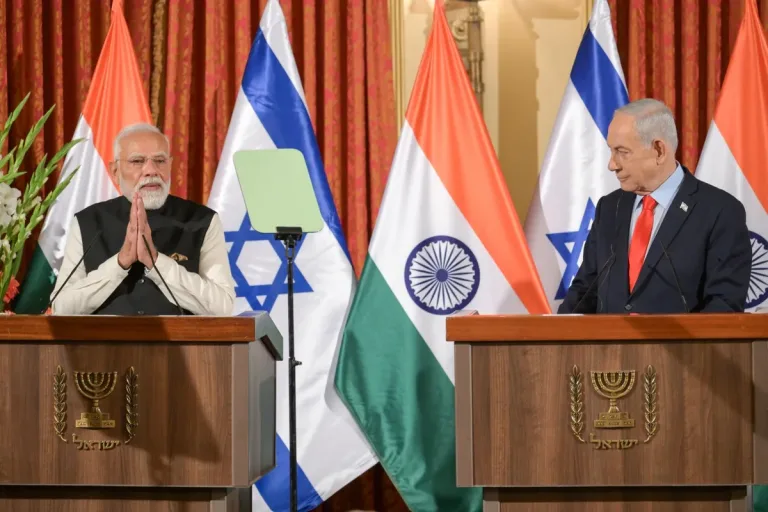
Jerusalem, 26 February, 2026 (TPS-IL) — Indian Prime Minister Narendra Modi wrapped up a two-day visit to Israel on Thursday with pledges to deepen economic cooperation, advance a long-discussed trade agreement, and work together on a major transportation and trade corridor linking India to Europe through the Middle East.
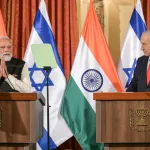
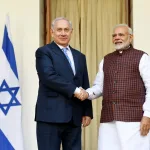
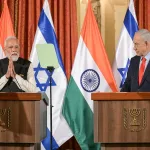
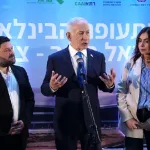
Speaking alongside Modi after a working meeting at Jerusalem’s King David Hotel, Israeli Prime MinisterBenjamin Netanyahu described the visit as brief but impactful. “This was an amazing visit with an amazing conclusion,” Netanyahu said. “It was short, but extraordinarily productive and deeply moving.” He said the discussions went beyond symbolism and focused on practical cooperation, adding that both countries were translating shared ideas into “concrete plans.”
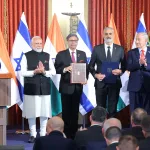
The two leaders oversaw the signing of 16 agreements covering areas such as agriculture, artificial intelligence, cyber technology, science, education, culture, and heritage. One agreement provides for the establishment of a research and innovation center for agriculture in India, including training programs, expert exchanges, and academic cooperation. Netanyahu stressed that innovation would be the backbone of the relationship.
“We are proud ancient civilizations, very proud of our past, but absolutely determined to seize the future,” he said. “The future belongs to innovators, and Israel and India are bent on innovation. We can do it better together.” He announced that a government-to-government meeting is expected to take place in India in the near future to further advance joint initiatives.
Modi thanked Netanyahu for what he called a warm and heartfelt welcome, saying that returning to Israel was an emotional moment. He said the friendship between the two countries was rooted in shared democratic values and mutual respect. “Our ties have stood the test of time,” Modi said. “Today, we made a historic decision to elevate our partnership to a special strategic partnership that reflects the aspirations of our peoples.”
A central focus of the talks was economic cooperation, including efforts to finalize a free trade agreement that has been under negotiation for years. Modi said both sides were committed to concluding an ambitious deal. “Our teams are working hard to give final shape to a mutually beneficial free trade agreement,” he said. “This will unlock enormous untapped potential in our trade and investment ties.”
The two leaders also discussed regional and global issues, including the proposed India–Middle East–Europe Economic Corridor, which aims to create a new route for trade, energy, and digital connectivity linking South Asia with Europe. Modi said the corridor could become a powerful engine for growth and stability. He also referenced broader cooperation frameworks involving the United States and the United Arab Emirates.
Security cooperation also featured prominently in the talks. “India and Israel are clear that there is no place for terrorism in the world, in any form or expression,” Modi said. “We will stand shoulder to shoulder against terrorism and those who support it, today and in the future.”
Earlier in the day, Modi visited Yad Vashem, Israel’s Holocaust memorial, where he laid a wreath and placed a stone in the Hall of Remembrance. In the guest book, he wrote that the site “speaks to the conscience of humanity” and serves as a reminder of the destructive consequences of hatred.
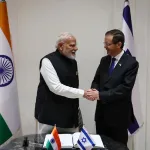
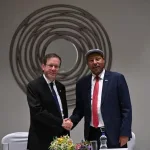
Modi also met with President Isaac Herzog, who accepted an invitation to visit India. Herzog said the relationship reflected a shared vision for the future, noting that India and the Middle East were increasingly interconnected.
On Wednesday, Israeli lawmakers gave Modi a standing ovation when he became the first Indian premier to address the Knesset.
Related Topics